×
App Icon
The Standard e-Paper
Stay Informed, Even Offline

★★★★ - on Play Store
Download App

Tanzanians petition African court over delayed 2020 election ruling

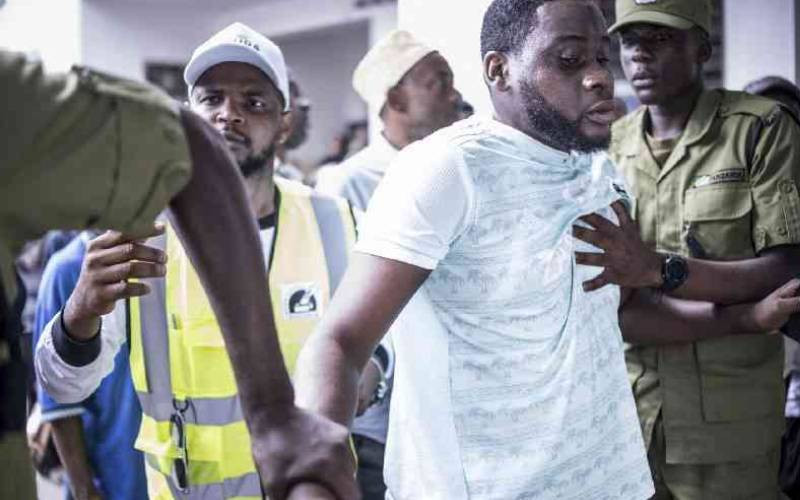
Tanzanian police detain a man accused of interfering with voting at a Stone Town polling station during the October 29, 2025, presidential elections. [Courtesy, AFP]

Tanzanian voters and opposition figures have petitioned the African Court on Human and Peoples’ Rights to urgently deliver a long-delayed judgment in a case challenging alleged violations during the country’s 2020 General Election.

In a joint statement issued in Nairobi, the Pan-African Lawyers Union (PALU), acting on behalf of Tanzanian voters and candidates, urged the African Court to issue a ruling as soon as possible in a case that has been pending for more than five years.

The application was presented yesterday, with the support of the Pan-African Solidarity Network, a coalition of regional civil society organisations and democracy defenders.


The case challenges what the applicants said was a widespread violations committed by the Government of Tanzania in connection with the General Election held on October 28, 2020.

According to the petitioners, the failure by the African Court to issue a timely judgment has had far-reaching consequences for Tanzania’s electoral environment and democratic governance.

The petitioners argued that the delay has taken on added urgency in light of the subsequent general election held on October 29, 2025, which they noted was a sham election and coronation exercise.

"We believe that if the court had released its judgment earlier, its decision would have deterred the violations that happened ahead of October 29, and after, which resulted in the murder of thousands of people. This is because previous decisions by the same court found that elections in Tanzania have violated laws and treaties to which Tanzania is a party," reads the statement.

The applicants point to previous rulings by the same court, which found that elections in Tanzania violated national laws and international treaties to which the country is a party.

They argue that those earlier decisions demonstrate the court’s ability to influence electoral conduct and prevent abuses when its judgments are delivered and enforced in a timely manner.

“This case was filed in November 2020. That is over five years ago. While this case has been pending, we have had another general election in Tanzania. Some of our original plaintiffs have sadly died too in the time that we have been on this case,” said Chidi Odinkatu, an advocate.

He added: “The Court had originally fixed judgment for 26 June 2025 by the way. That's more than seven months ago. The day before the judgment was due, the Government of Tanzania surreptitiously moved the court to arrest the judgment."

Odinkatu noted that the continued delay risks undermining public confidence in the continental judicial system.

“We are concerned that the continued delay of judgment in this case may do irreparable damage to the institutional credibility of the African Court system and leave African citizens asking questions about the court that none of us can answer,” he said.

The African Court on Human and Peoples’ Rights is the principal judicial organ of the African Union, which comprises 55 member states.

The court is headquartered in Arusha, Tanzania, a fact the petitioners stated gives Tanzania a particularly compelling reputational obligation to respect the court’s authority and rulings.

The applicants argued that the case before the court is not just about past elections but about the broader responsibility of the African Court to address persistent and unresolved violations.

They noted that the court has both the mandate and the tools to remedy what they describe as the Tanzanian government’s unwillingness to take meaningful steps to correct violations previously identified by the court and other credible bodies.

This, they argued, includes ordering remedies to address historical violations dating back to the 2015 and 2020 elections.

The current case is the fifth election-related case filed against Tanzania at the African Court.

In the first three cases, the court found significant problems with how elections were conducted and ordered the government to implement constitutional and legislative reforms.

These included measures to allow independent candidates to contest elections, restore the authority of domestic courts to adjudicate presidential election disputes, and clearly prescribe qualifications for key electoral officials such as the Director of Elections and returning officers.

According to the petitioners, the government has taken “woefully inadequate steps” to comply with those rulings.

The fourth case, which is still pending, challenges the lack of independence of both the National and Zanzibari electoral commissions.

That case had also been scheduled for judgment on June 26, 2025, but was reopened after the Tanzanian government filed a request a day before the scheduled ruling.

In the instant case, the applicants raise not only the issues addressed in earlier litigation but also allege a wide range of additional violations.

These include constitutional provisions that prevent Tanzanian courts from investigating alleged violations during presidential elections, detention of candidates without cause, arbitrary suspension of opposition campaign activities, and the disqualification of numerous parliamentary and local council candidates.

They also allege the appointment of a ruling party cadre as Director of the National Election Commission, violence against opposition candidates and supporters, with women candidates reportedly subjected to particularly degrading attacks, as well as vote-buying, ballot-stuffing, irregular vote counting, and the harvesting of votes from ungazetted polling stations.

Further allegations include the suppression of independent and opposition media across print, broadcast and online platforms, as well as restrictions on internet and social media services.