×

The Standard e-Paper
Home To Bold Columnists
 The Standard Group Plc is a
multi-media organization with investments in media platforms spanning newspaper
print operations, television, radio broadcasting, digital and online services. The
Standard Group is recognized as a leading multi-media house in Kenya with a key
influence in matters of national and international interest.
The Standard Group Plc is a
multi-media organization with investments in media platforms spanning newspaper
print operations, television, radio broadcasting, digital and online services. The
Standard Group is recognized as a leading multi-media house in Kenya with a key
influence in matters of national and international interest.

Audio By Vocalize
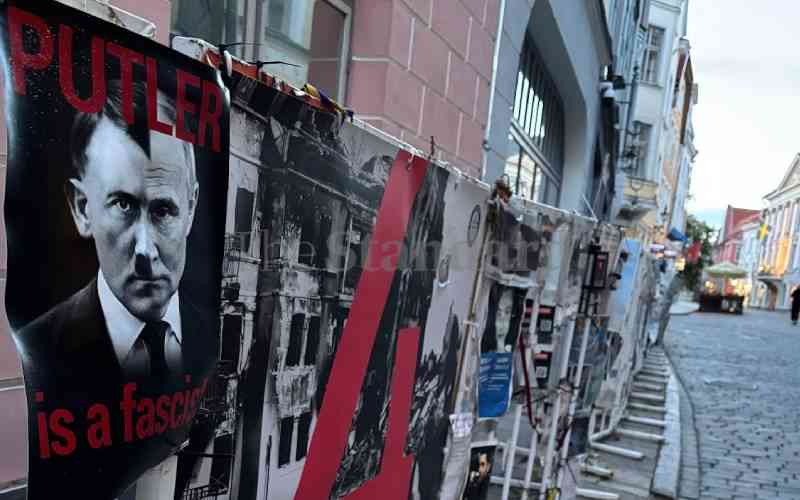
Anti-Putin poster on a street in Tallinn, Estonia. [Wellingtone Nyongesa, Standard]
There is clearly no love lost between Estonia and Russia. A walk through the country’s capital city, Tallinn, sends home an inherent message that anything leaning towards Moscow is unwanted here.
Several Kenyan families who today mourn sons duped into serving in the Russian army and later dying as war expendables could easily find a common bond here. These families are now suffering the same experience Estonians lived through during the many years of Russian rule, first under the Tsarist regimes and later under the Union of Soviet Socialist Republics (USSR).
The post-1917 overthrow of Tsar Nicholas II was responsible for ending Estonia’s 1918 independence, replacing it with the red gospel of communism under Vladimir Lenin, later aided by Josef Stalin and the later-day strongmen who called the shots from the Kremlin until 1991.
During the dark cloud of Russian rule, spanning a cumulative period of 280 years, Estonia suffered from the Kremlin’s disregard for people who were not ethnic Russians. Kenyan returnees from the frontlines such as Dickson Chege and Javan Okoth (not their real names) have experienced this and once told The Standard, “Mwafrika kufa si kitu kwa makamanda wa Russia” (the death of an African means nothing to a Russian commander).
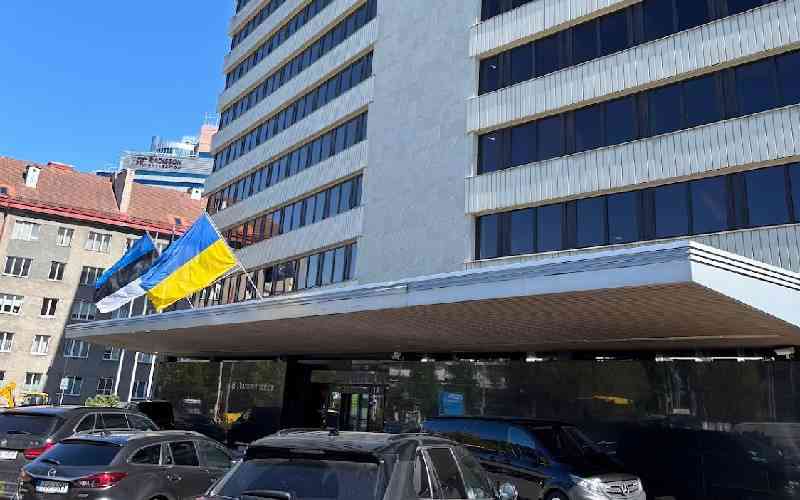
Because of this, sympathies for Ukraine today override anything Russian in Estonia as Vladimir Putin’s war enters its fifth year. All government buildings here fly the blue-and-yellow Ukrainian flag next to the black, blue, and white-striped Estonian flag and the blue flag with yellow stars of the European Union.
Deputy Minister for Foreign Affairs Marrin Ratnik told The Standard in her office that Estonia will eternally fly the Ukrainian flag alongside its own because “Ukraine is fighting our war.”
“Solidarity towards Ukraine runs through our whole society. Obviously, there is much more than just the flag, including volunteers from here joining Ukraine’s foreign legion. You see the Ukrainian flag flying in different places where there are government offices. It will remain that way until victory — Ukrainian victory, of course. And we will not take the flags down until then.”
Ratnik said her country has, since 2022, been taking in many Ukrainian refugees as a form of unwavering support.
“When they come here, they are fully integrated into our labour market and we have also created Ukrainian-speaking schools so that Ukrainian children can learn in their mother tongue.”
Estonia’s Ministry of Interior declares on its website that the country fully supports Ukraine, which has fallen victim to the unlawful aggression of the Russian Federation.
“Justification of this war has no place in Estonia. We believe that the majority of the Estonian population values the sovereignty of independent countries and their right to live in peace. Anyone approving of the war initiated by the Russian Federation must acknowledge that they become morally co-responsible for war crimes.”
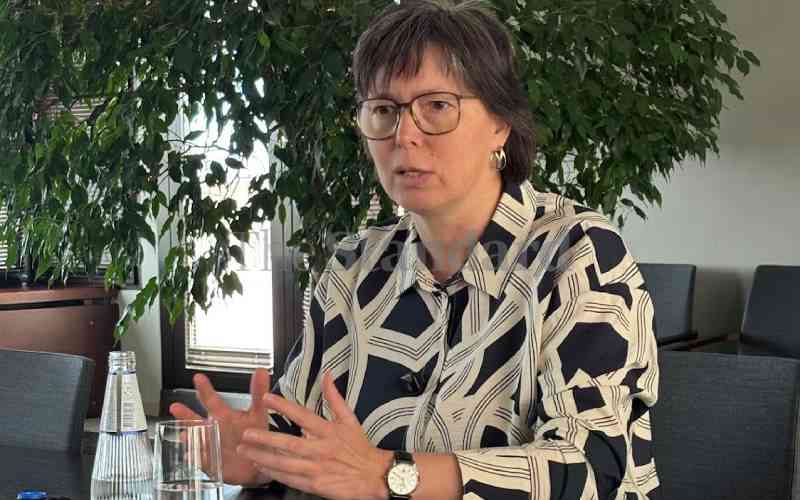
Deputy Foreign Minister Mariin Ratnik addresses the Press in her office in Estonia. [Wellingtone Nyongesa, Standard]
One would expect that, owing to colonial legacy, Russia’s influence should be strong here. But it is not. The official language remains Estonian, while Russian has been relegated to the category of foreign languages. English is taught in all Estonian schools, as is the case in Kenya, making it the second most spoken language after Estonian.
Stay informed. Subscribe to our newsletter
Even Estonians of Russian ethnicity such as Olga Bogdanova consider themselves fully Estonian.
“I do have relatives in Russia, but I neither visit nor communicate with them. At some point they cursed me for betrayal — for becoming Estonian,” she told The Standard.
“Up to 2024, we had two parallel schooling systems, one with Estonian as the language of instruction and the other with Russian. Nowadays there is only the first one. You can still study Russian as a foreign language in school for about four to five hours a week.”
This is despite several colonial powers ruling the small Baltic state, beginning with the Danes in the 13th and 14th centuries, followed by the Swedes between the 16th and 18th centuries, and later the Russian Empire from 1711 through to 1991. Russian influence was only interrupted during World War II between 1940 and 1945, before returning at the end of the war, making it the most recent colonial power to dominate Estonia over the last 800 years.
The growth of a strong scientific community in Estonia has dealt a blow to what was once an effective colonial tool — religion. Estonia rejected the Russian Orthodox Church almost entirely. Today, the remaining signs of that church are stone buildings with magnificent architecture scattered around the capital city and countryside. They remain largely empty on Sundays as many people here find spiritual nourishment in understanding nature and science.
Because of this, the country has become a highly rational society that refuses to flow with religious biases of any kind.
“We are not Christians. We do not believe in church. We believe in rational thinking, science, and nature,” says Anna-Lisa Aavik, an officer who works at the Business Diplomacy Division in the Ministry of Foreign Affairs.
“I can, for instance, read a lot into a black cat crossing my path in the morning.”
“We are the most non-religious country in the European Union,” says Hannele Kand, a tour guide in Tallinn. “I, for instance, believe in the theory of evolution and not that stuff from church.”
Estonia's Foreign Ministry with the Ukrainian and Estonian flags. [Wellingtone Nyongesa, Standard]
Many Estonians seem to consider the church a tool of Russian colonialism and frown upon it. Backed by a liberal government ready to fund innovations and start-ups, the country has become a hub of digital innovation.
Here, Russia is viewed as the greatest threat to the country’s prospects, its relations with neighbours, and all efforts to run the progressive society the Baltic state has been trying to build.
Estonia’s former Prime Minister, who is today the European Union’s High Representative for Foreign Affairs, Kaja Kallas, has consistently maintained that Russia poses an existential long-term threat to all Baltic states and Europe.
She has repeatedly warned that Europe has a critical window of three to five years to prepare for a potential military threat on NATO’s eastern flank. She notes that if Russia achieves a pause or truce in Ukraine, it will use that time to rebuild its military resources.
Kallas firmly believes that “weakness provokes aggressors.” She has continually advocated for a “forward defense” posture, urging NATO to increase boots on the ground and military investments in the Baltic region rather than rely on an outdated “tripwire” strategy that would only retake territory after an invasion.
Beyond conventional military threats, she continually emphasizes the dangers of ongoing Russian hybrid warfare, including cyberattacks and disinformation. For instance, she has dismissed Moscow’s attempts to intimidate the Baltic states with false narratives — such as baseless accusations that Estonia allows Ukrainian drones to transit its airspace — as signs of Kremlin weakness rather than strength.
This wariness of Russia has now reached Kenyan villages after Putin signed a declaration allowing the Russian army to recruit from outside the country to supplement dwindling numbers on the war front.
On May 9, gathered in Mukhunga Village in Busia County, the family of Charles Mutokha, relatives, and friends held a burial without a body.
With tears flowing, they laid to rest Oscar Khagola’s spirit, represented in the grave by an engraved stone tablet — a painful reminder of the emptiness and uncertainty surrounding the death of the former Kenya Defence Forces soldier, who was Mutokha’s only son.
The sombre ceremony in a humble Kenyan village laid bare the agony that nearly 70 families in Kenya are going through as they struggle to find closure after their relatives were killed fighting for Russia following Putin’s May 2025 decision to open recruitment outside Russia.
The recruitment of men from the Global South lacked legal structures, allowing human trafficking syndicates to exploit the process using disinformation and promises of well-paying jobs in Russia.
“Oscar told us he had been recruited into the Russian army a month after going missing. He was sent to the frontline after only two weeks of training. I wondered how military training could only take two weeks because when he was in the Kenya Defence Forces, training took much longer,” said his father, Mutokha, who today curses Russia.
“We are really heartbroken. At first, we communicated frequently after he arrived, but communication suddenly stopped. Now we are left in pain because he was my only son. This family is completely devastated.”
Dozens of heartbroken Kenyan families have been holding symbolic mock burials while cursing Russia and the inept Kenyan government after receiving news that their sons had been killed fighting for the Russian military.
Lured to Russia by human traffickers promising high-paying civilian jobs or education opportunities, many were swiftly coerced into frontline combat. Because repatriation has proved impossible, grieving relatives have been forced to bury empty caskets, plant memorial trees, and light candles without bodies.
On Christmas Day last year in Kenori Village, Nyeri County, the family of 31-year-old Charles Waithaka laid an empty casket in a grave after he was killed in action. Relatives lit 31 candles representing the years of his life.
Following confirmation of his death on the Donetsk frontline, the family of 29-year-old former Qatar security guard Clinton Nyapara made the painful decision to plant a tree over an empty grave in Bomariba Village, Kisii County, on March 9 as a symbolic burial for their son. They had waited in vain for his body to be returned from Russia.
In Limuru, Kiambu County, relatives held a symbolic send-off where they lit and extinguished 33 candles to honour the 33 years of James Kamau, who was killed fighting for Russia.
Kenyan human rights organizations have condemned the widespread deception that has ensnared more than 1,000 young Kenyans in foreign military contracts. The families are now urging the Kenyan Ministry of Foreign Affairs and international advocates to intervene, secure justice, and provide answers.

Subscribe to our newsletter and stay updated on the latest developments and special offers!









 join
join