×

The Standard e-Paper
Fearless, Trusted News
 The Standard Group Plc is a
multi-media organization with investments in media platforms spanning newspaper
print operations, television, radio broadcasting, digital and online services. The
Standard Group is recognized as a leading multi-media house in Kenya with a key
influence in matters of national and international interest.
The Standard Group Plc is a
multi-media organization with investments in media platforms spanning newspaper
print operations, television, radio broadcasting, digital and online services. The
Standard Group is recognized as a leading multi-media house in Kenya with a key
influence in matters of national and international interest.

Audio By Vocalize
Kenya’s wheat problem is no longer just about farmers struggling to make a profit.
It is becoming a food-security, climate and public-health question.
Domestic wheat production fell 18.2 per cent to 254,900 tonnes in 2025, even as the country imported 2.24 million tonnes, according to the Kenya National Bureau of Statistics.
Imported wheat accounted for 89.8 per cent of Kenya’s total wheat supply last year.
The figures expose a widening gap between what Kenyan farmers produce and what the country consumes a gap that is being shaped by climate stress, crop diseases, shrinking farmland and the economics of farming.
At the centre of that problem is a crop that is already deeply embedded in the Kenyan food system.
Bread, chapati, mandazi, pasta and other wheat-based foods are consumed across the country. Wheat flour is also one of the vehicles used in food fortification, making the crop relevant beyond agriculture and trade.
The World Health Organisation says fortification of wheat flour with micronutrients such as iron and folic acid can improve the nutritional quality of the food supply and help address deficiencies. WHO notes that folic acid fortification can reduce the risk of neural tube defects, while iron fortification can help reduce anaemia.
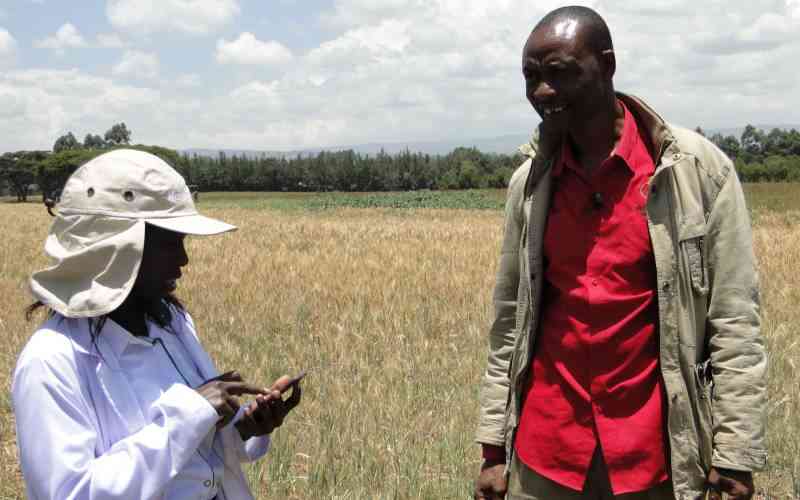
In Chesoton, Njoro, wheat farmer Vincent Chelule has watched the industry change since he began growing the crop in 1994.
“I liked the work he was doing, so I decided to follow in his footsteps,” he says, recalling how he followed his father into farming.
But six years later, rising production costs and declining returns forced him to stop growing wheat.
He eventually returned, this time adding seed production and bulking to his farming activities.
Today, he farms about 20 acres, rotating wheat with other crops. Last year, about half of his land was under wheat.
But the basic problem remains.
Stay informed. Subscribe to our newsletter
“The major challenge for us as farmers is therefore the market,” he says. “The market exists, but the problem is the price.”
KNBS says farmers reduced the area under wheat partly because they shifted to crops offering better prices. The statistics agency also identifies seed recycling, quelea bird attacks and land fragmentation among factors associated with the fall in production.
For Chelule, the numbers are felt in the field.
He estimates that producing an acre of wheat can cost more than Sh50,000.
At a selling price of Sh6,000 for a 90-kilogramme bag, a farmer needs more than eight bags from an acre simply to begin recovering production costs.
A poor season can wipe out the margin altogether.
Last year, Chelule planted two acres using about 100 kilogrammes of Njoro seed.
Drought affected the crop.
He harvested about 20 bags from the two acres.
Under favourable conditions, he says, farmers can harvest between 18 and 25 bags an acre.
Weather is now one of the biggest variables in that calculation.
Wheat is largely grown under rain-fed conditions in Kenya, leaving farmers exposed to dry spells, excessive rainfall and changes in the timing of precipitation.
Chelule experienced both extremes.

There was initially too much rain, leaving some fields waterlogged and affecting germination.
About a month after planting, the rains stopped.
The dry spell came as the wheat was producing tillers — shoots that contribute to the development of the plant and ultimately influence yield.
Rain returned, but he says it was too late to fully reverse the damage.
“You may expect rain and get drought, or expect drought and get rain,” he says. “This has become a major problem for farmers.”
For scientists, this is precisely where wheat research is becoming increasingly important.
The challenge is no longer simply to develop a variety capable of producing high yields under ideal conditions.
Researchers need wheat capable of surviving multiple stresses at once.
Recent scientific research examining the combined effects of heat and drought found that the two stresses can interact and cause greater yield losses in wheat than either stress acting alone.
That makes climate-resilient breeding increasingly important as farmers face more uncertain growing conditions.
At the Kenya Agricultural and Livestock Research Organisation’s Njoro centre, scientists are working on several fronts.
KALRO wheat breeder Dr Martin Lagat says researchers are developing varieties capable of tolerating drought, acidic soils and low fertility while improving nutrient-use efficiency.
The objective is to move the crop from simply producing more grain under good conditions to producing reliably under difficult ones.
But climate is not the only biological threat.
Disease can destroy the gains made through breeding and good farm management. Chelule remembers growing the Robin wheat variety.
After two or three years, he says, the variety became susceptible to stem rust and was eventually removed from the recommended list.
That experience is part of a much bigger scientific battle. Njoro is home to an international wheat disease-screening facility where researchers expose wheat material to some of the world's most serious rust threats.
The facility was established through collaboration between KALRO and the International Maize and Wheat Improvement Centre after the emergence of the Ug99 stem-rust race.
The reason is simple.
Rust pathogens evolve.
A variety that performs well today may become vulnerable when the pathogen changes.
Research on Ug99-related stem rust has demonstrated the potential scale of the damage. Field experiments have recorded substantial yield losses in susceptible wheat material under severe disease pressure.
At Njoro, plant pathologist Dr Zennah Kosgey is part of the effort to identify wheat lines that can withstand the disease.
“Stem rust attacks the stem. Yellow rust, also known as stripe rust, attacks the leaves,” she points out.
The damage has consequences beyond the appearance of the crop.
When rust destroys leaves prematurely, the plant loses photosynthetic capacity — reducing the energy available to develop and fill the grain.
The result can be lower yields and greater losses for farmers.
Resistance is also not permanent.
Pathogens evolve, which means breeders must continually test wheat against new and changing disease populations.
Kosgey therefore recommends several layers of protection.
“Farmers should start with certified seed and resistant varieties, scout their fields early, maintain good crop-management practices and use approved fungicides when necessary,” she says.
Timing matters.
“You'd rather prevent it than cure it later on,” Kosgey says.
That scientific principle is increasingly important as Kenya tries to produce more wheat under less predictable conditions.
The country has already demonstrated that improved genetics can dramatically increase the potential of the crop.
Since the establishment of the wheat breeding programme at Njoro, scientists have released numerous varieties adapted to Kenyan conditions.
Lagat says yield potential has increased from about 1.5 tonnes per hectare in the 1970s to as much as eight tonnes per hectare in some of the newer varieties.
But potential yield is not the same as what a farmer actually harvests.
A variety may have high genetic potential but fail because of drought, disease, poor soil fertility, inadequate inputs or late planting.
That is why access to improved seed is as important as developing it.
Chelule currently grows Jacana.
“I planted it last year and the seed performed well, so I decided to plant it again,” he says.
His relationship with KALRO began through a farmer-group project after an agricultural officer selected his group to participate in wheat seed production.
He later received specialised training, including a two-week course at Ol Joro Orok.
Seed production has become another source of income.
But producing certified seed requires considerably more care than producing wheat simply for grain.
Chelule and his workers remove off-types — plants that differ from the variety being multiplied.
On one acre, he may need about four workers for a day to carry out the task.
The seed is later harvested, inspected and processed.
At KALRO Njoro, seed scientist Cavin Otieno oversees subsequent stages.
The seed is weighed and records checked before the Kenya Plant Health Inspectorate Service inspects the lots.
The grain is then cleaned to remove weed seeds, chaff, stones, broken and shrivelled grains and other impurities.
It is eventually dressed to protect it against disease before being prepared for farmers.
The process is scientific because the quality of today's seed affects tomorrow's harvest.
But science alone cannot close Kenya's wheat deficit.
Farmers still have to be able to afford the technology.
They have to find buyers.
They need machinery and suitable land. And they need weather that does not destroy the crop between planting and harvest.
Land fragmentation is making that increasingly difficult.
As agricultural land around Njoro is divided into smaller parcels, machinery becomes harder and more expensive to deploy.
Wheat is particularly suited to mechanised production, meaning smaller plots can undermine the economics of cultivation. The same farmers are also comparing wheat with other crops.
If another crop offers better returns with lower production costs, the decision to leave wheat becomes rational at farm level even when the country has a national deficit.
That is the contradiction Kenya now faces.
The country needs more wheat.
But the farmers producing it are increasingly questioning whether wheat pays.
Chelule has experienced the consequences of weak markets himself.
Two years ago, farmers harvested wheat and struggled to find buyers.
Some kept grain in stores for months.
At one point, Chelule had about 200 bags in storage.
“Imagine harvesting in August and still having the wheat in your store in November,” he says.
Some farmers eventually sold at Sh4,000 a bag after already spending heavily on production.
The losses pushed some out of wheat farming.
“Many farmers have still stopped growing wheat,” Chelule says.
That withdrawal has consequences beyond the farm.
When domestic production falls, Kenya must rely more heavily on imports to keep millers supplied.
That leaves the food system more exposed to international prices and disruptions in global supply.
It also raises a different question for public health: how resilient is a food system when such a large proportion of a staple crop comes from outside the country?
WHO considers large-scale fortification of staple foods an evidence-informed strategy for addressing micronutrient deficiencies, including iron and folate deficiencies. But the effectiveness of such programmes depends on implementation, monitoring, access and regular consumption of fortified foods.
The health value of wheat also depends on what happens after milling.
WHO recommends diets built around a diversity of foods, including whole grains, while cautioning that highly processed foods high in salt, free sugars or unhealthy fats can contribute to poor health outcomes.
So increasing wheat production does not automatically mean improving health.
The question is how wheat enters the food system — from the variety planted in Njoro, to the nutrients available in the soil, to the disease resistance of the crop, to milling and fortification, and finally to what consumers eat.
That makes Kenya's wheat shortage a problem that cannot be solved by one intervention.
Plant breeders can produce varieties that withstand rust.
Agronomists can improve water and nutrient management.
Seed scientists can improve planting material.
Researchers can screen wheat against evolving pathogens. Public-health experts can strengthen food fortification, but farmers still need a viable business.
Chelule entered wheat because his father grew it. He abandoned it when the economics stopped making sense. He returned after finding another way to remain in the industry.
He is still planting, but every season remains a calculation. The seed must perform. The rains must come at the right time. Disease must be contained. The crop must survive. The machinery must arrive. Then after all that, there must be a buyer willing to pay enough to make the next season possible.
Kenya may have the science to grow better wheat.
The unresolved question is whether it can build a food system in which farmers can afford to keep growing it.
Subscribe to our newsletter and stay updated on the latest developments and special offers!

 Prefer the Standard on Google








 join
join