×

The Standard e-Paper
Fearless, Trusted News
 The Standard Group Plc is a
multi-media organization with investments in media platforms spanning newspaper
print operations, television, radio broadcasting, digital and online services. The
Standard Group is recognized as a leading multi-media house in Kenya with a key
influence in matters of national and international interest.
The Standard Group Plc is a
multi-media organization with investments in media platforms spanning newspaper
print operations, television, radio broadcasting, digital and online services. The
Standard Group is recognized as a leading multi-media house in Kenya with a key
influence in matters of national and international interest.

Audio By Vocalize
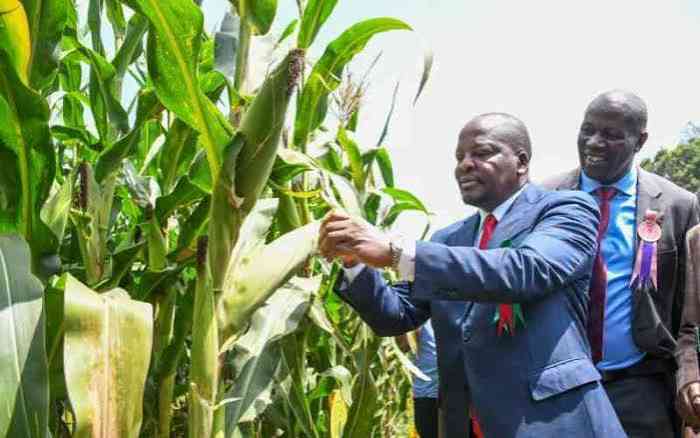
Agriculture and Livestock Development Cabinet Secretary Mutahi Kagwe has reassured farmers that Kenya is well stocked with seeds for the upcoming planting season, even in light of the drought related losses anticipated in seed production.
While visiting the Kenya Seed Company (KSC) in Kitale, Kagwe emphasized that the company has taken the necessary steps to support farmers during these dry conditions, with losses expected to be between 25 and 30 percent.
He urged farmers not to mistake the decline in maize production for a shortage of planting seeds.
“We need to distinguish between the seed situation and maize production, which will clearly be lower than anticipated across the nation. The Kenya Seed Company has done an excellent job,” Kagwe stated.
He also highlighted that KSC is financially sound and has compensated seed growers.
"We have enough stocks in the country, so farmers shouldn’t be concerned about whether we’ll have sufficient seeds,” he added.
Kagwe pointed to climate change as a factor behind the unpredictable weather, noting that the government is relying on scientific forecasts for preparation.
“Science gives us insights into what to expect, yet it’s astonishing how unpredictable our weather can be, despite the scientific advancements we have globally,” he remarked.
He mentioned that the government is already gearing up for a potential El Niño season.
KSC Managing Director Sammy Chepsiror confirmed that the company has ample seed supplies, including over 30 million kilograms of maize seed. KSC board director Benard Wambwa and Trans Nzoia Senator Allan Chesang’ encouraged farmers to take advantage of short season maize varieties and return to their fields to bolster food security, even amid the drought.
Wambwa praised the government for settling part of its debt, noting that the company had been owed over KSh2 billion since 2013, with KSh1.6 billion already paid, which has motivated seed growers to ramp up production.
Kagwe mentioned that Kenya plans to import maize, rice and sugar to fill in the supply gaps.
He pointed out that the country only produces about 10 percent of its wheat needs and relies heavily on imports for the rest, while local rice production covers around 20 percent of the demand.
He also noted that sugar imports might be reduced due to reforms that have successfully doubled domestic production.
Stay informed. Subscribe to our newsletter
Additionally, he explained that maize imports will be necessary due to drought affecting local production, but Kenya can look to the COMESA region, which has plenty of stocks available.
Subscribe to our newsletter and stay updated on the latest developments and special offers!


 Prefer the Standard on Google









 join
join