×
App Icon
The Standard e-Paper
Smart Minds Choose Us
★★★★ - on Play Store
Download App

Cross-breeding vs inbreeding: Which way?

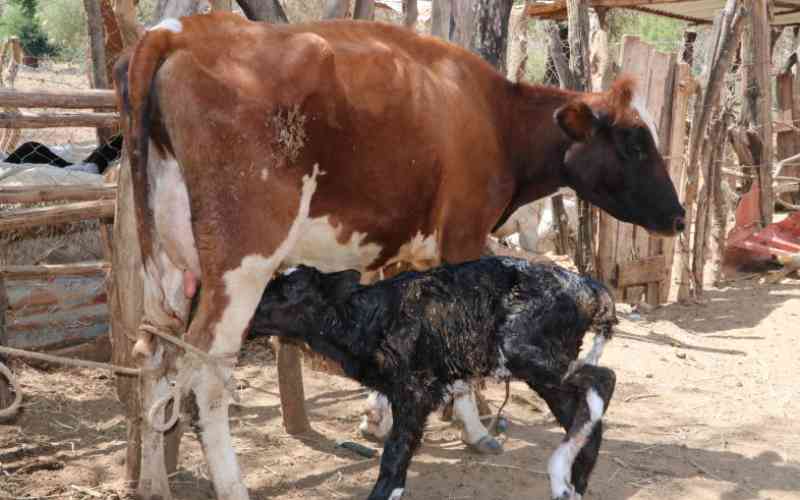
A newly born calf suckles her mother at a dairy farm owned by Regina Muange in Mwilu village, Makueni county. [File, Standard]

Dear Joseph,

I appreciate your excellent and educational work. I’m just starting out in farming, and I’m learning a lot.

I appreciate the topics that have already been covered in this column; it has been a great resource. This breeding issue is of interest to me.

Since there are currently no controls, I am concerned that I could easily overlook this because I own a ranch. If you could give me a brief explanation of breeding and crossbreeding, I would be very grateful.


Kaisane James

Thank you, James; I appreciate your thoughtful inquiry. Indeed, without breeding, cattle farming is impossible. Even though few farmers are interested in breeding, they make sure that it is controlled, mostly by avoiding inbreeding and using cross-breeding.

But many farmers are oblivious of how their animals breed, which ultimately affects the final productivity of the herd. On ranches, inbreeding could easily happen, with negative results.

So, what is cross-breeding?

Cross-breeding refers to breeding/mating two different cattle breeds to produce offspring that are a mix of the best traits of both parent breeds.

When done properly, cross-breeding provides multiple advantages. It maximises productivity in traits like growth rate, milk production, fertility, and calf growth rate and survival.

Cross-bred offspring will often exhibit improved growth rate, fertility, and disease resistance and be adaptable to various weather conditions.

In breeding, hybrid vigour, or heterosis, is a valuable index that makes the cross-bred offspring superior in traits as compared to the parents. This increases productivity traits, among others.

Cross-breeding also brings out complementarity through the combination of the strengths of two or more breeds, with the offspring being of higher performance in many traits. 

However, it’s instructive to note that these two – heterosis and breed complementarity – can only be realised through a well-designed cross-breeding programme that must select the best or superior parent breeds.

You cannot expect good results with a poor bull. Although this can still be solved by artificial insemination, which, apart from being relatively cheap, also gives you a wide choice of good-quality semen from good bulls with known and documented history.

Heterosis is most effective when there is a wide genetic diversity between the breeds being crossed or the parents of the offspring. 

Genetic diversity is the degree of similarity or dissimilarity that exists between two breeds. They should be of different origins and should have lived through different environments that exerted different selection pressures during their development so as to increase the genetic diversity.

The final performance is further determined by good animal husbandry. It must be noted that even the best cross-breeding programme can never solve biological and economic problems caused by poor animal husbandry, like poor disease control, poor nutrition and other animal welfare concerns.

Cross-breeding is not a one-off event; it has to be well designed and keenly followed through generations to continually improve on the selected traits. Without such a plan, cross-breeding will not yield much and may result in poor productivity instead.

While cross-breeding, when done properly, results in an incremental improvement of the genetics of an animal, inbreeding, on the other hand, results in the reduction of production, reproduction, growth, and other desirable traits.

Inbreeding is a major challenge, especially for smallholder farmers who still rely on bulls for mating. If you have been wondering why our zebus are reducing in size and milk production, it is largely due to inbreeding, which is now a common feature in herds.

Inbreeding is a breeding method where closely related animals are mated. As earlier indicated, it negatively impacts the growth rate, weight at maturity and other reproductive and productive traits.

In other words, inbreeding achieves almost the opposite of what cross-breeding strives to achieve. Apart from lowering important genetic traits, inbreeding has been attributed to genetic abnormalities.

[Dr Othieno is a veterinary surgeon and currently the head of communications at the Food and Agriculture Organisation of the United Nations (FAO) Kenya. The views expressed here are not necessarily FAO’s but his own]