×

The Standard e-Paper
Fearless, Trusted News
 The Standard Group Plc is a
multi-media organization with investments in media platforms spanning newspaper
print operations, television, radio broadcasting, digital and online services. The
Standard Group is recognized as a leading multi-media house in Kenya with a key
influence in matters of national and international interest.
The Standard Group Plc is a
multi-media organization with investments in media platforms spanning newspaper
print operations, television, radio broadcasting, digital and online services. The
Standard Group is recognized as a leading multi-media house in Kenya with a key
influence in matters of national and international interest.

Audio By Vocalize
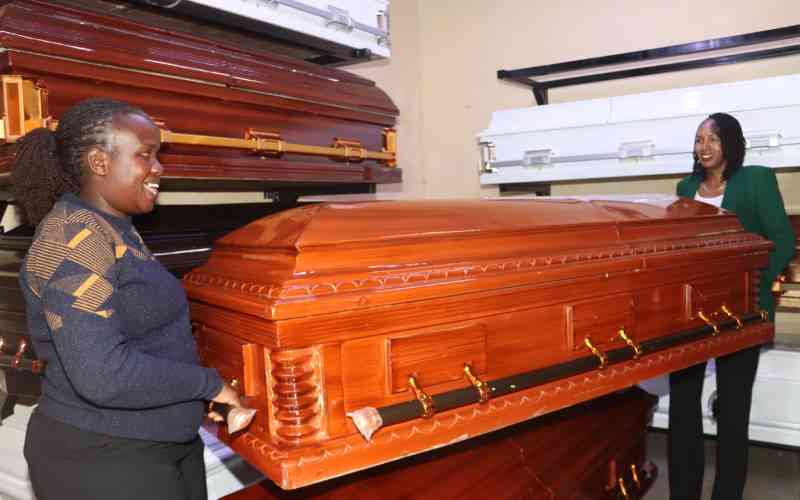
Before Sharon Chebet reports to her shop off the busy Kisumu Road in Eldoret City, she rarely forgets to ask God to give her her daily bread.
The earnings she yearns for come from her emerging coffin-selling venture.
Even the roar of the furiously flowing waters of River Sosiani has not stopped a youthful Chebet from building her business, despite opposition from peers, family and a community reluctant to accept the display of caskets.
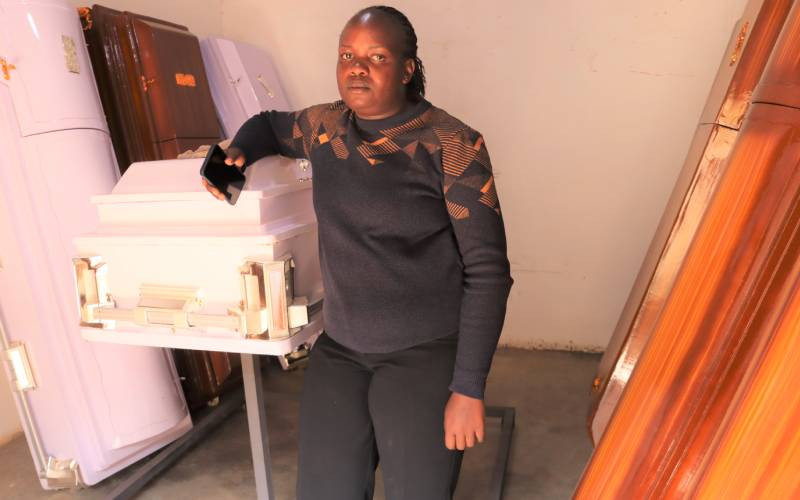
For the last four days, Chebet has been trending on social media after she confidently told hundreds of youths in a government function in Eldoret that she was a proud seller of the furniture where human beings spend their final moments after death.
While it is the dream of many Kenyan youths to venture into Artificial Intelligence (AI) and technology-driven businesses, Chebet, who is in her late 20s, chose to go against the grain.
After years of job-hunting in Eldoret, the thought of her father’s death in Londiani, Kericho County, in 2000 crossed her mind.
She remembered how poverty pushed her family into burying her late father with an amateurish homemade coffin, wrapped in a cheap blanket, and she made affordable coffins for the poor, her daily business.
In November last year, the mother of two secured capital to realise her dream by purchasing five decent but affordable coffins.
However, Chebet has weathered storms that would force a youthful peer to quit and shift into a business that could be embraced by family and society.
From stigma to online trolls by people, especially those from Chebet’s community, who consider coffin making and selling taboo and to suspicions by families of the sick, the entrepreneur is clearing one hurdle after another.
Before last November, Chebet had worked for months as a coffin broker
“I was informed about how my father was buried when he died in the year 2000 and the story disturbed me. My family was so poor that my father was buried with a simple homemade coffin. That pushed into selling decent caskets at lower prices so that other families don’t face the same challenges that we faced,” Chebet said at her new shop in Pioneer, on the banks of River Sosiani.
She adds: “I was moving from one restaurant to another looking for jobs and I met a friend who introduced me to the idea of working as a coffin sales lady. Someone employed, but at the same time my dream of starting my own business was still not actualised.”
Since last Friday, Chebet said, family members and her community who were unaware of her business have been calling to find out the truth, but most of them, according to Chebet, are in disbelief.
“Coffin making and selling are still taboo in my community. Many people who have called said they doubted my tribe,” she said.
Stay informed. Subscribe to our newsletter
But the worst part of her eight months of coffin selling has been a doubt about her compassion.
“When I started, many people accused me of praying for more deaths so that I could get more business opportunities. I have, however, resisted attempts to quit the business because this is what pays our house rent, school fees for my children and siblings,” she said.
She says she is yet to take her casket business to the desired level.
Chebet recalls one day earlier in the day when an elderly man walked into her shop and accused her of betraying her community by selling coffins.
Additionally, she says some family members blocked her calls and messages as they condemned her for continuing with her coffin business.
“My mother is yet to accept my business but appreciates my efforts. She keeps saying that she prays for me to get another job. For me, this is my job. Even when I get employed, I will employ someone else to take care of this business for me,” she says.
She goes on to say: “I want my coffin business to grow into a bigger enterprise, with modern send-off needs such as hearses and automatic lowering gears.”
“One of the relatives who condemned me had promised to help me secure a job but failed to honour their promise. I am proud of my business and I will keep making people understand that death is inevitable and when it happens to our loved ones, we will all try to give them a decent send-off.”
Brenda Chelimo, who has been selling coffins in Eldoret since 2015, describes Chebet as a resilient youth seeking to prove that young people can go against norms in their push to create employment opportunities for themselves.
According to Chelimo, coffin sellers like Chebet and her are not considered selfish during times of sickness and death.
“When you visit an ailing relative or a friend in hospital, people think you have come to wish them death so that you sell them a coffin and flowers. The reality is that we also mourn with bereaved families and we comfort them when they seek our services. We are genuine in our feelings,” says Chelimo.
Sheila Kimwatan, a social worker who quit her private-sector job nine months ago to start a coffin-selling business, says stigma is real in the casket-selling business.
Subscribe to our newsletter and stay updated on the latest developments and special offers!

 Prefer the Standard on Google