×

The Standard e-Paper
Home To Bold Columnists
 The Standard Group Plc is a
multi-media organization with investments in media platforms spanning newspaper
print operations, television, radio broadcasting, digital and online services. The
Standard Group is recognized as a leading multi-media house in Kenya with a key
influence in matters of national and international interest.
The Standard Group Plc is a
multi-media organization with investments in media platforms spanning newspaper
print operations, television, radio broadcasting, digital and online services. The
Standard Group is recognized as a leading multi-media house in Kenya with a key
influence in matters of national and international interest.

Audio By Vocalize
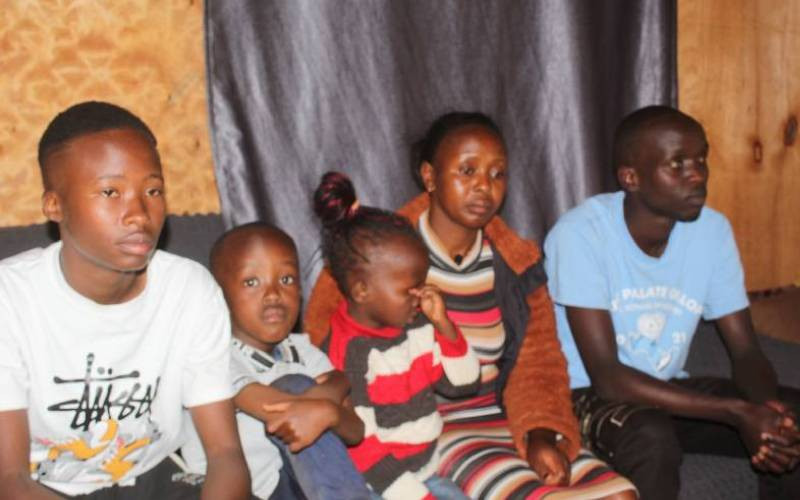
Grace Gathoni, widow of Martin Macharia, who was killed in Russia, with family members at their home in Ruaka, Kiambu County. [Benard Orwongo, Standard]
Nelly Wambui (her real name changed for security reasons) was still waiting for official confirmation of whether her son was alive or dead when a man identifying himself as Alex approached her, offering to help secure compensation from Russia. Her son was among the roughly 1,000 Kenyans whom Parliament was told in February had been recruited to fight for Russia.
He had travelled to Russia after being promised civilian work but later disappeared from contact. Wambui last heard from him in November 2025. Since then, she says, “Neither Kenyan nor Russian authorities have provided reliable confirmation of his whereabouts or status.”
It was during that uncertainty that Alex approached the family. According to the August 2026 investigation by Journalists for Justice (JFJ), based on interviews with affected families, recruits, officials and intermediaries, as well as documentary evidence, Alex told families he could help pursue compensation for relatives whose kin had died or gone missing while serving in the Russian military.
The man claimed families could receive up to US$150,000 (approximately Sh19.2 million) within 60 to 90 days and said his commission would be 30 per cent, according to JFJ. That would amount to as much as US$45,000 (Sh5.7 million) on a maximum claim.
JFJ says it could not establish whether Alex had official authority from the Russian government or military to process compensation claims.
The investigation found that Alex remained largely anonymous to the families he was dealing with. None of the relatives interviewed by JFJ said they had seen his face. During a Zoom meeting with affected families on June 18, 2026, he kept his camera off while asking relatives to provide sensitive documents, including records needed to establish their relationship with missing or deceased recruits.
Families repeatedly asked him for official communication from Russia's Defence Ministry confirming their eligibility for compensation and explaining how claims should be filed. According to JFJ, he did not produce such documentation, nor an official letter authorising him to act for the Russian government or military, a registered business address or verifiable credentials for a Moscow lawyer he said would handle the cases.
The investigation raises a question more complicated than whether compensation exists: who is authorised to help Kenyan families obtain it, how much are families entitled to receive, and how much of that money could be taken by intermediaries before it reaches them?
The question has become increasingly urgent because the Kenyan government itself acknowledges that families have struggled to obtain clear information about relatives who travelled to Russia.
At a closed-door meeting with affected families on July 14, Principal Secretary for Diaspora Affairs Roseline Njogu acknowledged that officials had not responded adequately to their inquiries, according to JFJ. She said Kenya remained dependent on information from Moscow to establish whether individual recruits were alive, injured, detained, missing or dead. Njogu also confirmed that an official compensation process had begun for some families.
“A number of you have received letters from the ministry stating that your relative was probably killed in action and asking you to submit documents for compensation,” she told the families, according to the report. “If you received that letter, the claim is already being processed.”
That admission was very important because it established that there was an official process, even though its precise workings have never been made public.
JFJ found that Russian rules governing payments to military families generally require documentary confirmation of death or, where a serviceman is missing, a court decision recognising the person as missing or declaring him dead. The investigation also found that Russian law introduced an expedited process under which a person who disappeared in circumstances suggesting death could eventually be declared dead through a court process.
But the report found a gap between those requirements and the language used in some correspondence received by Kenyan families. The term “probably killed in action”, it found, is not itself a final legal status that automatically guarantees payment.
Stay informed. Subscribe to our newsletter
Njogu did not clarify whether letters sent to Kenyan families represented preliminary document collection or whether compensation could be approved before a recruit's death was legally established. JFJ report also notes that officials did not provide families with copies of the original communications from Russian authorities on which the compensation notifications were based, nor disclose the criteria used to determine which families received them.
That information gap has created room for private intermediaries. Kelvin Ochieng is the Kenyan intermediary working with Alex. JFJ found that Ochieng acted as a local contact, communicating with families in Kiswahili and Sheng.
When approached by JFJ on August 1, Ochieng said he was not seeking to profit from the arrangement and that any payment would go to Alex.
But when a JFJ reporter contacted him on July 22 while posing as a relative of a Kenyan man who had travelled to Russia and stopped communicating, Ochieng gave a detailed account of how the proposed process would work.
He described Alex as a commander in Russia who could help trace missing men and process compensation claims. Ochieng did not provide Alex's full name, military rank, unit or official authority to handle compensation.
According to Ochieng, families would need to provide passports, birth certificates, identification documents and proof of their relationship to the missing or deceased recruit. Some relatives, he said, might have to travel to Moscow, remain there for as long as three months and provide DNA samples to identify their relatives' remains.
Alex, he said, would pay for flights and accommodation, while families would prepare and notarise documents and meet their own legal costs.
Ochieng also said his Kenyan team would take Sh2 million after a family received its money. In the same conversations, however, he gave a different account of Alex's fee, saying Alex might make about one per cent after travel and accommodation costs were reimbursed.
JFJ found that neither Ochieng nor Alex identified the Russian institution that would release the compensation or the payment channel through which money would reach Kenya.
The uncertainty becomes clearer when it comes to the money recruits left behind. JFJ found that some Kenyan recruits struggled to access funds held in Russian bank accounts, while others were pressured to sign powers of attorney giving intermediaries access to their money.
Ochieng also told JFJ that the first Kenyan claimant could travel to Russia in August and said several families had already submitted documents. He also said his group could help secure the release of a Kenyan prisoner of war in Ukraine for a fee ranging from Sh1 million to Sh3.2 million, although he did not identify the prisoner involved.
JFJ reports note that prisoner exchanges involving Ukrainian-held prisoners are handled through state institutions and that Ukrainian authorities have warned families against unauthorised intermediaries and payments.
Ochieng and Alex were not the only people approaching affected families. JFJ also documented communications involving Festus Arasa Ommwaba, director of Global Face Human Resources, the recruitment agency identified in the investigation as a major part of Kenya's recruitment pipeline.
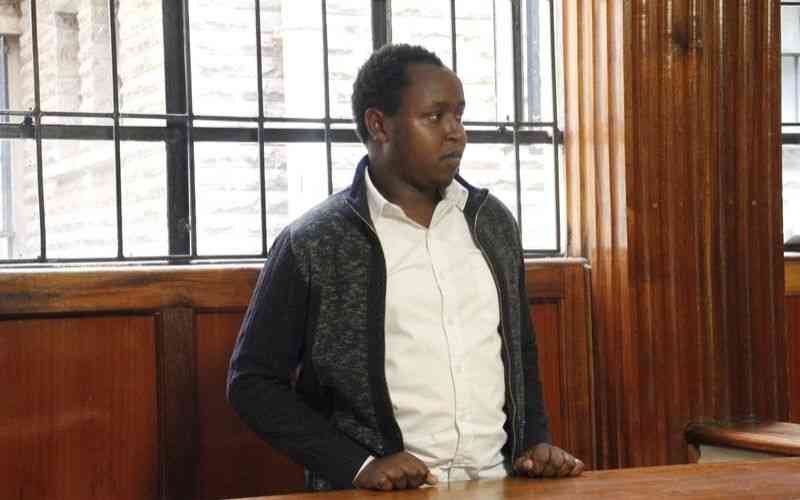
Omwamba is facing a separate criminal case in the Kahawa Chief Magistrate's Court in Kiambu County in which he has been charged with trafficking 25 Kenyans to Russia through deceptive job offers. He pleaded not guilty, was released on a Sh5 million bond and was ordered to surrender his travel documents and remain in Kenya while the case is pending, according to the JFJ report.
Despite the pending case, JFJ found that Omwamba still approached a representative of affected families and offered to connect them with people he said could help obtain information and pursue compensation.
The report claims he urged the families to organise collectively and suggested that negotiation rather than litigation would produce results more quickly. He said relatives would have to travel to Russia and presented a contact named Sasha as a faster route to compensation.
In a subsequent call, Sasha reportedly said compensation would be transferred through cryptocurrency because it was “the only possible way”.
JFJ report also notes that Omwamba discouraged public scrutiny and said Russian authorities did not want to be publicly associated with the recruitment of foreign fighters. Omwamba did not respond to JFJ's questions about his role, the basis of the compensation process he described, whether he had authority to assist with claims or whether he stood to receive any financial benefit.
A third intermediary, who identified himself as Igor, approached several families while claiming to represent Nasha Derzhava, a Moscow company. JFJ report says he told families they could receive between Sh10 million and Sh15 million, without an upfront payment, after signing documents at the Russian Embassy in Nairobi authorising the company to act for them.
He said the money would be paid within three to four months and assured one family that “this is not a scam”.
JFJ found, however, that Nasha Derzhava's public website primarily advertised travel and concierge services and found no public indication that the company was authorised to handle compensation claims for foreign military recruits. Calls to the Kenyan number used by Igor went unanswered.
The information vacuum
The implication of these approaches lies in what families do not know. Kenya is not merely one of several African countries affected by Russia's recruitment drive. It has the largest documented contingent in the JFJ investigation, which identified at least 3,066 African nationals from 40 countries recruited into Russia's armed forces since October 2022. Of those, 873 were Kenyan, ahead of Egypt with 407, Cameroon with 383 and Ghana with 337. JFJ recorded 76 confirmed Kenyan deaths, although the report cautions that its figures are based on documented cases and are likely incomplete.
Kenyan parliamentary and Senate proceedings have produced higher estimates. Kenya's National Intelligence Service told Parliament in February 2026 that more than 1,000 Kenyans had been recruited, including 89 reported to be on the frontline, 39 hospitalised and 28 missing. The gap between the documented cases and the intelligence estimate is significant because it points to how little is known about the full scale of the pipeline – and how many families may still be waiting for reliable information about relatives who left Kenya for what they believed were jobs.
For families, however, the problem is less statistical than personal. They need to know whether a relative is alive, missing, wounded, held as a prisoner of war or dead. They also need to know whether money is legally owed to them, who is authorised to process a claim and how much they are entitled to receive. JFJ found that the absence of clear public information has created what it describes as a “compensation industry”.
The investigation also records warnings from the International Committee of the Red Cross that scammers have posed as Red Cross staff and offered false information about prisoners of war, repatriation and payments.
At the July meeting, PS Njogu told families that Kenya could only provide information based on what the Russian government supplied.
The government has also previously acknowledged the recruitment problem and pursued the return of some Kenyans. In April, Foreign Affairs Cabinet Secretary Musalia Mudavadi said report to parliament that Kenya and Russia had agreed to expedite compensation processes and strengthen information sharing to combat trafficking and misleading recruitment schemes.
Four months later, in August, the JFJ investigation found that families still lacked a publicly explained system for determining compensation, verifying claims and understanding deductions.
Kenya and India comparison
The report also documents a different approach in India. On July 31, India's Supreme Court directed the Ministry of External Affairs to appoint a nodal officer to coordinate with families of Indians killed, injured or missing after joining the Russian military. The court also directed the government to facilitate DNA matching, assist families with compensation claims through the Russian Embassy and provide legal assistance.
However, for Kenyan families, the central issue is not simply whether Russia owes compensation or whether intermediaries are legitimate. It is rather whether the Kenyan government is willing to provide a transparent, verifiable route through which families can establish the status of their relatives, understand any compensation due to them and receive it without surrendering an unknown portion to unverified middlemen.
For Wambui, the starting point remains more basic. Her son is still missing.
She does not know whether he is alive or dead. She has no definitive answer from the Kenyan government. And while private intermediaries have offered families answers, money and access, JFJ's investigation found that some of those promises remain unsupported by documentation showing who authorised them, what the families are legally entitled to receive or how the money would reach them.
Subscribe to our newsletter and stay updated on the latest developments and special offers!


 Prefer the Standard on Google