×

The Standard e-Paper
Stay Informed, Even Offline
 The Standard Group Plc is a
multi-media organization with investments in media platforms spanning newspaper
print operations, television, radio broadcasting, digital and online services. The
Standard Group is recognized as a leading multi-media house in Kenya with a key
influence in matters of national and international interest.
The Standard Group Plc is a
multi-media organization with investments in media platforms spanning newspaper
print operations, television, radio broadcasting, digital and online services. The
Standard Group is recognized as a leading multi-media house in Kenya with a key
influence in matters of national and international interest.

Audio By Vocalize
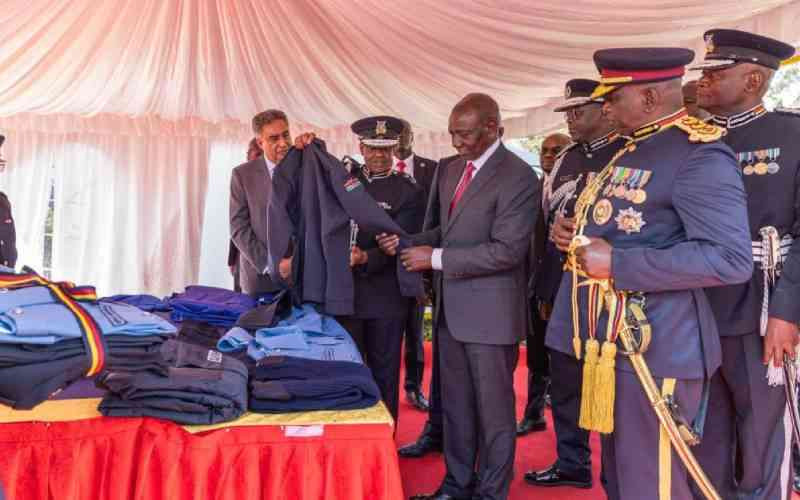
There are moments when a nation needs a policeman. There are other moments when a nation needs a tailor. Kenya, apparently, has decided that this is the latter.
On Friday, President William Ruto stood at Kiganjo and inspected the newly unveiled police uniform with the solemnity of a surgeon examining a patient. The nation watched as the Commander-in-Chief admired shirts, trousers, badges, berets and maternity wear. One could almost hear Kenya asking: Mr President, of all the things wrong with the police, this is what caught your eye?
The Internet, that unruly village elder with a smartphone, immediately held a baraza.
Kenyans have been merciless. One commentator essentially wondered whether Kenya had run out of problems and decided to manufacture one. Another asked, in effect, whether the police had merely changed clothes while the behaviour remained on duty. Social media, as usual, turned the ceremony into a national comedy show.
And perhaps Kenyans have a point.
The police uniform has changed several times in recent years. The latest one returns to the familiar sky-blue shirt and dark trousers, replacing the predominantly deep-blue outfit introduced in 2018. The government says the change follows consultations and recommendations of the police reform process.
But here is the village question: when did Kenya's police problem become a wardrobe problem?
The old police motto was Utumishi kwa Wote service to all. Yet many Kenyans have come to experience the roadside police stop as an unofficial taxation point, and the police station as somewhere one may need money before justice begins walking. The accusations of bribery, brutality, abuse of power and impunity have not exactly been hidden under the mattress.
Indeed, public hostility towards police has become so poisonous that, on occasions, officers have themselves been attacked or beaten by angry citizens. When a society that should fear and respect its police begins to treat an opportunity to confront them as a football derby, something deeper than fabric is torn.
So one wonders: did presidential intelligence not whisper that a roadblock is not a supermarket checkout?
Did nobody explain that a police officer is not employed to collect chai from motorists? Did nobody tell the Commander-in-Chief that a police station is not a mobile-money kiosk?
And what of recruitment? Kenyans have long complained about allegations of corruption surrounding police recruitment, with figures circulating publicly about the cost of securing entry into the service. If the uniform costs tens of thousands of shillings, while an officer's salary remains modest, should we be surprised when Kenyans jokingly ask whether the new shirt will require a new bribe tariff?
The reported price about KSh25,000 per set has already raised eyebrows, while estimates put the wider two-set rollout at around KSh3 billion. Political leaders have demanded transparency over the tender.
And therein lies the comedy.
Kenya has a police force struggling with housing, welfare, equipment, vehicles, working conditions, corruption allegations, brutality concerns and public trust. Yet the national surgical operation begins with the sleeve.
Stay informed. Subscribe to our newsletter
We have changed the shirt without changing the character.
We have polished the shoe while leaving the foot wounded.
We have ironed the trousers while the institution itself remains creased.
This is not to say police officers do not deserve decent uniforms. They do. A professional service deserves professional clothing. But a new uniform cannot manufacture professionalism any more than a new Bible can manufacture a saint.
The danger is that Kenya may be mistaking appearance for reform.
The police do not merely need new clothes. They need a new relationship with the citizen.
They need a culture where a traffic stop does not automatically sound like the opening negotiation of a business transaction; where reporting a crime does not require knowing somebody; where an officer can attend an emergency without first calculating fuel; and where the badge means protection rather than intimidation.
Otherwise, Kenya will soon have the best-dressed police force in East Africa and perhaps the most beautifully uniformed old problem.
The tailor will have won.
The citizen will still be waiting for Utumishi kwa Wote.
And the rot, having survived another wardrobe change, will simply tuck its shirt neatly into its trousers and report for duty on Monday.
Subscribe to our newsletter and stay updated on the latest developments and special offers!


 Prefer the Standard on Google







 join
join