×

The Standard e-Paper
Smart Minds Choose Us
 The Standard Group Plc is a
multi-media organization with investments in media platforms spanning newspaper
print operations, television, radio broadcasting, digital and online services. The
Standard Group is recognized as a leading multi-media house in Kenya with a key
influence in matters of national and international interest.
The Standard Group Plc is a
multi-media organization with investments in media platforms spanning newspaper
print operations, television, radio broadcasting, digital and online services. The
Standard Group is recognized as a leading multi-media house in Kenya with a key
influence in matters of national and international interest.

Audio By Vocalize
August carries a particular memory in Kenya’s history of the Church’s relationship with power. Bishop Alexander Kipsang Muge was killed in August 1990. Ten years later, in August 2000, Father John Anthony Kaiser was also killed. Both men had been outspoken on justice, human rights and the conduct of political power.
Twenty six years after Kaiser’s death, August 2026 finds Kenya once again looking towards an election. It is worth asking what the Church’s prophetic voice should look like as the country heads towards 2027.
The lesson from Muge and Kaiser is not that the Church should recreate the politics of the past. It is that religious leadership carries responsibilities beyond administering institutions and filling pews. When political power threatens human dignity, the Church cannot afford to look away.
Kenya’s experience in 2022 should remain fresh. Politicians took their campaigns into churches, and in some cases the pulpit became part of the political contest. Donations and handouts were displayed in sanctuaries, while some clergy appeared to accommodate political mobilisation from the altar. Religious leaders were criticised for aligning themselves with political camps, while some religious organisations entered questionable political negotiations.
The problem was not that politicians went to church. Nor should the Church withdraw from public affairs. Corruption, violence, inequality, human rights and governance are moral questions as much as political ones. The problem was the blurring of the line between a Church engaging politics and one becoming part of the political machinery. When that happens, the Church’s ability to hold power accountable becomes weaker.
Yet it would be unfair to conclude that the Kenyan Church has lost its way.
In July 2026, National Council of Churches of Kenya (NCCK) warned the President about what it described as a rising “gangland” culture and called for action against government officials sponsoring political goons. It also raised concerns about abductions, police brutality, respect for court orders and the integrity of the process of appointing Independent Electoral and Boundaries Commission commissioners. NCCK called for a wider national response to politically motivated violence.
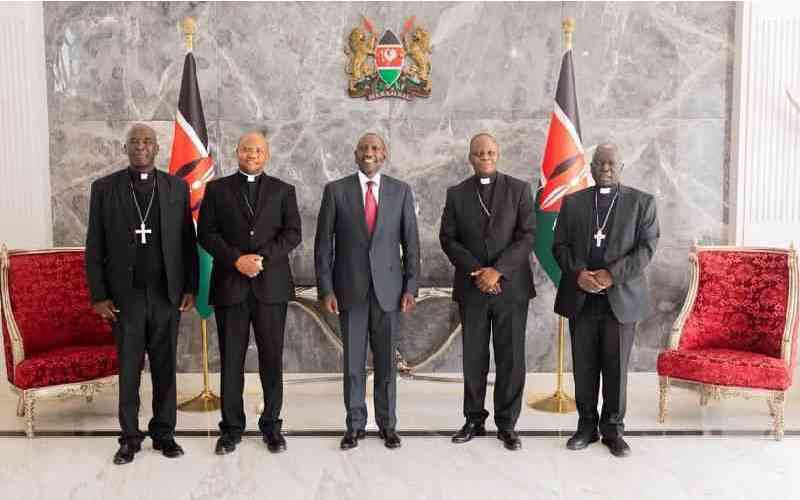
In August 2026, Kenya Conference of Catholic Bishops leaders met President William Ruto and raised issues including ethical governance, goons, healthcare funding and youth empowerment, and lack of political hygiene.
There are useful examples beyond Kenya. Pope Leo XIV leads a Catholic Church of more than 1.4 billion people, while the Anglican Communion has more than 85 million members across more than 165 countries. Their leaders therefore command an extraordinary global platform.Leo has shown confidence in using it. During his April visit to Equatorial Guinea, he spoke about justice, human rights, and the responsibilities of political leaders while meeting authoritarian President Nguema Mbasogo.
In Cameroon, he condemned what he described as an “endless cycle of destabilisation and death” in a region that has endured years of conflict.
These examples matter because religious authority is not simply about numbers. It is about what leaders do with the trust and influence those institutions command.
As 2027 approaches, the Church should ask candidates difficult questions about political violence, corruption, institutional independence, constitutionalism and the future of young Kenyans. It should challenge the government when it is wrong and the Opposition when it is wrong. The Church does not have to choose a presidential candidate to influence an election.
The writer is a governance analyst. simplyhannahwanja@gmail.com
Subscribe to our newsletter and stay updated on the latest developments and special offers!

 Prefer the Standard on Google






 join
join