×
App Icon
The Standard e-Paper
Stay Informed, Even Offline
★★★★ - on Play Store
Download App

Residents along River Yala risk crocodile attacks in daily search for water

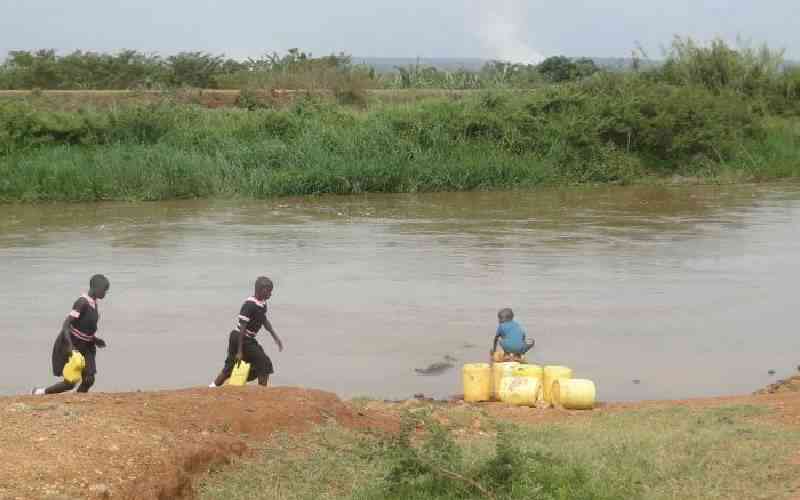
Learners fetch water at the banks of River Yala, Bondo sub-county. [File, Standard]

From a distance, villages along River Yala seem abundantly blessed. The river snakes through wetlands and farms before pouring into Lake Victoria, with water everywhere and seemingly within reach.

Yet for the families who live along the riverbanks in Odhuro, Ngunya, Ragak, Rahondho, Kasau, Mago and Lela, water remains out of reach.

Despite being surrounded by water, many villages along River Yala in Yimbo East Ward have no piped supply. Every drop used for drinking, cooking and washing must be fetched from the river, which is inhabited by crocodiles.


For decades, what should be a routine household chore has become a gamble with death.

At dawn, women arrive at the riverbank with yellow jerricans. Donkey carts line up, plastic drums are tied down with ropes, and cyclists wait their turn.

It is the same spot where a Grade Six pupil was killed by a crocodile in November 2025 while fetching water.

The memory still hangs heavily over the riverbank. Yet, despite the fatal attack, villagers continue to throng the area daily to draw water. Fear is visible in their hesitation, but thirst leaves little room for choice.

“We know the danger, but without this water, our families cannot survive,” says George Onyango, a resident.

In another incident, a 25-year-old man was killed by a crocodile on Tuesday morning while fetching water.

John Otieno, a father of two, had gone to fetch water when the incident occurred. His family camped at the riverbank during the search for his body.

Women and children bear the heaviest burden of water collection. Cultural norms and poverty force them to make several trips to the river daily, often early in the morning or late in the evening.

The risk is compounded by distance. According to the Siaya County 2023–2033 Spatial Plan, the majority of residents access water points located between two and three kilometres from their homes.

For communities along River Yala, that distance often ends at the riverbank.

The long walk forces families to collect as much water as possible in one trip, explaining the queues of donkey carts and bicycles. County plans acknowledge the burden, with the government expressing an intention to reduce water access distance to about 500 metres.

For now, however, that goal remains distant. In many rural areas, residents still spend up to one hour fetching water. Along River Yala, that hour is time spent exposed to danger.

County budget documents show that attempts have been made—at least on paper—to address the crisis.

In the 2023/2024 financial year, Sh5 million was allocated for the solarisation and expansion of the Bar Kanyango Water Supply, Sh2.8 million for the extension of the Got Matar Water Project to Othach sub-location, and Sh6 million for the renovation of the Agola Water Project.

In the 2024/2025 financial year, another Sh4 million was allocated for the expansion of the Got Matar water supply.

On the ground, residents say the impact remains largely invisible.

“We hear figures announced every year, but the river is still our tap,” says Caren Atieno, a resident.

The strain is already visible in Yimbo East Ward, one of the areas most affected by reliance on River Yala. County projections show that the ward’s population is expected to reach 36,827 by 2027, with a projected annual water demand of 1.27 million cubic metres.

Yet much of that demand is still met through unsafe, unprotected water points along the river.

Without rapid expansion of piped water infrastructure, residents fear the pressure will only intensify, forcing more people, more frequently, back to the same dangerous riverbanks.

Kenya Wildlife Service (KWS) officers warn that River Yala is a known crocodile habitat and that human activity at the same access points increases the likelihood of attacks.

However, villagers say such warnings ring hollow without alternatives.

“You cannot warn someone away from water. You must give them another source,” says Atieno.

According to Yimbo East MCA Francis Otiato, despite limited resources, efforts are being made to improve access to water.

“We have revived PENWA and established Got Matar with a current allocation of Sh15 million to ensure water reaches all our public institutions,” says Otiato.

Beyond Yimbo East, the challenge facing Siaya County is expanding rapidly. County planning projections show the population is expected to rise to about 1.57 million by 2046, pushing total annual water demand to an estimated 458,890,942 cubic metres.