×

The Standard e-Paper
Home To Bold Columnists
 The Standard Group Plc is a
multi-media organization with investments in media platforms spanning newspaper
print operations, television, radio broadcasting, digital and online services. The
Standard Group is recognized as a leading multi-media house in Kenya with a key
influence in matters of national and international interest.
The Standard Group Plc is a
multi-media organization with investments in media platforms spanning newspaper
print operations, television, radio broadcasting, digital and online services. The
Standard Group is recognized as a leading multi-media house in Kenya with a key
influence in matters of national and international interest.

Audio By Vocalize
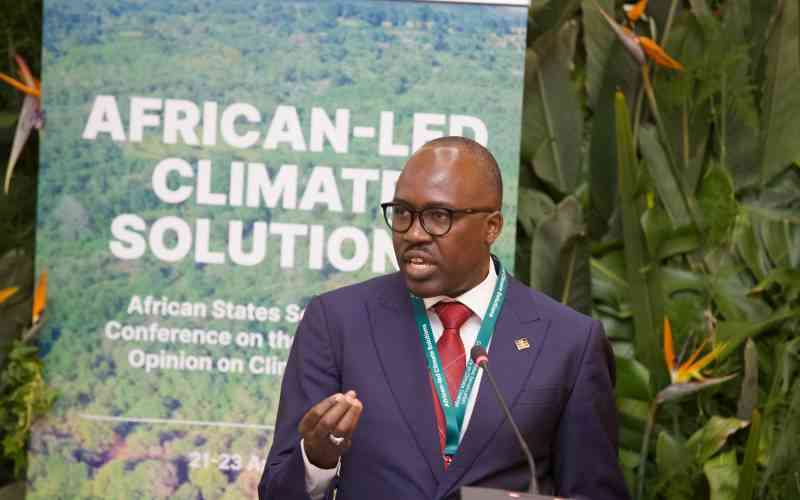
PS foreign affairs Abraham Korir addresses delegates from across Africa during the African-led climate solutions conference. [Juliet Omelo, Standard]
Kenya has welcomed the landmark advisory opinion by the International Court of Justice (ICJ) on climate change.
Principal Secretary for Foreign Affairs Abraham Korir Sing'Oei said the decision strengthens the legal basis for holding states accountable and accelerating global climate action.
Speaking during the opening of the African-led climate solutions conference in Nairobi, which convened scientists, legal experts, and policymakers, Sing'Oei said the ruling marks a turning point in defining binding obligations on states to address climate change.
Kenya, alongside Pacific Island nation Vanuatu, was among the countries that pushed for the advisory opinion, driven by concerns that developed nations have been selectively applying international climate commitments while the crisis worsens.

Panelists during a discussion at the official opening of the African-led climate solutions conference. [Juliet Omelo, Standard]
"Africa contributes the least to global emissions but suffers the most. This decision affirms that climate obligations are not optional," Sing'Oei said, citing increased floods, droughts, health risks, and declining productivity across the continent.
The advisory opinion reinforces commitments under the Paris Agreement. Still, it goes further by clarifying that states have a legal obligation, not merely political commitments, to implement their Nationally Determined Contributions (NDCs) and broader climate responsibilities.
Crucially, the court affirmed that climate obligations extend beyond the Paris Agreement and must be interpreted holistically across international law, including human rights and customary international law.
It underscored that states cannot selectively comply with climate treaties while ignoring related legal duties.
The ruling also establishes key legal principles, including the 'polluter pays' principle, requiring countries responsible for emissions to compensate for damage caused, and the duty of due diligence, obligating states to prevent environmental harm within and beyond their borders.
In addition, the court emphasized the principle of prevention, requiring governments to undertake environmental impact assessments before approving projects that could harm the environment, and to put in place mitigation measures where risks are identified.
Importantly, the advisory opinion makes it clear that states have a duty to regulate private sector actors, including multinational corporations, to ensure they do not engage in environmentally harmful activities.
This marks a significant shift toward greater corporate accountability in climate governance.
Philip Osano, the Chief Operating Officer, CIFOR-ICRAF, added that the ruling strengthens Kenya's position in pushing for increased climate financing, particularly through mechanisms such as the Green Climate Fund and the loss and damage fund, noting that existing funding levels remain insufficient.
Stay informed. Subscribe to our newsletter
"This gives us stronger ground to advocate for more resources for both mitigation and adaptation," he said.
The decision is also expected to enhance coordination of climate action within Kenya, bringing together institutions across government, academia, and environmental sectors to deliver more unified responses.
He noted that at the international level, the ruling is set to influence Kenya's trade negotiations with partners such as the United States, China, and the European Union, adding that environmental safeguards will be more firmly embedded in trade agreements.
''Technology transfer from developed countries to the Global South also featured prominently, with Kenya pushing for access to green technologies to unlock its renewable energy potential in geothermal, hydro, and solar resources,'' Asano said.
On enforcement, George Wamukoya, the team leader for the Africa Group of Negotiators, acknowledged that while Kenya has strong environmental laws, including restrictions on single-use plastics, the main challenge has been implementation.
He said the ICJ opinion strengthens the case for stricter enforcement of both national and international standards.
Wamukoya noted that the ruling is likely to trigger an increase in climate litigation, as communities, civil society groups, and states seek to enforce newly clarified obligations.
"It empowers communities to seek justice, especially where environmental harm intersects with human rights," he said.
The decision is also expected to influence regional jurisprudence, including a pending advisory opinion before the African Court on Human and Peoples' Rights, which is examining the intersection of climate change and human rights in Africa.
At the global level, Kenya and its partners are also pushing for innovative financing mechanisms, including a proposed maritime 'solidarity levy' under the International Maritime Organisation.
"The levy, targeting emissions from the shipping sector, would fund climate adaptation and mitigation efforts in developing countries, though negotiations remain ongoing,'' said Ps Sing'Oei.
African negotiators warned that the continent continues to face shrinking public climate finance and rising debt burdens, with many countries spending between three and five percent of their GDP on climate response despite contributing less than four percent of global emissions.
The advisory opinion also addresses gaps in global climate governance by clarifying that even countries that withdraw from specific agreements remain bound by broader international legal obligations on climate change.
Experts said this could open the door for legal action against major emitters that fail to meet their responsibilities, strengthening the hand of developing countries in global negotiations.
"In its 80-year history, this is one of the most defining decisions by the court. It removes ambiguity and establishes clear consequences for inaction,'' said Prof. George Odera-Outa, Associate Professor at the Technical University of Kenya.
As countries prepare for upcoming global climate negotiations, Kenyan officials say the focus must now shift from pledges to implementation, backed by enforceable legal standards.
"The era of voluntary commitments is behind us. What this ruling makes clear is that climate action is a legal duty, and accountability must follow,' Sing'Oei said.
Subscribe to our newsletter and stay updated on the latest developments and special offers!


 Prefer the Standard on Google







 join
join