×
App Icon
The Standard e-Paper
Home To Bold Columnists
★★★★ - on Play Store
Download App

Mysterious death of street families in city

18 year old street girl Shelvin Nasimiyu at the Made in The Street home in Eastleigh Estate, Nairobi on February 4, 2026[Boniface Okendo, Standard]

Inside the squeezed compound, hemmed in by concrete walls, a group of boys play football barefoot, their feet kicking up as if this narrow space were a stadium.

For a moment, it was easy to forget where we were. The street children were conspicuously jovial and in high spirits, unperturbed by the heating afternoon sun. 

Our arrival at Made in the Streets rescue Centre in Nairobi's Mlango Kubwa, though, seemed to have caught their attention as others in groups of two who were engrossed in chats and a few engaged in cleaning utensils, raised their heads. 


Moments later, the ball was abandoned. The boys lined up quietly and walked into a small hall for prayers. Heads bowed, hands clasped, they whispered words of hope.

Thereafter, they were served a lunch of beans and rice. After which, some lingered. Others slipped out of the gate back to the streets until the next day, when they would return, hungry, tired, but alive, this publication was told. 

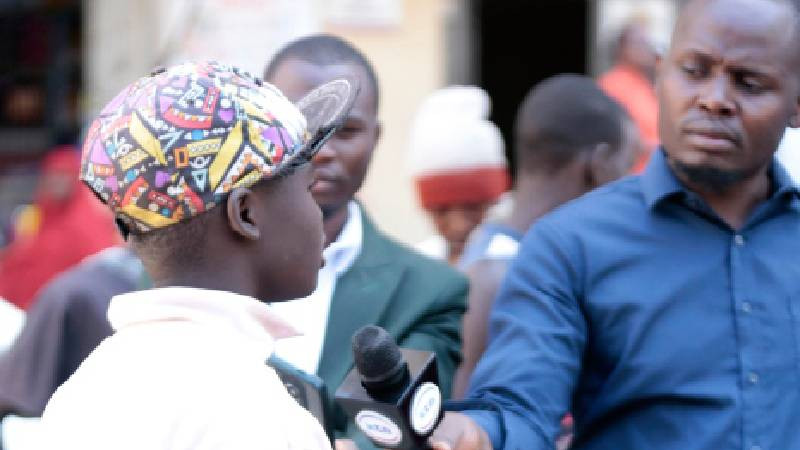
Among them was Brian Muinini (13) and another who preferred not to give his name. Their stories revealed the brutal reality behind the brief safety this centre offers.

“I didn’t choose the streets,” Brian said softly to The Standard during a visit to the rescue centre yesterday. “Home became too hard to survive.”

Brian said he grew up in Meru with both parents, but peace did not last. His parents separated, and he moved to Isiolo with his mother. Life quickly unraveled. His father stopped sending money, food became scarce, and school fees were impossible to raise.

“Some days we slept hungry,” he recalled. “Sometimes I would go a whole day without eating. Life became unbearable. There were no school fees, and I dropped out and went to the streets.”

17 year old street boy Alex Mutwiri at the Made in The Street home in Eastleigh Estate, Nairobi on February 4, 2026[Boniface Okendo, Standard] 

Eventually, he said, hunger pushed him to board a lorry transporting goats locally known as a ‘gari ya mbuzi’ that brought him to Nairobi. That journey marked the beginning of his life on the city streets.

For the second boy, the story is painfully similar. He left home after constant conflict with his parents over their inability to pay his school fees.

“At home, there was no peace, no school, no food,” he said. “On the street, at least you survive day by day.”

Shelvin Nasimiyu, who hails from Kiambio (18), shared that she chose the streets as her home three years ago after she faced constant abuse from her employers as a house-help since she could not return home to a situation that is "severe." 

"I can't go back home bare-handed. I would want to one day go back home to my mother with a skill and a job to help rescue her from poverty. It hurts me seeing my family in that sorry state," she said.

She added, "The last time I went back, my younger brother had also escaped to the streets." 

But survival, they explained, comes at a steep cost.

Street life, both boys explained, is defined by hunger, fear, and rejection. Each morning begins with uncertainty about whether they will eat, bathe, or escape harassment.

“Finding food is the biggest struggle,” Brian said. “If you don’t get food, you feel weak. If you sleep outside, you can be beaten or robbed.”

"I face sexual harassment daily. I am frustrated," said Nasimiyu. 

They spoke of being chased from shops, insulted by passersby, and treated as criminals. Bathing is rare, dignity even rarer.

Worse still are the deaths.

Several of their friends, they said, did not survive street life.  Others died from drug abuse and diseases like pneumonia. A few, overwhelmed by despair, took their own lives. 

“We have lost many,” one boy said quietly. “Some sniff glue and drugs until they lose their minds. Others hang themselves because they feel life has no meaning.”

Brian explained that drugs are often an escape from hunger and emotional pain. “When you are high, you forget hunger. You forget stress. But later, it destroys you.”

He described a close friend who died after prolonged drug use. “He had no money, no job, no family. One day, he just gave up and hanged himself in Mathare slums. I felt so sad.”

Others, they said, lost their lives due to constant abuse and assault from the police and members of the public. 

Their story mirrored the recent revelation of increased deaths of street-connected people, particularly children, nine of whom were buried at Langata cemetery last week, with questions now swirling over the circumstances surrounding the deaths.

Joel Njue, the Centre's manager, said that they documented 38 deaths in 2025 and six "sudden" ones in January this year alone. 

He attributed the deaths to mental issues, drug and substance abuse, hunger, and preventable diseases. 

"Frustrations of life. Sometimes living on the streets is not easy. Sometimes,s experiencing physical abuse or sexual abuse or any other abuse or even rejection from the family can push these kids to a point where they just want to end their lives," he said. 

"So we have life skills and forums whereby we are helping them overcome those challenges. But I think our society has not embraced the idea of counselling. Whenever these kids or families experience trauma, they don't know where to turn to," added Njue. 

The government has been largely blamed for the rising deaths on city streets.

“We express grave concern over the unexplained deaths of at least 15 street-connected youth and children in the past month and the complete absence of accountability from government agencies,” Eric Mukoya, the executive director of Undugu Society of Kenya, recently said. 

Peter Mweke, a reformed street family member who now advocates for the welfare of the street-connected children, urged the government to intervene and address their plight. 

"Let the government build homes for the families and take them to school so that they can learn how to survive," he said. 

Despite the trauma, hope still flickers.

They said they do not want the streets forever. Their greatest wish is simple: education.

“If I got a chance to go back to school, I would leave the streets,” Brian said firmly. “School is the only way out.”

They also called on the government to do more reduce access to drugs, build more rehabilitation centres, and take street children back to school.

“Even if they just take us to school and feed us,” said Nasimiyu. “Our lives can change. I want to help my family.”