×

The Standard e-Paper
Smart Minds Choose Us
 The Standard Group Plc is a
multi-media organization with investments in media platforms spanning newspaper
print operations, television, radio broadcasting, digital and online services. The
Standard Group is recognized as a leading multi-media house in Kenya with a key
influence in matters of national and international interest.
The Standard Group Plc is a
multi-media organization with investments in media platforms spanning newspaper
print operations, television, radio broadcasting, digital and online services. The
Standard Group is recognized as a leading multi-media house in Kenya with a key
influence in matters of national and international interest.

Audio By Vocalize
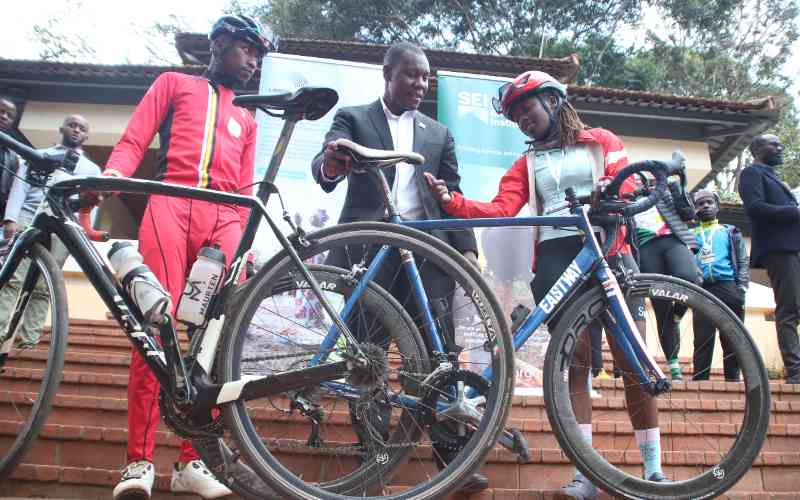
Cycling has for decades been used globally for transport, recreation, exercise and competitive sport, with cities increasingly incorporating it into active mobility and urban transport planning.
In Nairobi, however, bicycles account for about 1.1 per cent of all trips, according to data on the city’s transport modes, despite participation in recreational cycling, cycling clubs and organised races.
The growth is now being accompanied by efforts to link cycling with environmental conservation, climate action and community development.
On Sunday, September 27, cyclists will take part in the Grand Nairobi Race with the event linked to activities at Oloolua Forest as organisers combine sport with tree growing and conservation.
The initiative builds on three years of community and climate action through the Grand Nairobi Race, including tree growing, fruit trees, orchards and school feeding programmes.
Race organiser Desmond Momanyi said more than 8,000 trees had been grown through the initiative, which is now being scaled up through the Oloolua Forest activities.
“We are talking about tree growing, not tree planting,” Momanyi said, emphasising the need to ensure trees survive after being planted.
“Over the years, we’ve gone for community impact, meaning that we’ve done food towers, fruit trees, orchards for community schools that impact the community, and school feeding programmes.”
Laura Mukhwana, Global Landscapes Forum (GLFx) Nairobi coordinator, said Oloolua Forest provides an opportunity to combine recreation with conservation. The forest covers about 660 hectares and has approximately 30 kilometres of walking and cycling trails.
It is managed through a participatory arrangement involving the Kenya Forest Service and the Community Forest Association, with community scouts supporting protection efforts.
Mukhwana highlighted degradation, illegal dumping and logging among the pressures facing the forest. Restoration activities will include growing indigenous trees in selected areas and supporting rehabilitation of degraded sections.
The environmental focus is part of a wider discussion on the sustainability of cycling events.
Philip Osano, chief operating officer of Landscape Alliance, said sporting events should consider their environmental impact beyond the competition itself, including transport, energy, waste, resource use and biodiversity.
Moses Okelloh, who presented on sustainability in cycling, said international sustainability principles needed to be translated into practical measures at local events, including waste management, cleaner transport and greater environmental awareness among participants and spectators.
Chemutai Brenda, who presented on carbon-footprint measurement, said event organisers could account for emissions from direct fuel use and purchased energy, as well as wider activities such as transport, accommodation, procurement, waste and catering.
Stay informed. Subscribe to our newsletter
The push for more cycling also comes with challenges for riders in an urban environment where cycling infrastructure remains limited.
An Urban Cyclist Exposure study presented during the dialogue found substantial variation in cyclists’ short-term exposure to PM2.5, or fine particular matter between different days and sections of routes.
The study monitored six cyclists along four pre-mapped routes before, during and after a car-free event using portable sensors measuring PM2.5, temperature and humidity.
The highest daily median concentration was recorded before the event, while the event day recorded comparatively lower levels.
The researchers, however, said the study was not designed to estimate long-term exposure or establish a causal effect of the car-free event. The small sample size and short monitoring period were also identified as limitations.
Cynthia Sitati, a research associate at the Stockholm Environment Institute Africa, said mobile monitoring could help identify pollution patterns at a finer scale than fixed monitoring stations.
The study suggests that recurring high-exposure sections could be mapped and considered when planning cycling infrastructure, including separated cycleways, buffers and lower-emission corridors.
For cyclists, road safety remains another concern. Geoffrey Waere, a cyclist from Nairobi who has been riding for about four years, said motorists were a major challenge for cyclists.
“The roads are not really the problem. The problem is the drivers. Most of the drivers are careless,” Waere said, citing motorists using their phones and failing to give cyclists sufficient consideration.
Another major cycling event will also take place on Sunday. The sixth edition of the Jubilee Live Free Race, powered by the Grand Nairobi Race, will be held at Uhuru Gardens, with thousands of participants expected to take part.
The race is themed “Pedal for purpose: sustainability, physical empowerment and holistic wellness” and seeks to promote cycling, active living, family participation and inclusion.
The event also supports physical mobility for children requiring prosthetic limbs through the Jubilee Children’s Fund
The two events come as cycling stakeholders push for greater recognition of the bicycle in Nairobi’s transport system, while linking the activity to environmental conservation, climate action, health and community development.
The focus is now on translating interest in cycling into safer infrastructure, better route planning and sustained environmental action beyond the events themselves.
Subscribe to our newsletter and stay updated on the latest developments and special offers!

 Prefer the Standard on Google








 join
join