
 The Standard Group Plc is a multi-media organization with investments in media
platforms spanning newspaper print
operations, television, radio broadcasting, digital and online services. The
Standard Group is recognized as a
leading multi-media house in Kenya with a key influence in matters of national
and international interest.
The Standard Group Plc is a multi-media organization with investments in media
platforms spanning newspaper print
operations, television, radio broadcasting, digital and online services. The
Standard Group is recognized as a
leading multi-media house in Kenya with a key influence in matters of national
and international interest.

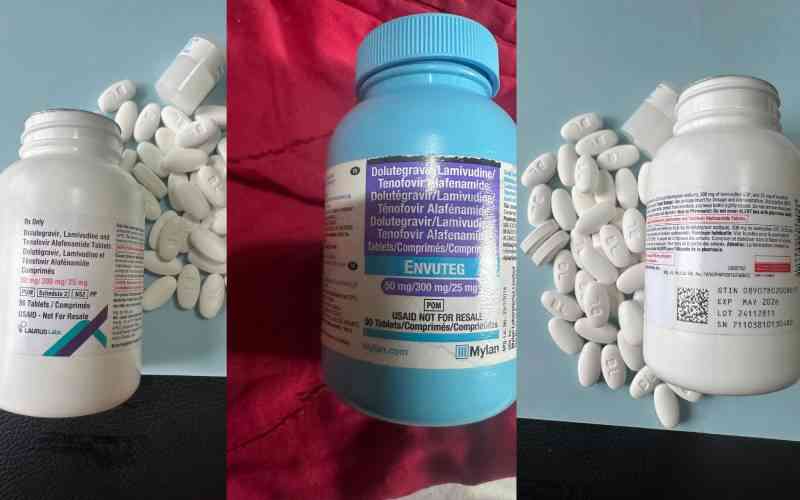
People living with HIV are demanding constant supply of quality and standard Antiretroviral (ARVs).
This follows an outcry that there has been shortage of some types of ARVs, forcing individuals to take expired medicines.
There have also been reports of shortages of infant prophylaxis drugs including Nevirapine and Zidovudine, used to prevent mother to child transmission of HIV.
However, the National AIDS and STIs Control Program (NASCOP) and Kenya Medical Supplies Authority (KEMSA) have maintained that there is no national shortage of ARVs.
Head of NASCOP Dr Andrew Mulwa maintained there is no shortage of Navirapine.
According to him, the country’s average monthly consumption of Nevirapine is 44,191 bottles, while KEMSA currently has 176,479.
The stock he said will last for four months.
- "HIV also a power problem," experts warn as teen infections rise in Africa
- Kenya, African leaders reject free use of pathogen data by developed states
- Calls grow for youth inclusion as HIV, GBV cases rise
- New rapid tests fight deadly infections in Africa
Keep Reading
“We have no shortage of Nevirapine. According to the end-of-May facility reports, facilities held commodities worth 1.8 months of stock. In June, KEMSA distributed a total of 102,153 bottles to the various facilities,” said Mulwa.
But despite the assurance, the National Empowerment Network of People Living with HIV/AIDS in Kenya (NEPHAK) maintains there is inconsistency in supply of HIV treatment drugs.
NEPHAK executive director Nelson Otwoma said a number of people are not able to access the treatment, an issue that risks transmission of the disease, and HIV related deaths.
According to Otwoma, inconsistency in supply of the treatment has been reported for the past three months according to NEPHAK, with individuals forced to take expired ones, for survival.
“What is at KEMSA is not accessible to recipients of care. We cannot all walk to KEMSA and pick medicines,” said Otwoma.
Otwoma said currently facilities are restocking Nevirapine, a drug taken by newborns to prevent them from acquiring the virus.
“Facilities are re-stocking now and there will be no challenge henceforth but what was reported by NEPHAK members was for April, May and part of June for some counties and facilities,” added Otwoma.
A number of Nevirapine, and Zidovudine for infants have been taken to NEPHAK offices.
Shockingly, mentor mothers said some newborns are being given the HIV preventive syrups that have expired, that doctors tell them they are better, than having nothing.
Even with the restocking of prophylaxis for babies, NEPHAK maintains there is still shortage of Tenofovir Alafenamide Lamivudine (TAFLD), ARVs administered to individuals who are 60 years and above.
“As for TAFLD, the delayed delivery has led to stock-out and now people, including those with chronic kidney disease and even the elderly PLHIV are not being transitioned,” regretted Otwoma.
Individuals already enrolled are given pills for one week, two weeks and one month, instead of the usual three or more months.
“We hope it is sorted soon. We get our updates from members who depend on these molecules daily and through Community Led Monitoring (CLM),” said Otwoma.
“But we have asked people to be vigilant and hope nobody will carry home medicine that is expired,” he added, noting that people are taking expired ARVs because of lack of an alternative.
Contrary, Mulwa maintained there is no stock out of TAFLD. Mulwa acknowledged that there is a pipeline delays occasioned by the United States Government (USG) transition.
With this delay, he said products that were to be delivered in June will be delivered end of July, or start of August.
“In order to forestall stock-out, we advised on temporary stop of switching new clients to the molecule until the supplies are in country,” said Dr Mulwa.
Lack of infant prophylaxis he said could be as a result of in country supply chain challenges. “Stocks don’t always translate to patients accessing products,” he said.
On accessing expired drugs, Mulwa said such is a quality-of-care issue, and should be addressed by pharmacovigilance committee and mechanisms.
The Kenya Medical Supplies Authority (KEMSA) Chief Executive Officer (CEO) Dr Waqo Ejersa dismissed supply of expired ARVs to patients.
Ejersa said KEMSA does not distribute health products that have a shelf life of less than six months.
The responsibility he said shifts to facilities and counties once theyu leave KEMSA stores.
“KEMSA, by policy does not distribute products that are less than six months. Facilities once the responsibility shifts to facilities and counties once they leave our stores.,” said Ejersa.
He maintained that specific facilities should explain how the ARVs got to them because ARVS at KEMSA stores are still in-date, and have not supplied short shelf life to hospitals across eh country.
“Drugs and health products we receive at KEMSA stores must have a minimum of at least 75 percent of the life to be being admitted to the stores.
For example, if medicine is set to last for 10 years, it should have at least a shelf life of seven and years,” said the KEMSA CEO.
For the product to leave the facility, it must have a minimum of six months, but is usually six years, three years, but at no expend expired.
Ejersa said once a drug is expired, they become poisonous and lacks potency they are meant to have.
“Once a drug is expired, it should be taken,” maintained Ejersa.
The KEMSA boss explained that if drugs expire, they become obsolete, and plan for destroying kicks in.
This he said is guided by the Public Procurement and Disposal Act.
The drugs are quarantined in a facility, and depending on volumes, reverse logistics is done, or have them destroyed on the site.
The CEO maintained that KEMSA only supply what NASCOP requests to be supply on time. We have third part logistics who supports us whom we pay to distribute to us, we have no challenges.
We buy what the program tells us to buy, and distribute where they tell us to distribute. We do not have any challenges,” said Ejersa.
Further, KEMSA maintained there are enough ARVs at its stores.
“We have enough supply of ARVS at KEMSA stores, and the pipeline looks good. We have also started procuring more,” he said.
Currently he said there is a stock to last Kenya for the next six months. Kenya’s HIV treatment that include ARVs is supported by Global Fund, Ministry of Health, through an allocation from The National Treasury.
The U.S. Government also supply ARVs to the country, supply made through Meds, a private distributor contracted by the U.S. Government.
“Combination of Meds and KEMA does not have shortage in case of an issue, we should be alerted. I do not know of any outcry,” added Ejersa.









 join
join