×

The Standard e-Paper
Kenya’s Boldest Voice
 The Standard Group Plc is a
multi-media organization with investments in media platforms spanning newspaper
print operations, television, radio broadcasting, digital and online services. The
Standard Group is recognized as a leading multi-media house in Kenya with a key
influence in matters of national and international interest.
The Standard Group Plc is a
multi-media organization with investments in media platforms spanning newspaper
print operations, television, radio broadcasting, digital and online services. The
Standard Group is recognized as a leading multi-media house in Kenya with a key
influence in matters of national and international interest.

Audio By Vocalize
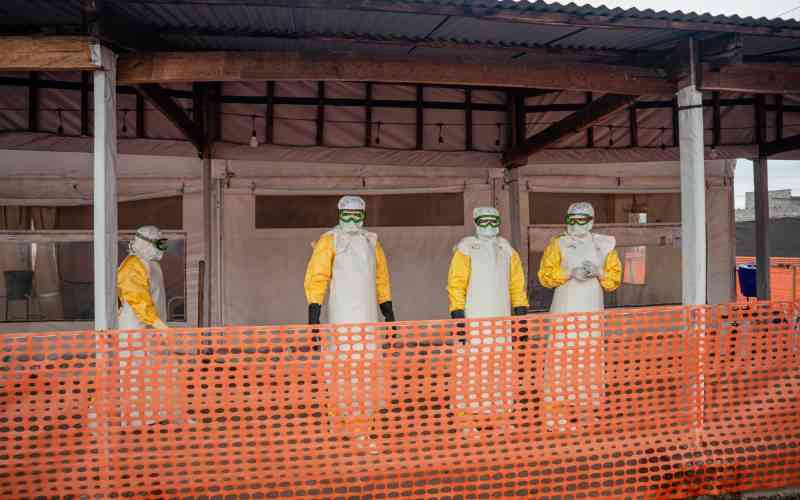
Health workers in the Democratic Republic of Congo’s worst-ever outbreak of the Bundibugyo strain of Ebola have threatened to down their tools as treatment centres are reaching capacity and deaths continue to balloon.
The strike notice, issued by health workers in Ituri Province, comes as the outbreak has claimed 508 lives from 1,561 confirmed infections, giving the epidemic a case fatality rate of 32 per cent.
That is in every 3 confirmed cases, 1 death has been reported. More than 250 patients have recovered, while hundreds of suspected infections are still under investigation.
Healthcare workers say they have gone weeks without outbreak-related allowances despite working long hours under extremely difficult conditions. They’re also asking for better pay, protective equipment and better working conditions.
Workers say many facilities still suffer shortages of basic supplies, while local staff say the authorities are avoiding them, with their attention going back to teams from Kinshasa.
So far, since the outbreak was announced, 75 health workers have been infected and 17 fatalities reported among the medics.
The industrial action threatens to disrupt contact tracing, patient care and newly launched clinical trials testing experimental therapies against the Bundibugyo strain, an Ebola species for which no approved vaccine or specific treatment currently exists.
The outbreak, which began in mid-May, continues to spread across eastern DRC, with Ituri being the epicentre, while cases have been confirmed in North Kivu and South Kivu.
And Dr Anne Ancia, a WHO representative in the DRC, warned that the epidemic has not yet reached a stable phase.
"It is still in the expansion phase, unfortunately. We would like to say it is stabilising but frankly, we cannot say it yet," she said.
She said Ebola treatment centres were filling up rapidly, with some facilities running at around 96 per cent occupancy, leaving little to no room if infections persist.
Dr Ancia also said infected miners in Mongbwalu are travelling to other areas instead of seeking treatment locally, accelerating transmission.
"Population movements, persistent insecurity and the fragility of the health system continue to complicate efforts to bring the outbreak under control," she said.
The progress comes as governments around the world are in Geneva negotiating ways to shore up world pandemic planning.
Stay informed. Subscribe to our newsletter
Tedros Adhanom Ghebreyesus, WHO Director-General, told the member states that the Ebola crisis is evidence that deadly outbreaks remain an immediate global threat.
"The next pandemic will not wait for us to be ready."
He added:
"The Ebola outbreak that is still occurring in the DRC right now is proof of that. It’s not some distant, hypothetical scenario. It is happening."
Tedros cautions that while Ebola may not become the next pandemic, the outbreak is "a painful reminder that the threat never truly goes away."
The response is even more complex because scientists are still searching for the outbreak’s index case and thousands of contacts need follow-up across affected communities.
Although WHO recently approved the first emergency diagnostic test specifically designed for the Bundibugyo strain and clinical trials of promising treatments have begun, health experts warn that these advances will have limited impact if frontline workers walk away from the response.
With treatment centres getting over capacity and the outbreak growing, and trials for treatment already being conducted in DRC, public health officials say retaining and supporting healthcare workers might prove just as important as developing new medicines in bringing the epidemic under control.
Subscribe to our newsletter and stay updated on the latest developments and special offers!


 Prefer the Standard on Google








 join
join