×

The Standard e-Paper
Stay Informed, Even Offline
 The Standard Group Plc is a
multi-media organization with investments in media platforms spanning newspaper
print operations, television, radio broadcasting, digital and online services. The
Standard Group is recognized as a leading multi-media house in Kenya with a key
influence in matters of national and international interest.

Audio By Vocalize
When Russia’s Vladimir Putin wove in his speech barbs against the West during the Russia-Africa Summit, citing its colonial past, keen observers noted a deliberate case of disinformation.
With his war against Ukraine having killed over 500 Africans on the frontline while more than 2,500 are still trapped by the Russian army in what the UN Independent Commission on Ukraine describes as human trafficking, Putin looked African leaders in the face and accused Europe of continuing to exploit Africa’s resources using debt to hold back development.
He rubbed in the recorded fact of colonialism, as was expected by pundits who have been following his speeches, in which he deliberately ignores his own administration’s use of fighters from impoverished backgrounds, most of whom are recruited through deception; promises of training and civilian jobs in his country, Russian citizenship and scholarships, which no recruit has been given.
The Standard has learnt that representatives of 46 African countries seemed to believe that Putin was speaking in their defence and nodded approval; some even cheered. Two countries, however, remained quiet. They were Rwanda and Kenya.
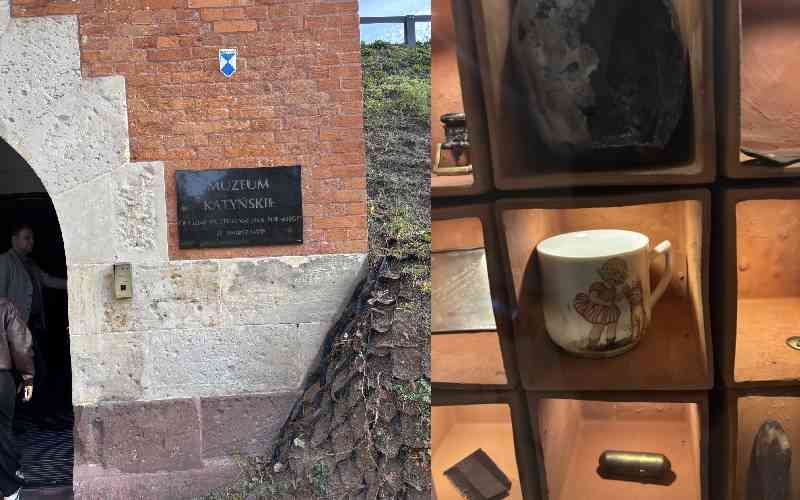
For Rwanda, officials who run the Kigali Genocide Memorial had just returned from a trip to Poland, where among other places of record they visited was the disturbing Katyn Forest Museum.
They had gone on a benchmarking visit to learn from Poland, which has leveraged on its painful past and watered the spirit of nationhood- free from ethnic hate and racial discrimination.
Nairobi, whose 76 nationals have been killed in Moscow’s war, according to the latest report by Journalists for Justice, kept quiet as Putin embellished his country’s image at the Summit, refusing to nod or cheer.
Now officials argue that their mission was to look forward as they work at building new partnerships in the East and West and not to revive old wounds about who between Western Europe and Russia was a coloniser, a source intimated to The Standard.
Rwanda’s officials, in a conversation with The Standard during a meetup in the Polish capital, Warsaw, said.
“Poland has lived through such atrocity in its history and has learned from it and is today among socially cohesive societies in the world, and also belongs among vibrant economies in the European Union. We have come to learn some lessons”.
Apart from visiting the Katyn Forest museum, the team of six had visited the World War II Museum and the Warsaw Uprising museum, which bear records of the horror meted out to the Polish nation by early 20th-century powers: Germany and the Soviet Union.
The following day the team travelled to the City of Krakow, which is considered a mirror of Polish heritage. There they visited centres that hold the history of Nazi concentration camps- among them the most notorious of Adolf Hitler’s extermination centres, Auschwitz- Birkenau.
Of the death camps built by Hitler’s criminal regime, Auschwitz holds the record for killing more than a million people.
Stay informed. Subscribe to our newsletter
At the Moscow Summit, as Putin gave his promises to Africa, the Rwandan delegation did not cheer. Perhaps they were reflecting on the similarities that the Katyn massacre bears to the 1994 genocide.
The difference was that for Katyn, the killings against the Polish people were done by a foreign power seated in Moscow. In the Rwandan case, the sword was wielded by their own government.
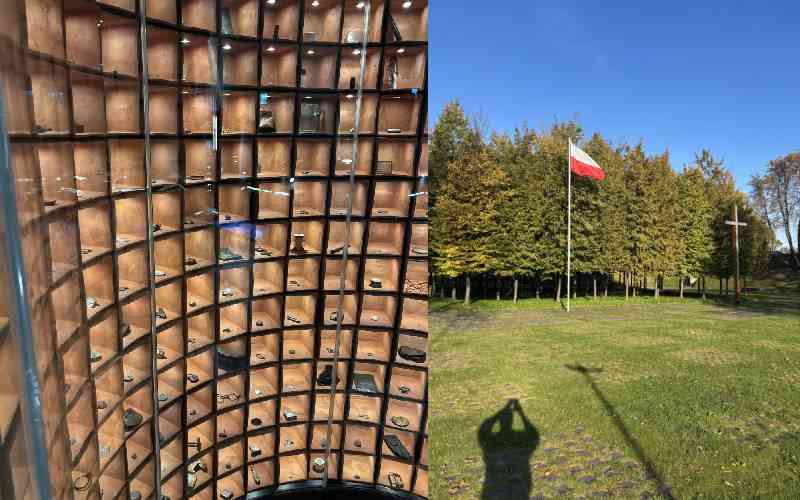
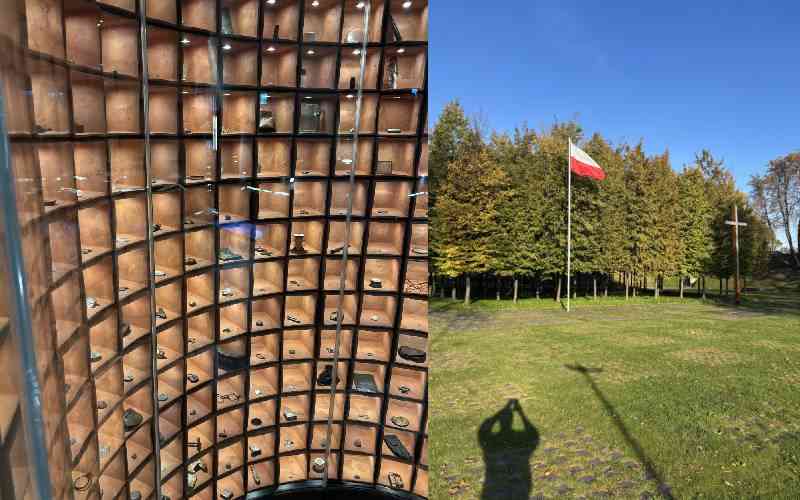
Built on the outskirts of the Warsaw metropolitan area, the Katyn Forest Museum is set to bring out the ambience of a forest ecosystem because it was in a forest that the massacre happened: trees and earthy embankments, green grass all over, while the museum is built underground.
The records therein are accessed through a self-guided walk-through. All preserved items, including pictures of the victims, letters penned by the victims, and personal effects, have their story told by remote control in select rooms. You get the audio story through an ear gadget as soon as you walk into a specific room.
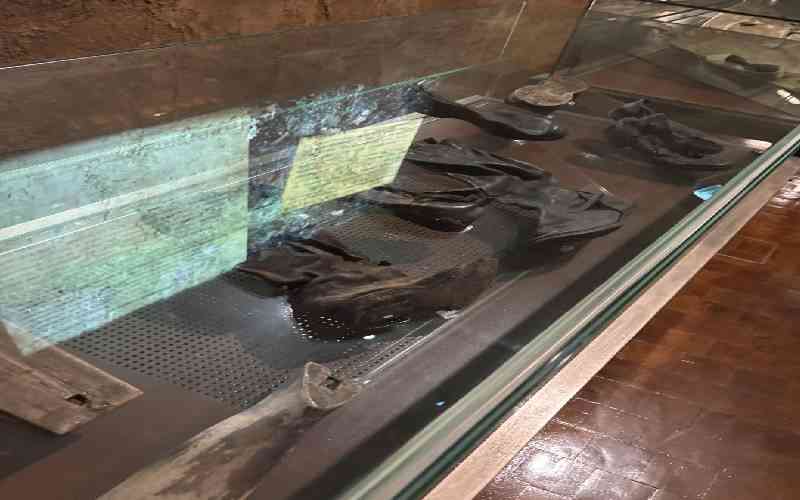
Combs, wedding rings, military medals, shoes, watches, cups, and clothes of victims of the massacre, some said to have been donated by an existing body called the Association of Katyn Families of Warsaw.
According to the Washington-based Victims of Communism Memorial Foundation, many of the Polish victims were called to be soldiers due to the outbreak of war.
Before World War II, they were outstanding doctors, lawyers, generals, lecturers and professors, scientists, political leaders, and artists.
They were well educated, intelligent, open-minded, prominent, distinguished people, either wealthy before the war or with prospects for great careers.
Many had graduated from the best universities in the world, were published in worldwide science journals, worked for foreign universities, medical clinics, or legal practices, and were recipients of foreign scholarships, awards, and prizes.
Investigations called by the United States Congress ruled that “there can be no doubt this massacre was a calculated plot to eliminate all Polish leaders who subsequently would have opposed the Soviets’ plan for communising Poland.”
In its plan to institute communist style colonialism in Poland, the Soviets killed nearly 22 000 accomplished Poles, among them big names of the time such as physician and professor Jan Nelken and his family, who owned a house in Konstancin-Jeziorna, near Warsaw.
An outstanding psychiatrist, Nelken could afford to hire two world-famous architects to build his house: Helena and Szymon Syrkus.
The house was top-notch; the concept and design were described in the press in 1935.
Another victim was the veterinarian surgeon Major Albin Ziemecki, who was an art and weapons collector.
His collection was interesting enough to be featured in the pre-war press in 1937, Światowid, as he was the owner of great Russian poet Alexander Pushkin’s revolvers.
The guns were the ones used in the famous duel in which Pushkin was killed. There are also Stefan and Adam Baczewski, who were co-owners of the well-known company J. A. Baczewski—the biggest producer of alcohol in Poland and one of the biggest in Central Europe. The Baczewski family was one of the wealthiest in the city of Lwow.
The recording of the massacre in world history is a revision of contemporary historical lessons taught in classrooms, mostly in the Commonwealth, about who between Nazi and Stalinist Russia spearheaded 20th century Genocides.
Katyn reveals that the Kremlin was ahead of Nazi Germany in its program of genocide against the Jews.
A walk through the museum shows that by the time the Nazi made their decision on the “final solution to the Jewish question”, with executions of Jews beginning in the summer of 1941, Soviet Russia had killed in secret the cream of Polish society and buried it in the Katyn forest - Smolensk, southern Russia.
A bit of background to the genesis of the massacre is that on August 23, 1939, Germany and Russia signed a non-aggression treaty which has come to be known as the Molotov-Ribbentrop Pact at the Kremlin.
This document divided Poland among the two aggressors and on September 1, 1939, Germany invaded it from the west, north, and south with five German armies.
On September 17, 1939, the Red Army entered Polish territory. The Soviets did not declare war on the country but gave an official reason as intending to help Belarusians and Ukrainians who were brothers of the Russians. The Red Army disarmed Polish troops and sent them to prisoner-of-war camps in the USSR.
At the beginning of March 1940, the Politburo approved a proposal to treat the Polish prisoners of war as “enemies of the Soviet authorities filled with hatred for the Soviet system of government.”
They should have been treated as prisoners of war in accordance with international treaties and conventions, but instead, the Soviets decided to kill them in secret for a month, from April 3 to May 1940.
The killings were carried out without any formal charges, investigation, or trial or indictment.
On April 13, 1943, the Germans announced that they had discovered mass graves of Polish officers in the Katyn forest in Russia.
By that time, the Nazi’s had dishonoured their deal with the Soviets and were in a war situation with them after invading them in 1941.
In response to the German Army announcement, the Soviets claimed that the Poles had been engaged in construction work west of Smolensk in 1941 and the invading German army had killed them after overrunning that area in August 1941.
But both German and Red Cross investigations of the Katyn corpses then produced firm physical evidence that the massacre took place in early 1940, at a time when the area was still under Soviet control.
The Polish government-in-exile in London requested that the international committee of the Red Cross examine the graves and also asked the Soviet government to provide official reports on the fate of the remaining missing prisoners.
The Soviet government refused the demands, and on April 25, 1943, the Soviets broke diplomatic relations with the Polish government in London.
The Soviets then set about establishing a Polish government-in-exile composed of Polish communists, ultimately turning post-war Poland into a communist leaning country.
For Poles today, some of whom we met and interacted with in Warsaw and in Gdansk, the northern city, Katyn remains a symbol of the many victims of Stalin’s Russia, whose aim was to weaken Poland by removing its thinkers, military and political leaders to establish a colonial communist administration with little opposition.
Because of this and other atrocities against Poland that followed across the years up to the fall of communism in 1989, the country considers Russia an atrocious colonial state.
That is why it stands with Ukraine in the ongoing war and opened its doors for Ukrainian populations when the war started, and has kept them open.
Subscribe to our newsletter and stay updated on the latest developments and special offers!

 Prefer the Standard on Google