×

The Standard e-Paper
Join Thousands Daily
 The Standard Group Plc is a
multi-media organization with investments in media platforms spanning newspaper
print operations, television, radio broadcasting, digital and online services. The
Standard Group is recognized as a leading multi-media house in Kenya with a key
influence in matters of national and international interest.
The Standard Group Plc is a
multi-media organization with investments in media platforms spanning newspaper
print operations, television, radio broadcasting, digital and online services. The
Standard Group is recognized as a leading multi-media house in Kenya with a key
influence in matters of national and international interest.

Audio By Vocalize
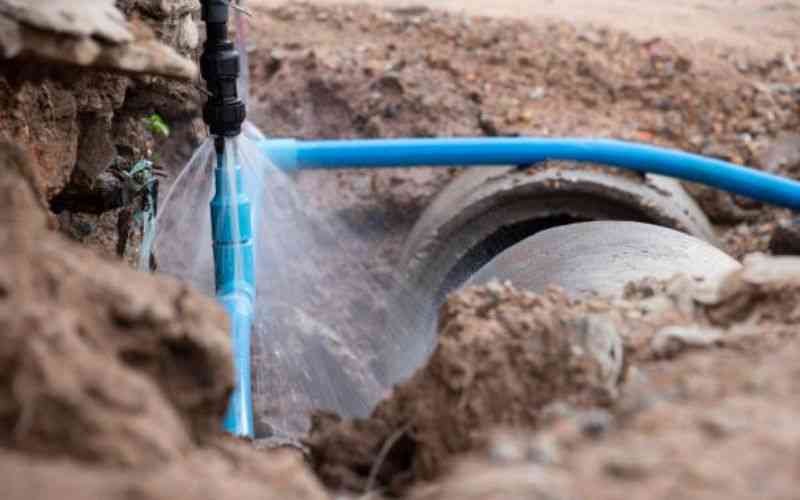
Kenya's water service providers are losing billions of shillings in potential revenue every year after nearly half of the country's treated water fails to reach paying customers, piling financial pressure on utilities and threatening efforts to expand access to clean and reliable water.
The latest Impact 18 Report shows that the country's Non-Revenue Water (NRW) has risen to 48 per cent, meaning almost one in every two litres of the 504 million cubic metres of treated water produced annually generates no income. The losses are linked to leaking pipelines, illegal connections, faulty meters, inaccurate billing and other operational inefficiencies.
The findings have raised concerns over the financial sustainability of water service providers, many of which are grappling with ageing infrastructure, rising operating costs and growing demand for water services.
Speaking at the opening of the three-day Non-Revenue Water Management Conference in Naivasha, Water Cabinet Secretary Eric Mugaa said Kenya can no longer afford to lose nearly half of its treated water while millions of households continue to experience unreliable supply.
"These losses are driven by physical, commercial and operational challenges. The solutions already exist, and our priority is to scale proven technologies and strengthen utility performance to reverse this trend," Mugaa said.
He noted that reducing Non-Revenue Water is one of the quickest and most cost-effective ways of improving utilities' financial health without raising water tariffs or investing heavily in new water sources.
"Every litre of water that is produced but fails to generate revenue represents lost income that could have been invested in expanding infrastructure, improving service delivery and strengthening the resilience of our water utilities," he said.
According to the report, the losses continue to deny utilities billions of shillings needed to maintain infrastructure, replace ageing pipelines and extend clean water services to underserved communities.
Principal Secretary for Water and Sanitation Julius Korir said the sector must embrace digital technologies to improve efficiency and recover revenue lost through inefficiencies.
"Smart metering, GIS and satellite mapping, District Metered Areas and real-time data systems are no longer optional; they are essential tools for reducing water losses and improving utility efficiency," Korir said.
He added that modern monitoring technologies would enable utilities to detect leaks earlier, improve billing accuracy, identify illegal connections and strengthen accountability.
The conference has brought together policymakers, county governments, regulators, development partners, researchers and technology firms to identify practical interventions to reverse the country's growing water losses.
Discussions are focusing on innovative financing options, including Public-Private Partnerships, blended finance and green bonds, alongside digital solutions that improve leak detection, meter accuracy and billing systems.
Sector experts say reducing Non-Revenue Water is one of the fastest ways utilities can improve their financial performance by generating more income from existing water production instead of relying on costly investments in new water sources.
Stakeholders argue that recovering even a fraction of the water currently lost would unlock billions of shillings for infrastructure upgrades, better service delivery and expanded access to reliable water without placing additional pressure on Kenya's scarce water resources.
Stay informed. Subscribe to our newsletter
Subscribe to our newsletter and stay updated on the latest developments and special offers!


 Prefer the Standard on Google






 join
join