 The Standard Group Plc is a multi-media organization with investments in media
platforms spanning newspaper print
operations, television, radio broadcasting, digital and online services. The
Standard Group is recognized as a
leading multi-media house in Kenya with a key influence in matters of national and
international interest.
The Standard Group Plc is a multi-media organization with investments in media
platforms spanning newspaper print
operations, television, radio broadcasting, digital and online services. The
Standard Group is recognized as a
leading multi-media house in Kenya with a key influence in matters of national and
international interest.

On any ordinary day, Sachangwan village, located on the outskirts of Bomet town, exudes a serene calm—a river murmurs softly, breaking the silence of a dense, green landscape. Paths through the village are sparsely tracked, creating an impression of isolation, almost a world apart. But this tranquility hides a disturbing reality: within these quiet confines, a criminal network has been operating a dark trade that threatens the health and lives of thousands of Kenyans.
Investigations by The Standard revealed the existence of one of the country’s most organised syndicates, engaged in the slaughter of dead and sick cattle. This network turns diseased and unfit meat into a profitable commodity, supplying butcheries and schools across the country.
The syndicate’s operations are highly sophisticated, exploiting legal loopholes, economic hardship, and the limited capacity of enforcement agencies. The network is so well-coordinated that it has become a persistent and hidden threat, serving meat almost daily, a “poisoned harvest” that could result in serious illness, hospitalisation, or, in extreme cases, death.
“These cases are worrying,” confirmed Felix Lang’at, Chief Officer for Health Services in Bomet County. “This crime involves a well-coordinated network operating from the village level, through county coordinators, and all the way to distributors supplying meat to butcheries in Nairobi. The reach and organisation of this syndicate is astounding.”
Beyond urban centres, children in schools are also victims. Schools, with their high volume of daily meals and ready-to-receive meat supplies, provide one of the quickest and most reliable markets for these criminal actors. “Most of this meat ends up in school kitchens, sometimes before it can even be tested for safety,” he added.
The network operates through several tiers. At the grassroots level, village and ward agents identify farmers with sick or dead cattle. These agents, often familiar to the farmers, persuade them to sell, falsely claiming that the animals will be fed to wildlife in national parks and reserves. Farmers receive as little as Sh 2,000 for a dead cow and up to Sh 5,000 for a sick one, depending on size and condition.
Once the transaction is complete, the agents notify county coordinators, who arrange collection, often under cover of darkness. The cattle are transported to private slaughterhouses, where they are butchered and packaged for distribution to butcheries in local towns and major cities, including Nairobi. Timing is critical; most butcheries receive deliveries at dawn, leaving little opportunity for oversight or inspection. “Butcheries deliver meat to schools very early to allow adequate cooking time. By the time investigators identify suspect meat, it has often already been cooked or served, preventing effective testing for suitability for consumption,” he explained.
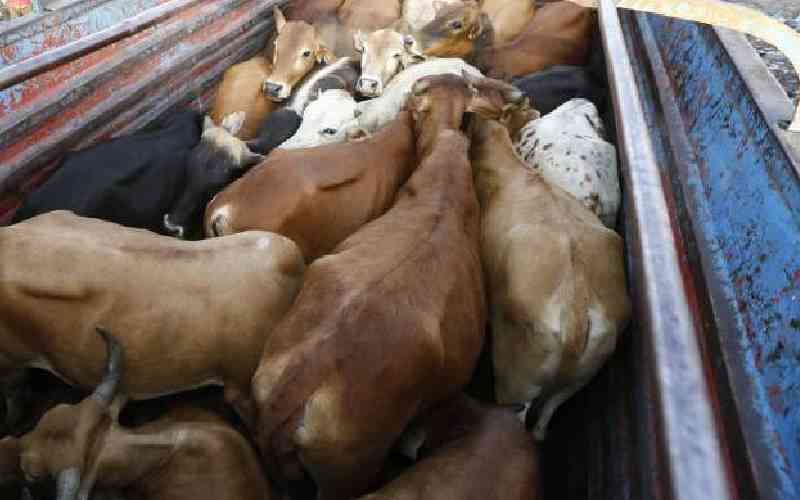
When The Standard visited one private slaughterhouse in Sachang’wan, previously closed due to similar offences, there were unmistakable signs of recent activity, including the stench of slaughter. The owner denied ongoing operations, but weeks later, a lorry carrying six cows, four visibly sick, was impounded en route to the same facility, indicating that the illegal trade continued unabated. Neighbours confirmed that slaughtering occurred on random days. The facility charges Sh500 to slaughter a single animal, most of which are cattle.
Economic pressures
Economic pressures and lack of awareness about health risks drive farmers to sell sick or dead cattle.
In March this year, Janet Rotich recounted an encounter with buyers who approached her about a sick cow. “They claimed the cow would feed wild animals in the park. I received Sh2,000 and they came back that evening to collect it,” Janet said.
Many other farmers in Bomet face similar decisions. Geoffrey Rono recalled being approached by brokers just as he prepared to bury a dead cow. “They offered a small sum, which is better than losing the animal entirely. Many of us are unaware of the risks involved,” he said.
Lang’at noted that unscrupulous businesspeople exploit both the farmers’ financial vulnerability and the lax enforcement of laws. “These traders make up to 200 per cent profit per cow, endangering the lives of countless consumers,” he said.
Cracking down on the syndicate is difficult due to the secrecy of their operations and the sophistication of their logistics. Additionally, administrative boundaries between counties limit the effectiveness of enforcement measures.
For instance, in August last year, security and public health teams from Bomet and Narok counties raided a private slaughterhouse in Mulot, located near the border.
The facility had been identified as a hotspot for slaughtering sick and dead cattle. However, jurisdictional limitations meant that authorities could not fully prosecute the offenders.
A transboundary, multi-sectoral team was subsequently formed to tackle the issue, but the network continues to operate in several counties, especially in urban areas where farmers lack proper disposal options for dead cattle.
Clement Maina, a resident in Nakuru, confirmed that some urban farmers actively sell sick cattle to avoid the logistical burden of disposing of carcasses.
Despite legislation such as the Meat Control Act, which regulates slaughter and sale of meat to ensure consumer safety, the syndicate exploits loopholes and limited enforcement capacity.
Bomet County has 199 veterinary officers, but only 135 are fully qualified and retained. Fines under the Act—up to Sh10,000 or 12 months’ imprisonment—are considered insufficient relative to the scale of the crime Veterinary officers are tasked with inspecting meat for animal health, while public health officers monitor slaughterhouse sanitation and certify food handlers.
Dr Ronald Kibet highlighted gaps between authorities as a major enforcement obstacle. “Unless veterinary officers, public health officers, law enforcement, and the judiciary work together, these criminal networks will continue to exploit loopholes,” he said.
The public health implications of consuming meat from sick or dead animals are profound. Diseases such as anthrax and rabies are prevalent in livestock-dense areas, such as Chepalungu, Bomet East, Konoin, and Sotik.
Many animals sold to these syndicates had been under antibiotic treatment, exposing consumers to high doses of chemicals and contributing to antimicrobial resistance. “Consuming meat from animals undergoing treatment exposes the human body to low doses of antibiotics, reducing the effectiveness of prescribed drugs,” Dr Kibet explained.
Health risks
Long-term consequences include cancer, liver cirrhosis, hepatitis, and other non-communicable diseases. Dr Kibet pointed to the high incidence of digestive system cancers in the South Rift Valley, suggesting a potential link to environmental toxins and diseased meat. “Research is urgently needed to understand these patterns,” he said.
The syndicate’s operations reflect broader social and economic issues. Farmers’ financial vulnerability, limited awareness, and weak enforcement allow the illegal trade to thrive. Unscrupulous traders profit massively at the expense of public health.
Experts advocate a multi-pronged approach, including stronger enforcement, closing legal loopholes, better coordination between veterinary and public health officers, and public awareness campaigns. Lang’at called for specialised prosecutors with medical knowledge, while Dr Kibet urged education campaigns and stricter slaughterhouse oversight.
“This is not just a rural problem. Urban populations, especially in high livestock areas, are equally at risk,” Lang’at said.
The exposure of this criminal network in Sachangwan is a wake-up call. Without urgent intervention, the syndicate will continue to profit from illegal, dangerous practices, endangering the health of thousands across Kenya. The pursuit of profit has created a public health crisis that demands stronger enforcement and widespread public education.
This story was supported by Wits Center for Journalism




