 The Standard Group Plc is a multi-media organization with investments in media
platforms spanning newspaper print
operations, television, radio broadcasting, digital and online services. The
Standard Group is recognized as a
leading multi-media house in Kenya with a key influence in matters of national and
international interest.
The Standard Group Plc is a multi-media organization with investments in media
platforms spanning newspaper print
operations, television, radio broadcasting, digital and online services. The
Standard Group is recognized as a
leading multi-media house in Kenya with a key influence in matters of national and
international interest.

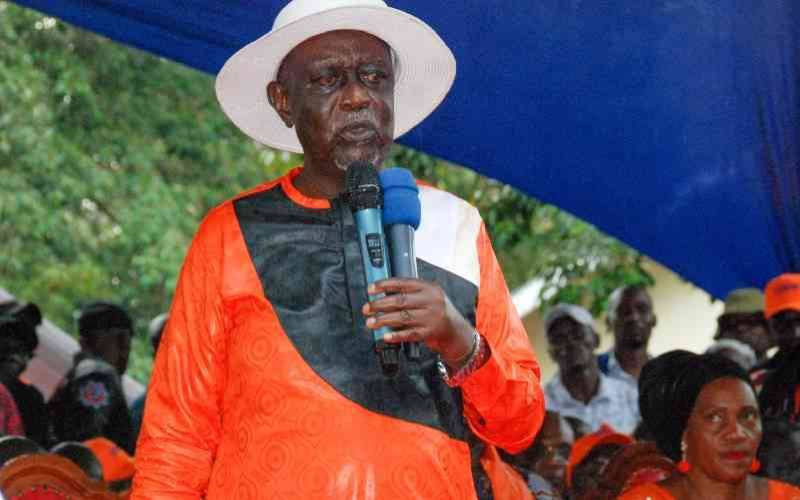
ODM leader Oburu Odinga addresses party delegates at his home in Bondo, Siaya. [File, Standard]
For decades western region has arguably remained a single political bloc, predictable, emotive and largely loyal to the Orange Democratic Movement (ODM).
From Busia to Kakamega to Vihiga, and Bungoma, the region's vote was often mobilised less by party structures than by one unifying political force, late Raila Odinga.
Today, that certainty is gone. As ODM party leader Oburu Odinga attempts to steady the party’s national grip and consolidate Western as a vote-rich anchor ahead of the 2027 general election, he is confronting a region in flux, fragmented by competing leadership centres, divergent strategies, generational shifts and an increasingly transactional politics driven by proximity to power rather than historical loyalty.
Western region is no longer moving in one political rhythm. It is negotiating, hedging, and in some cases rebelling.
Once considered ODM’s second-most dependable stronghold after Nyanza, Western region is now politically fragmented, with governors, MPs and grassroots leaders openly disagreeing on the party’s future direction, particularly its engagement with President William Ruto’s administration.
For nearly 20 years, late Raila Odinga provided that gravitational pull transcending county, ethnicity, and local rivalries.
Without him now, Western has reverted to its natural political condition. Cracks widen as Western leaders pursue divergent paths.
Political analysts say the biggest obstacle facing Oburu is the absence of a unifying figure capable of holding together the region's diverse political interests following the exit of Raila Odinga from frontline politics.
“Western is no longer a monolithic political unit. Each county is now negotiating power independently, and ODM is struggling to enforce collective discipline,” said Nerima Wako.
This reality has been most visible in Kakamega County, where rivalry between former governor Wycliffe Oparanya and incumbent Fernandes Barasa continues to expose deep fissures within ODM.
No county better illustrates ODM’s western dilemma than Kakamega, the region’s most populous county and historically its political nerve centre.
Oparanya, now serving in President Ruto’s cabinet, retains deep grassroots networks built over two terms as a governor.
His allies still command influence within ODM’s local structures and parliamentary ranks.
Many of them believe Oparanya was deliberately edged out of ODM’s inner circle as succession battles intensified.
“Oparanya is our leader and the western kingpin. We cannot go to the discussion without him. Our Luhya kingpin must be at the table. Kakamega must be there on our behalf,” said Nabii Nabwera during a recent political event in Kakamega.
Kakamega Woman representative Elsie Muhanda also weighed in and asked Oburu not to sideline Oparanya who, according to her fits the bill of serving as the Deputy President.
Muhanda added that the party had sidelined long-serving leaders in favour of a “small clique” aligned with the current party leadership.
“You cannot preach unity while humiliating people who built ODM in Western. Some of us feel deliberately pushed out, and that resentment is real,” she avers.
Governor Barasa, on the other hand, represents a newer ODM establishment, assertive, institutionally aligned with the party headquarters, and openly pragmatic about working with the Kenya Kwanza administration.
The two camps coexist uneasily. Barasa’s supporters accuse Oparanya’s allies of sabotaging ODM from within and quietly undermining party unity.
“Politics is about timing and strategy. Working with the government does not mean betrayal. It means delivering development to our people,” said Peter Owino, a political commentator.
Beyond Kakamega, Oburu must also contend with western governors whose political calculations are increasingly shaped by access to national power rather than party orthodoxy.
In Busia, Governor Paul Otuoma has repeatedly defended engagement with the national government, arguing that development outcomes matter more than party positioning.
“My responsibility is to the people of Busia, not perpetual political battles. If cooperation brings roads, markets and healthcare, then that is what we will pursue,” said Otuoma.
In Vihiga, Governor Wilber Ottichilo, who is doing his second and last term as the county chief, has adopted a similar stance, urging leaders to prioritise service delivery over partisan confrontations.
“Voters are tired of politics that do not translate into results,” Ottichilo said at a recent county function. “Development is not opposition or government; it is a right.”
While both governors insist they remain loyal to ODM, their positions have weakened the party’s traditional opposition narrative in the region, creating uncertainty among grassroots supporters.
If Kakamega represents ODM’s internal contradictions, Bungoma and Trans Nzoia represent its external erosion.
These counties have never been doctrinally ODM. Their support for Raila was often personal, not institutional.
With Raila no longer anchoring that loyalty, alternative political identities are rapidly taking root. In Trans Nzoia, Governor George Natembeya has emerged as a vocal critic of both ODM and Kenya Kwanza elites, rallying support around his Tawe Movement.
Through his Tawe movement, Natembeya has framed himself as western nationalist, critical of both ODM’s old guard and Kenya Kwanza’s centralised power structure.
His rhetoric appeals to a growing segment of voters frustrated by elite bargaining and perceived political neglect.
His message is disruptive. It does not merely compete with ODM; it questions the relevance of party politics altogether, replacing it with regional mobilisation.
“Western has been used as a voting machine without a meaningful return. Our people deserve leadership that speaks for them, not negotiates behind closed doors,” said Natembeya last month.
In Bungoma, ODM faces stiff competition from the ruling United Democratic Alliance (UDA), with several local leaders publicly praising the government’s development record.
“People here want projects, not slogans. If ODM cannot show tangible gains, voters will look elsewhere,” said Edwin Wepukhulu, a resident of Bungoma.
Internal divisions within ODM were further exposed by the attempted removal of party Secretary-General Edwin Sifuna, a move that triggered mixed reactions across Western region.
Some county officials supported the decision, accusing Sifuna of undermining the party leadership through constant criticism of President Ruto’s administration.
“You cannot oppose everything when the party is trying to reposition itself. Discipline is necessary. We support the changes and we want Catherine Omanyo confirmed as the secretary general of the party as soon as possible,” said ODM county secretary Fidelis Opeto.
However, a significant fraction of grassroots leaders and youth organisers opposed the move, warning that silencing dissent could alienate the party’s base.
“Sifuna speaks what many ODM supporters feel. Punishing him sends the message that loyalty is now about obedience, not values. We want fresh blood like his and we are behind him,” said Victor Odinga.
Political observers say the Sifuna saga has weakened Oburu’s efforts to project unity at a time when ODM needs cohesion.
Analysts caution that ODM’s historical dominance in Western may no longer guarantee electoral returns. “Western voters are becoming transactional. They will support whoever delivers, regardless of party history,” said Barack Muluka.
He added that younger voters in urban centres are less attached to ODM’s liberation narrative and more concerned with economic opportunities.
Muluka said it’s rather obvious that there are very serious rifts in the party.
"I can't call it a 'Sifuna-Odinga saga." It is bigger than that. At one level, this is an ideological struggle that is bigger than a power struggle between two individuals. Oburu represents old-fashioned comfort-zone bourgeoisie conservatism. What this lot wants is power and privilege, on any Government," he said.
He adds that Sifuna represents youthful political idealism. They believe in better-governed, accountable democracies.
The Oburus have no such public-spirited great dreams. Their focus is limited to what they can gain now, as individuals. They have no dreams for society today, or even tomorrow. Give them power and privilege today and they will be satisfied.




