 The Standard Group Plc is a multi-media organization with investments in media
platforms spanning newspaper print
operations, television, radio broadcasting, digital and online services. The
Standard Group is recognized as a
leading multi-media house in Kenya with a key influence in matters of national and
international interest.
The Standard Group Plc is a multi-media organization with investments in media
platforms spanning newspaper print
operations, television, radio broadcasting, digital and online services. The
Standard Group is recognized as a
leading multi-media house in Kenya with a key influence in matters of national and
international interest.

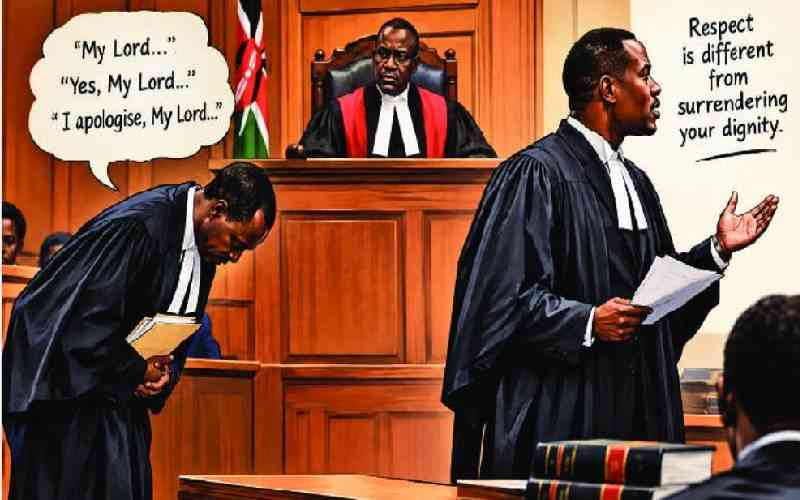
There is a strange animal in the East African legal jungle: the advocate who enters court standing upright, bends at the waist, lowers the voice, swallows the argument, apologises for breathing too loudly and then walks out wondering why he was treated like a pupil sent to the headteacher for leaving his shirt untucked.
When Ugandan lawyers recently declared war on “My Lord”, “My Lady”, “Your Lordship” and courtroom bowing, I scratched my beard and asked: Could it be that Uganda has remembered something Kenya forgot?
The Uganda Law Society announced its members should stop using colonial-era honorifics and bowing before judicial officers, arguing that such rituals create an unnecessary hierarchy between judges and the citizens they serve. The Judiciary pushed back, saying courtroom procedure and decorum cannot simply be dictated by the lobby.
Now, before the Kenyan Bar starts sharpening its objections, let me confess something. I like the Ugandan question. Not because judges do not deserve respect. They do. And certainly not because advocates should abandon courtesy, decorum or professional discipline.
But there is a difference between respecting judicial authority and theatrically surrendering one’s dignity. That distinction seems to have escaped us.
Kenya has an interesting courtroom culture. The advocate is an officer of the court, trained in law, admitted to practice, and entrusted by a client to protect property, liberty and constitutional rights. Yet sometimes, when the Bench clears its throat, the learned friend suddenly behaves like a Form One student caught chewing sugarcane behind the laboratory.
“Sorry, My Lord.” “Yes, My Lord.” “I apologise, My Lord.” “Much obliged, My Lord.” One begins to wonder whether the advocate has forgotten that he too took an oath.
And then comes the real tragedy. A judge finds a defect in a plaint. A paragraph is badly drafted. A document was filed late. Counsel appears without the correct dress. An authority is missing. And suddenly the advocate is spoken to as though he has stolen the school bell.
Of course, judges must control proceedings. They have the jurisdiction. They must enforce procedure. Advocates must comply with legitimate directions. But judicial authority is not a licence for humiliation.
That is where the Ugandan debate becomes uncomfortable for us. Kenya itself has wrestled with judicial dress and forms of address. In 2011, then Chief Justice Willy Mutunga announced changes that discarded wigs and provided that judges, magistrates and Kadhis would be addressed as “Your Honour/Mheshimiwa.”
Kenyan judicial materials emphasise courtroom etiquette and decorum for both Bench and Bar. But decorum must travel in both directions. The judge is not the only person in the room with dignity. The advocate, litigant and witness have dignity too. Even the man who came to court because his cow crossed somebody’s boundary has dignity.
A courtroom is not a palace. It is a constitutional institution. And perhaps this is where Kenya’s “learned friends” need to rediscover their friendship with learning. For what is an advocate? Not a professional bowing machine. Not a human extension of the judge’s robe.
An advocate is an officer of the court whose duty includes assisting the court to arrive at a just determination. The relationship between Bench and Bar should resemble two wheels of the same cart, not a king and a subject. The judge decides; the advocate argues, responds, accepts correction where warranted and, where necessary, respectfully disagrees. That is law.
That is why I sometimes become curious when I see an advocate being roasted before a client over a procedural mistake. Imagine the same advocate leaving court, collecting his files, walking into the corridor and telling his client: “My Lord has disciplined me.” Why has he left his spine at the courtroom door?
There is an even darker question. When lawyers become too frightened of judges, who protects the client? If counsel is afraid to challenge an erroneous direction, contest an application, raise a constitutional objection or insist upon a client’s rights because he fears displeasing the Bench, then the problem is no longer about etiquette. It becomes a question of justice.
The advocate who cannot speak courageously for the client has become decoration. And a wig cannot turn decoration into advocacy.
And let us not misunderstand the point. This is not an invitation for advocates to disrespect judges. Quite the opposite. A strong Bar strengthens the Bench. A confident advocate does not weaken judicial authority. He makes judicial authority meaningful because it is tested by competent argument.
If every advocate simply says “Yes, My Lord” before the argument has even begun, the courtroom has ceased to be a contest of legal reasoning and become a choir rehearsal. Perhaps that is why the Ugandan intervention deserves a second look. Not because everything Uganda does is automatically wise. But because sometimes your neighbour can see the termites in your granary before you do.
There is another matter we should discuss without hiding behind our wigs.
The legal profession has become increasingly commercialised. Clients complain about costs. Lawyers complain about delayed payments. Courts complain about overloaded dockets.
And somewhere in the middle stands the unfortunate litigant, opening his wallet like a man opening a chicken coop during a hawk attack.
There are also persistent public concerns about corruption and improper influence in justice systems across the region. Such concerns should never become blanket accusations; allegations of misconduct require evidence and proper disciplinary or criminal processes.
But the profession must ask itself a painful question: How did an advocate become comfortable being perceived merely as a conduit between a desperate client and a powerful judicial officer? That is beneath the profession. The Bar should be the constitutional watchdog at the courtroom door, not the doorman asking who should be allowed to approach power.
And now Artificial Intelligence is knocking. AI can draft, search, summarise and produce authorities faster than a junior associate can finish making tea. What AI cannot replace easily is professional courage, judgement, ethics, strategic reasoning and the human responsibility of standing beside a client when the law becomes frightening. That is where the future of the advocate lies. Not in bowing lower. In thinking higher.
The profession once carried an almost priestly public respect because lawyers were seen as custodians of reason, liberty and justice. If today’s advocates want that respect back, they must earn it by becoming so intellectually formidable, ethically upright and professionally courageous that the courtroom itself remembers why the profession was called “learned”.
The village elder has a simple saying: if you bend too much before every strong wind, one day you may discover that you have forgotten how to stand. Kenya’s lawyers should not be rude. They should not be rebellious for theatre. But neither should they surrender the independence of advocacy in exchange for ceremonial approval.
The judge is not God and the advocate a servant. Both are servants of justice.




