 The Standard Group Plc is a multi-media organization with investments in media
platforms spanning newspaper print
operations, television, radio broadcasting, digital and online services. The
Standard Group is recognized as a
leading multi-media house in Kenya with a key influence in matters of national and
international interest.
The Standard Group Plc is a multi-media organization with investments in media
platforms spanning newspaper print
operations, television, radio broadcasting, digital and online services. The
Standard Group is recognized as a
leading multi-media house in Kenya with a key influence in matters of national and
international interest.

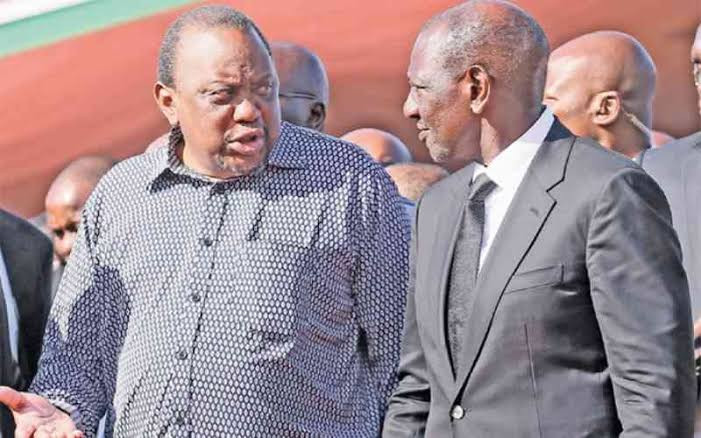
Nearly four years after William Ruto became President, Uhuru Kenyatta remains a recurring character in Kenya’s political conversation. His name continues to surface on the economy, debt, fuel prices, Gen Z, opposition politics and, increasingly, his retirement benefits. At what point does holding a former president accountable for his record become scapegoating?
This is where Scapegoat Theory offers a useful lens. It looks at how political actors can direct public frustration towards a convenient individual when confronting difficult circumstances.
A predecessor can become an easy target. Uhuru himself appeared to recognise this pattern. Speaking in Mwingi in November 2023, he said:
“Every time someone fails, they say, ‘Oh! Previous government.’ Tomorrow when women fail to give birth they will say, ‘you know Uhuru did it’. I don’t know, but I am used to it.” He said it with humour, but the message was serious.
Uhuru’s record belongs to history and can be debated on its merits. Every presidency should be scrutinised. But this is not about rewriting his record, defending every decision made during his tenure or placing him beyond criticism. It is about the continued political invocation of his name long after he left office.
There is also an important fact that cannot be separated from this history. Ruto served as Uhuru’s Deputy President for ten years. That does not make him responsible for every decision made during those years, nor does it erase the constitutional distinction between the two offices. But it does mean Kenya’s political history cannot simply be divided into an Uhuru past and a Ruto present as though there were no connection between the two.
In the early months of the Ruto presidency, then Deputy President Rigathi Gachagua repeatedly spoke of what the new administration had inherited, including the memorable “empty coffers”.
The government also pointed to inherited debt and other challenges when explaining some of its early policy choices. But politics has a clock. Four years into an administration, citizens are entitled to ask when the explanation of inheritance gives way to responsibility for the present.
What is striking is how expansive the accusation has become. Uhuru is no longer merely being blamed for what his government did while he was President. He is now being presented as responsible for what young people are protesting, what opposition politicians are saying and even the political activities of people who are not part of his administration. That is precisely where the politics of blame begins to resemble scapegoating.
President Ruto has also said he reached out to Uhuru, including visiting him at Ichaweri and later at his Nairobi office, asking him to help forge a new national vision. Ruto said Uhuru was reluctant and did not take up the proposal.
But there is something basic about democratic life. When one makes a request, it can be accepted or denied. A request does not become an obligation simply because it came from the President. If Uhuru declined the invitation, that was his choice.
Article 38 of the Constitution gives every citizen political rights, including the right to make political choices, participate in political parties and campaign for a political party or cause. Those rights are subject to the law, but they do not disappear because a citizen once occupied State House.
This brings us to the growing debate over Uhuru’s retirement benefits. In May 2026, Nandi Senator Cherargei brought a motion seeking to withdraw, reduce or reallocate Uhuru’s retirement benefits, citing his political activities. The issue returned to the political arena in August when Kakamega Deputy Governor challenged Sirisia MP to table a motion seeking to withdraw Uhuru’s benefits. Waluke subsequently said Uhuru’s pension should be withdrawn if he continued engaging in politics.
There is a legal framework governing the benefits of former presidents. Article 151(3) of the Constitution provides that retirement benefits, facilities and privileges of a former President and former Deputy President shall not be varied to their disadvantage during their lifetime. The law also provides a process for dealing with specific circumstances concerning those benefits.
Other former presidents offer a useful comparison. Barack Obama has remained publicly engaged after leaving office, including through the Obama Presidential Center. Jimmy Carter remained an influential public voice long after his presidency, while Nigeria’s Olusegun Obasanjo continued to speak openly about politics .
Imagine if Uhuru had established a presidential centre like Obama’s. Would Kenya have seen it simply as an institution preserving presidential history and contributing to civic life, or would it immediately have been described as a political machine? The question says something about how Kenya treats former presidents. A former president may leave State House, but he does not cease to be a citizen.
President Ruto now owns the present. His administration will ultimately be judged by its own record, its own decisions and its own promises. Kenya does not need a permanent political bogeyman. It needs a political culture mature enough to know when historical accountability ends and present responsibility begins.




