 The Standard Group Plc is a multi-media organization with investments in media
platforms spanning newspaper print
operations, television, radio broadcasting, digital and online services. The
Standard Group is recognized as a
leading multi-media house in Kenya with a key influence in matters of national and
international interest.
The Standard Group Plc is a multi-media organization with investments in media
platforms spanning newspaper print
operations, television, radio broadcasting, digital and online services. The
Standard Group is recognized as a
leading multi-media house in Kenya with a key influence in matters of national and
international interest.

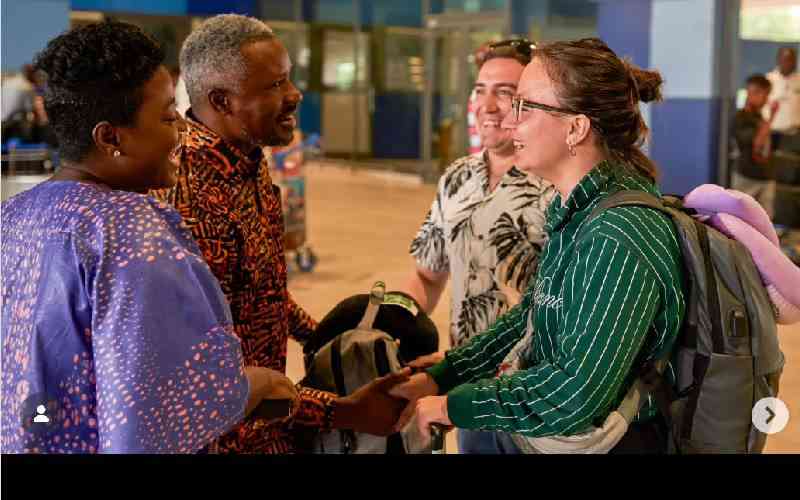
The Russian who would pass for a gentleman armed with halting English, and incidentally, used it across several African countries, duping jobless youths into serving in war factories in Russia, is now linked to child sex abuse.
The surprising revelations about Konstantin Trifonov, the man with a deceptively friendly face, emerge at a time when Kenyan authorities have gone silent, avoiding questions around ongoing fresh recruitments by discreet Russian agents in the country. Emails to the agency mandated to provide a comprehensive institutional framework for employment management in the country, the National Employment Authority, have remained unanswered.
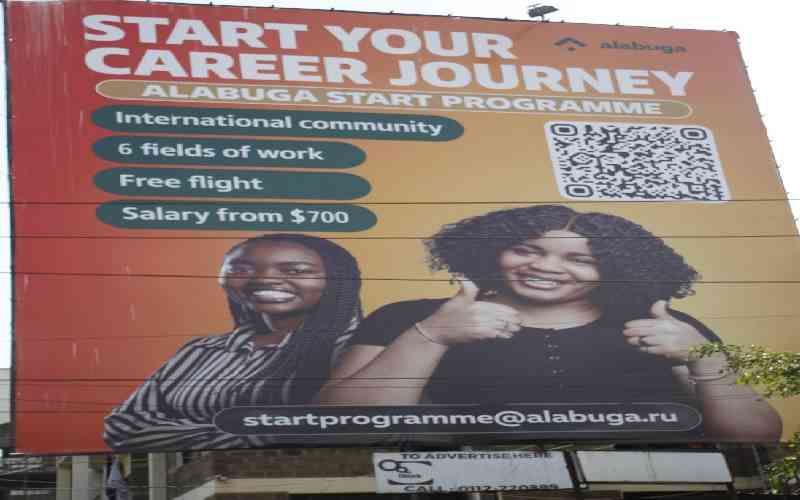
Following intensified investigations by the Directorate of Criminal Investigations, previous in-person recruitments that netted thousands of Kenyans last year, sending them to their deaths on the war front, have moved online as the main suspect, Festus Omwamba, faces a lengthy affair before the courts. Available billboards strategically placed in parts of the city, which The Standard has captured in pictures, only lead interested youths to websites that demand membership to the Telegram social networking platform.
Promising the beginning of a career journey, and below that, the name Alabuga Start program conspicuously presented in bold letters on the Billboards is a lofty claim of training and employment opportunities in Russia for African youths.
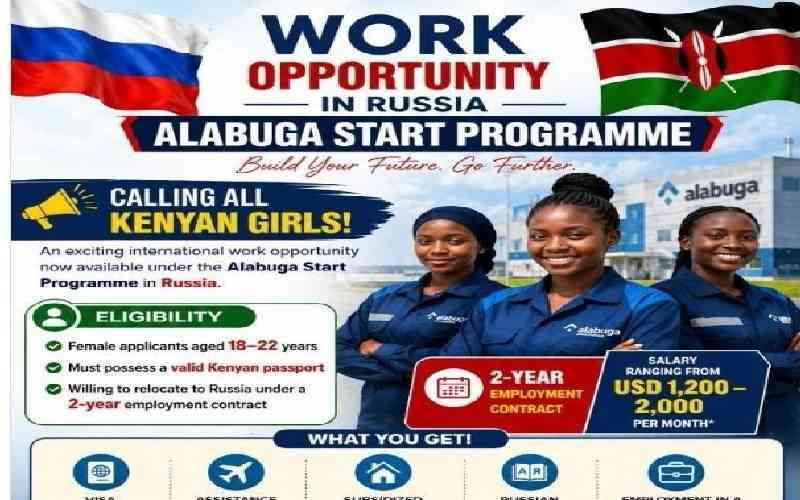
There is an alluring promise of a salary of USD 700 per month. Online, the campaign gets more specific, spotting a detail that reads: Calling all Kenyan girls. The posters have a more mouth-watering promise of a 2-year employment contract and salaries ranging from USD 1200 – 2000. The age is listed as 18-22, while other requirements include holding a Kenyan passport and the willingness to relocate to Russia.
Now it is emerging that the chief recruiter, the man behind this, 31-year-old Trifonov, already slapped with sanctions by the United Kingdom, is a participant in child sex abuse online. The Alabuga Start Program Human resources executive ironically uses the Telegram networking platform to engage in acts that are beyond recruiting jobless youths from African countries.
British popular publication Daily Mail has revealed that a personal Telegram account of Trifonov was found to be a member of multiple channels promoting child sexual abuse. A Telegram analysis tool classified the account as having ‘enthusiastic engagement with child pornography content’. The HR official is a member of sex channels hosted by Telegram with titles that include School 69/ Young girls and kindergarten cookie.

Hit with sanctions stopping him from doing business with any entities associated with the United Kingdom across the world, Trifonov has been Russia’s Special Economic Zone messiah, spreading the gospel of well-paying jobs to Kenyans and other job-seeking youths in Africa online and through physical meetings in his visits to the continent. Photographs and videos that we have accessed show him in Uganda, Ghana, Zimbabwe, Zambia, Tanzania and Madagascar - visiting schools, meeting government officials and promoting “a life-changing program”.
Trifonov met representatives of governments both in Russia and overseas to develop relationships and advance recruitment partnerships. He has met Congolese, Dominican and Kenyan officials in Russia. It is not clear whether a delegation from the National Employment Authority that visited Alabuga in March this year met him
“No formal deals were signed. This was primarily a fact-finding mission.” Said NEA in response to our questions following the March visit, “What the delegation did agree to was continued engagement with Alabuga SEZ on how to explore legitimate job opportunities for Kenyans, not in drone manufacturing as has been alleged, but in fields such as hospitality, manufacturing, education, and vocational training”
The program is a front for drone production, the British Broadcasting Corporation reported in a special investigation released in November 2025. The women who arrive find themselves assembling military drones that Russia has been using against Ukrainian civilians and soldiers.
Trifonov is today limited in accessing Kenya and other African countries after a May 5th announcement by the UK’s Foreign Office.
“Trifonov has been involved in the recruitment of foreign nationals on behalf of Alabuga Start Programme”. Read a statement from the British Secretary of State for Foreign Affairs posted on the official government website, adding, “The Alabuga Start Programme is a Russian recruitment scheme that hires individuals from outside Russia, usually from economically insecure backgrounds, using deceptive practices and puts them to work in Russia's Alabuga Special Economic Zone in the Republic of Tatarstan. These individuals assist in the production of military drones within the Alabuga Special Economic Zone, which are then deployed as attack and reconnaissance vehicles in Ukraine.”
The ban also hit another Russian, Mikhail Lyapin, who was deported from Kenya in September last year following a raid on a house in Athi River that was holding a group of fresh recruits en route to Russia.
The 22 individuals that ended up in court have said in their statements, some of which The Standard has in its possession, that they had been promised well-paying jobs on construction projects, the hospitality industry and shopping malls in Russia’s cities.
Vincent Awiti, a returnee who alerted sleuths of the secretive recruitment, told The Standard that he had alerted a source at the Directorate of Criminal Investigations since men who had sent him and others to Russia were involved.
“Walikuwa wakifikiria ahadi zenye walipewa ni za ukweli (they thought the lofty promises they were given were true,” Awiti said and added, “mimi nilikuwa nimetoroka Russia na nilijua wanaenda kulazimishwa kujoin jeshi halafu waende frontline (I had narrowly escaped death in Russia and I knew that after arriving in Russia they will be forced into the army and end up on the frontline)”
Awiti’s fellow fresh recruits, five in total, who had been taken to the frontline after arriving in Russia in May last year, were all killed in the first three days.
The whistle blow of mid-September last year saved 22 lives and led to the deportation of Lyapin, who had been working in Kenya under the guise of an investor operating an establishment that had employed Kenyans.
He arrived in Kenya in 2016 and launched a mobile loan app in 2017, which he named Afrikaloan, and for eight years the man 'squeezed money from the natives' and had the confidence to tell this story in his racist tone to the Russian press in his native language. In an interview with Forbes Russia, he spoke of "childish employees" in Kenya whose labour is readily available and cheap. He considered them "childish because they needed reminding daily, could not keep time to meetings, were fearful and would not ask even if they didn't understand". He spoke of how he was told by his colleagues that it was in fact possible for any white man to meet the president and offer him a bribe of $400 (Sh51,600).
Unfortunately for him, he was deported by Kenyan authorities before attempting to bribe whatever African president he believed he would.
While slapping him with sanctions in May the UK said; “Lyapin engaged in the deception and recruitment of Kenyan nationals into Russia through his associations with Global Face Human Resources and the Russian Embassy,” the statement read, “but, upon the Kenyan nationals’ arrival in Russia, they were forced to fight on the front line of Russia’s war of aggression against Ukraine under coercion”.
Trifonov, on the other hand, ran recruitment for Alabuga and spread the Kremlin gospel of accessing what is considered cheap labour from poor nations of the Global South.
The Alabuga Start programme operates inside the Alabuga Special Economic Zone (SEZ), an industrial compound in Tatarstan, western Russia. Its website describes it as "designed for ambitious girls between 18-22 years." It promises scholarships, funded training, Russian language courses, paid flights, accommodation, health insurance and a salary of between $500 and $700 per month - a significant sum in the countries it targets. By 2024, more than 1,000 African women had already been recruited into the programme.
In its advertising materials, the programme refers to African women using a derogatory racial slur. Earlier recruitment campaigns in Uganda accepted applicants as young as 13. The minimum age was raised to 18 in 2023.
Recruits who arrive do not receive the work they were promised. A BBC investigation found that women who applied for jobs in hospitality, catering and other sectors were instead assigned to work in a drone manufacturing factory producing military equipment. Others are given menial work - cleaning, canteen duties. A Ugandan woman who joined the programme told Ugandan publication New Vision: "The working hours are longer, and the payment is not the $700 that we were promised."
Former recruits have described gruelling shifts, racism, sexual abuse, isolation and dangerous working conditions inside the compound. Trapped in a closed-off industrial zone in a foreign country, and with insufficient funds to leave, some women who have been fired from Alabuga have reportedly been pushed into prostitution.
The Global Initiative Against Transnational Organised Crime has concluded that Alabuga Start displays multiple indicators consistent with human trafficking, citing deceptive recruitment and exploitative labour practices. The organisation described the operation as appearing to involve what it called "fraudulent exploitation."




