 The Standard Group Plc is a multi-media organization with investments in media
platforms spanning newspaper print
operations, television, radio broadcasting, digital and online services. The
Standard Group is recognized as a
leading multi-media house in Kenya with a key influence in matters of national and
international interest.
The Standard Group Plc is a multi-media organization with investments in media
platforms spanning newspaper print
operations, television, radio broadcasting, digital and online services. The
Standard Group is recognized as a
leading multi-media house in Kenya with a key influence in matters of national and
international interest.

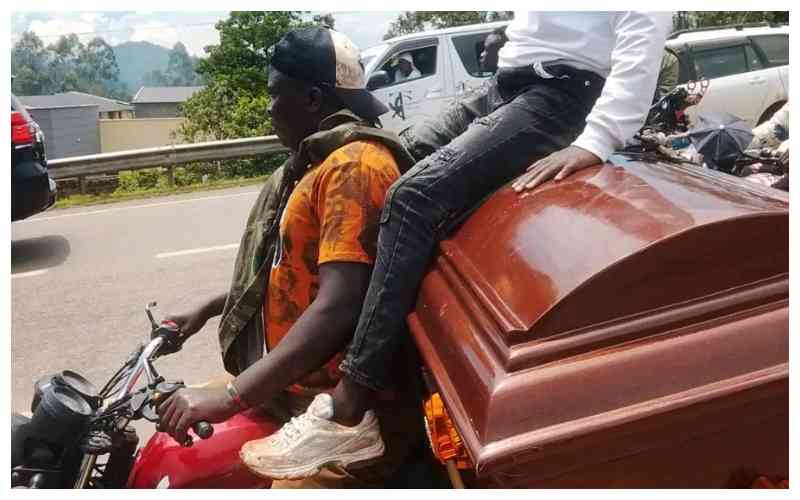
It is Friday morning on the busy Kisumu–Kakamega and Kisumu-Busia highways.
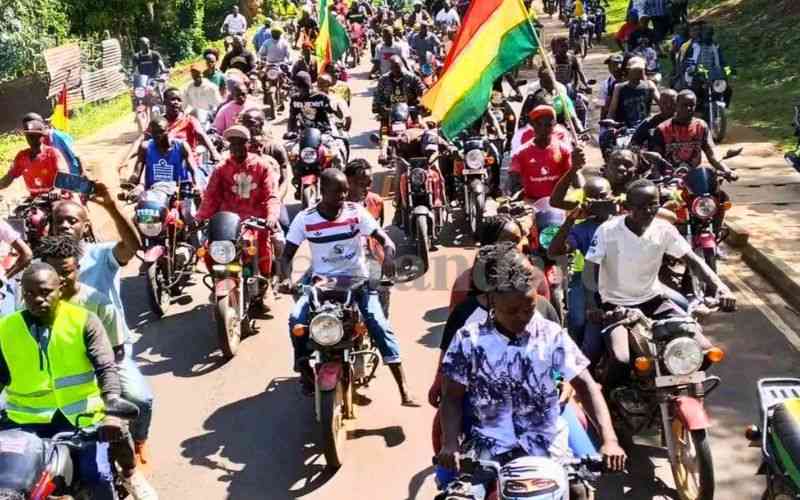
Motorists inch forward in frustration as a seemingly endless convoy of motorcycles snakes along the road.
Vehicles come to a complete standstill. Shopkeepers step outside to watch. Pedestrians move to the roadside as loud reggae music blares from powerful speakers mounted on trucks.
'Reggae na Lami' boda boda funeral processions in Western Kenya spark growing road safety concerns. Video by Brian Kisanji pic.twitter.com/MTPQfQ0Ens
— The Standard Digital (@StandardKenya) June 30, 2026
There has been no road accident, nor is a presidential motorcade passing. Instead, hundreds of boda boda riders are escorting one of their own from the mortuary ahead of his burial, scheduled for Saturday.
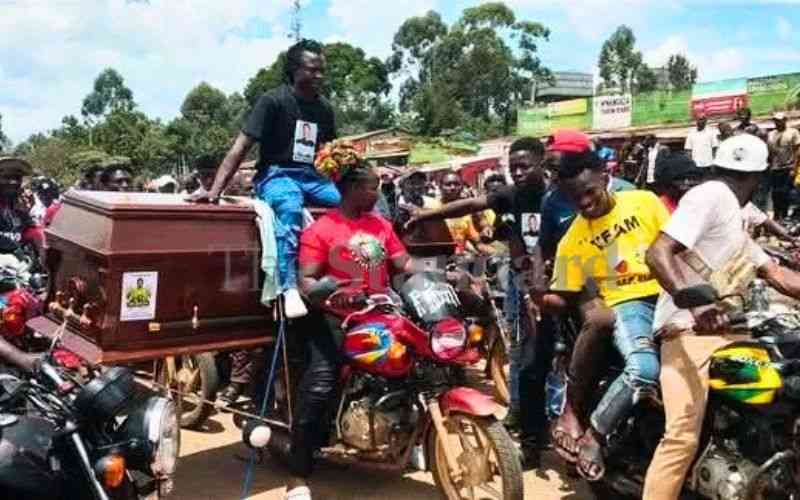
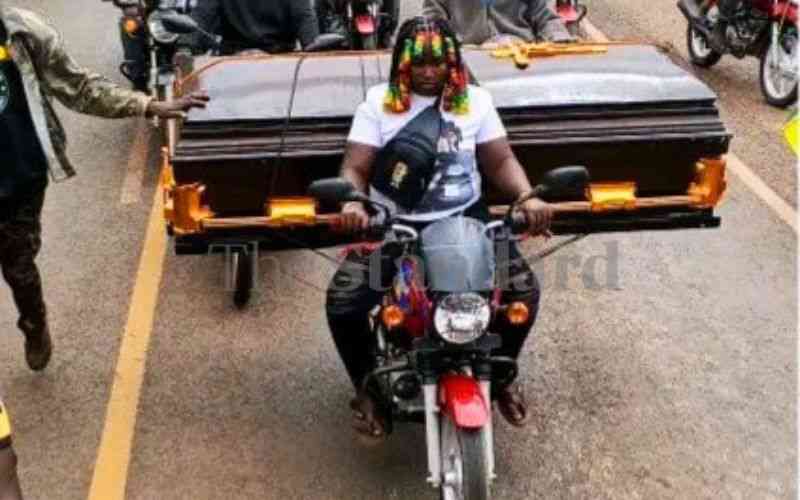
Then comes the moment that has become both symbolic and controversial. A coffin is lifted from the hearse, placed carefully on a motorcycle, and ridden at high speed along the highway as fellow riders cheer, rev their engines, and perform dangerous stunts.
For many residents across Western Kenya, the spectacle has become almost routine every Thursday and Friday.
Yet what some riders proudly describe as "Reggae na Lami," "Reggae Defenders," and "Nduthi Culture" has increasingly become a source of fear, controversy, and concern. Here, the dead do not know peace. They must enjoy loud reggae music, get their body popped around and be transported home in chaos.
The growing practice of using motorcycles to transport the dead has attracted widespread attention in the region following two incidents that sparked debate over safety, cost, and dignity in funeral arrangements.
In April, 24-year-old Kakamega Town-based boda boda rider Consolata Adhiambo, popularly known as Dem Mngori, went viral after photographs showed her transporting a coffin on her motorcycle.
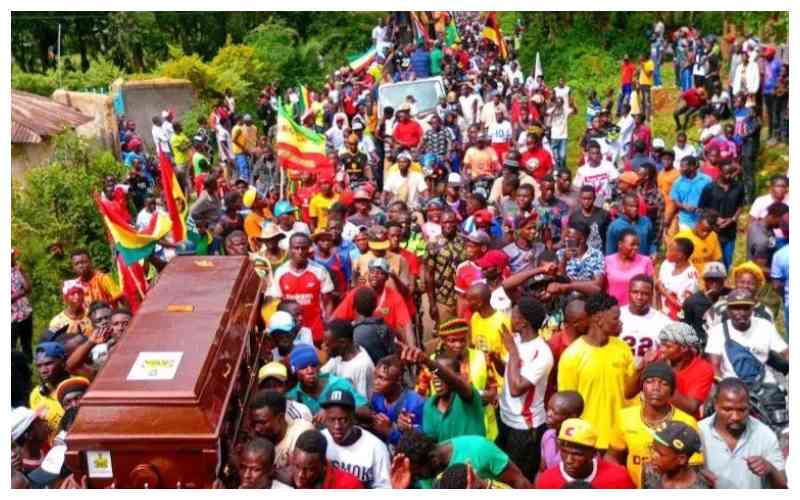
Barely two months later, tragedy struck in Malava when a motorcycle carrying a coffin to a burial collided with a lorry along the Eldoret–Kakamega highway.
The impact threw the coffin onto the road, causing it to burst open and disrupting burial plans as the family was forced to return the body to the mortuary.
The two incidents have fuelled debate over the emerging "last ride" culture, with critics questioning its safety and dignity.
Residents say the motorised funeral processions have repeatedly paralysed traffic in central business districts whenever bodies are collected from mortuaries before Saturday burials.
"What began as an expression of solidarity among boda boda riders has gradually evolved into a movement attracting the attention of police, anti-drug agencies, and road safety officials," laments Abel Sasia, a resident of Luanda Town in Vihiga County.
Across Vihiga, Kakamega, Bungoma, and parts of Busia counties, "Reggae na Lami" groups are emerging every day and registering members.
Residents claim the members exhibit cult-like behaviour whenever one of their colleagues dies.
It is characterised by organised biker clubs, customised motorcycles, convoy rides, branded riding gear, reggae music, Rastafarian-inspired dreadlocks, and elaborate funeral processions that often stretch for kilometres.
Among the most recognisable small groups under the two mother organisations are the Rambo Family, Mavisu ni Sisi, Reggae Defenders, and Usiku Sacco, names now familiar to residents across the region.
Luanda Town now lies at the epicentre of this culture.
Almost daily, reggae music echoes through the streets while many young men proudly wear the red, gold, and green colours associated with Rastafarian culture.
Residents say it is common to see youths openly smoking bhang in public spaces while on their motorcycles.
"At funerals, mourners describe groups casually sharing rolls of bhang as they escort the deceased from the mortuary amid deafening music and motorcycle processions," narrates Sasia.
While many boda boda riders insist the movement promotes unity, charity, and mutual support during sickness and bereavement, security agencies say sections of the culture have drifted dangerously into criminality.
Luanda residents are now increasingly associating some of the groups with intimidation, robberies, violence, and widespread drug abuse.
"They are not just mere boda boda riders honouring one of their own but a rowdy group. Their mouths reek of bhang in broad daylight," says Phoebe
Mutange, who recently lost her nephew after he was involved in an accident while accompanying fellow riders in a mortuary procession.
Every Friday between about 9 a.m. and noon, motorists travelling along the Kisumu–Kakamega and Kisumu–Busia highways expect delays caused by the long motorcycle convoys.
The frequency of the processions has left many residents asking difficult questions.
Just how many young riders are dying to justify weekly funeral convoys?
Police records attribute most of the deaths among members of the Reggae na Lami groups to road accidents—some occurring during the funeral processions themselves—as well as violent attacks and unexplained killings.
Their drama doesn't just end on the road; it extends to homes in villages and on the burial day.
For many bereaved families whose kin was a member, the funerals themselves have become another source of trauma and destruction at their homes.
Instead of quiet mourning, the ceremonies are often dominated by hundreds of motorcycles, loud music, and celebrations that sometimes overshadow grieving relatives.
Recently, at Buyangu village in Luanda, while a procession was underway, one motorcycle was hit by a vehicle, leading to the deaths of two other youths who were close relatives of the deceased. Another procession was in the offing.
One of the most dramatic incidents occurred in Butere in 2025 during the burial of a Rastafarian boda boda rider.
The burial descended into chaos after members of the riding fraternity allegedly chased away the officiating preacher when he attempted to stop what they described as their traditions.
Clergy from Bukura Salvation Army Church reportedly abandoned the burial service at Woluyali Village after disagreeing with the riders over the funeral procession.
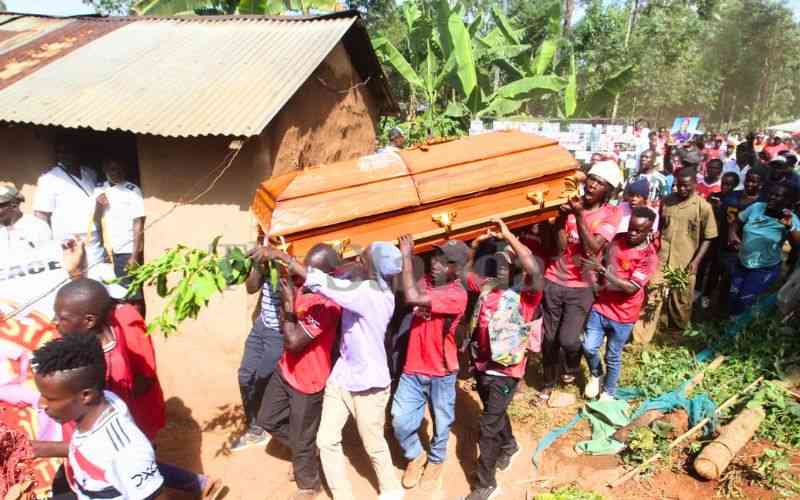
The youths seized the body, carried it to a nearby market where they remained for hours before returning to the burial.
Videos that later went viral showed riders revving motorcycles around the gravesite, making deafening noise, and even riding over the grave—acts they described as part of their culture.
"We have seen these cases here in Western Kenya, and we have normalised them, and it is annoying," says Boniface Obonyo, a resident of Bukura.
Residents also point to the emergence of numerous youth "bases," especially in Luanda, the epicentre, where they allege hard drugs like bhang are consumed openly.
According to locals, the widespread use of bhang has become one of the major drivers of the culture.
"I remember they gave chang'aa and bhang to a dead boy in a casket in the middle of a church sermon. It became so chaotic that the pastor almost gave up. I doubt if intellectuals can do the things that I've seen most of the boda boda riders do," narrates Maureen Minayo, a resident of Luanda.
The growing public concern prompted authorities to act, but sparingly, as they are blamed for being in cahoots with the riders.
Last year, local administrators ordered the disbandment of several groups, accusing them of operating as criminal gangs while masquerading as responsible youth organisations.
Police intelligence reportedly placed members under surveillance. Despite the ban, residents insist the groups remain active.
Authorities have also imposed a 10 p.m. curfew on motorcycle taxi operators following rising cases of motorcycle theft and violent attacks.
Not everyone, however, believes the culture should be condemned. Some residents argue that every profession develops traditions that deserve respect, provided public order is maintained.
"Every group has its own culture and must be respected. I have never seen clergy abandon a body for police officers or soldiers. They do their own things, and that's in order. Why not boda boda?" asks Robert Kuka, a resident of Butere.
Leaders of the Vihiga Bikers group, popularly associated with the positive side of the "Nduthi Culture," also reject attempts to paint all motorcycle clubs with the same brush.
The officials say they are a legally registered organisation that focuses on community service and social support.
"All our members are required to have national identity cards and the logbooks for their motorcycles to ensure accountability in everything they do," says David Ambembo, an official of the group.
According to the officials, members spend most of their time working individually and only come together for charity work and social welfare activities.
However, security agencies insist that criminal elements have infiltrated some motorcycle groups.
In 2025, two youth groups—Reggae Defenders and Usiku Sacco—were outlawed in Vihiga over alleged links to criminal activities and what authorities described as cult-like behaviour.
Police linked the groups to motorcycle thefts, murders, and violent robberies. Security agencies said the gangs had unleashed months of terror, leaving behind a trail of death.
Victims were allegedly shot, hacked to death, or robbed after ritual-like attacks. Survivors described their attackers as young men heavily intoxicated by alcohol and drugs.
Vihiga County Commissioner Peter Maina said the arrests were made to demonstrate the government's commitment to dismantling criminal networks.
Speaking during a multi-agency operation targeting illicit alcohol and drugs in Vihiga and Kakamega, Maina warned boda boda riders against turning funeral processions into lawless gatherings.
"We are warning boda boda operators to desist from the unbecoming culture of escorting bodies while playing loud music and causing unnecessary commotion. Such gatherings create an opportunity for criminals to hide among mourners and commit offences," he said.
He reiterated that night funeral vigils, commonly known as Disco Matanga, remain outlawed.
"Disco Matanga remains banned. Criminals have been taking advantage of such gatherings to terrorise residents, and we shall not allow public events to become breeding grounds for crime."
Maina directed National Government Administrative Officers to profile funerals and other public events and arrest anyone violating the law.
"We have instructed our officers to profile public events, including funerals, and take action against anyone found violating the law."Maina's stance is not the first in Vihiga.
His predecessor, Felix Watakila, was vocal on the issue and even announced the ban on the processions after intelligence reports concluded that the groups posed a security threat.
"They are called Reggae Defenders. What are they defending? This group has criminals disguised as responsible members of society. They smoke bhang, steal, maim, and rape women at night!" Watakila declared during a public baraza at Ebusikhale Mumboha Church of God grounds.
The County Security Committee also demanded the immediate withdrawal of the group's social welfare registration certificate.
"I want their certificate withdrawn with immediate effect, and the security apparatus will continue to monitor their movement," Watakila said.He questioned why Luanda's Social Services office had registered a group using reggae as its identity.
The Reggae Defenders Luanda group's chairman, Solomon Okusi, defended the organisation."Our activities are lawful, for we contribute to our members in times of sickness or bereavement. I will, however, surrender the registration certificate as directed by the security team," Okusi said.
John Olenya, Secretary-General of the Luanda Boda Boda Association, said not all boda boda riders were members of the gang-like groups. To him, it was concerning that eight riders had been killed while 30 motorcycles had been stolen within five months.
The recent case happened on May 29, when a boda boda rider was hacked to death before a gang stole his motorcycle and injured a pillion passenger at Esibuye Market in Emuhaya Sub-County, Vihiga.
It is alleged some stolen motorcycles are repainted in the colours associated with Reggae na Lami, Reggae Defenders, and Nduthi Culture groups.
"On December 11 last year, a boda boda rider was killed after his head was hit with a blunt object to a pulp. We buried him on January 3, and on that night, three other riders were killed in cold blood and their bodies dumped near a police station," Olenya says.
He says the victims' motorcycles and mobile phones were stolen. Among those killed were Kennedy Ochingwa alias "Mcoast," Shem Omoko, and Benson Olubala Maina, one of three riders whose bodies were dumped outside Luanda Town.
On March 6, officers arrested two key suspects in Mumias believed to belong to a gang behind a series of motorcycle robberies in Luanda and other centers like Chavakali.
Western Kenya continues to rank among the regions with high levels of alcohol and substance abuse, one of the drivers of the cult-like culture among boda boda riders.
The National Authority for the Campaign Against Alcohol and Drug Abuse (NACADA) has repeatedly identified the region among those recording the highest prevalence of illicit alcohol and drug use.
Speaking during anti-drug sensitisation campaigns in Vihiga, NACADA Western Regional Coordinator Eunice Arubia warned that criminal groups are increasingly exploiting funeral processions.
According to intelligence received by the agency, some convoys allegedly use coffins and funeral vehicles to transport illicit alcohol and narcotic drugs.
"Authorities have previously linked some funeral processions to disorder, drug abuse, and criminal activities," Arubia said.
She urged communities to reject practices that allow criminals to hide behind cultural events.
Elders in the region have expressed concern over the growing erosion of traditional funeral practices, warning that increasing disorder during burials is robbing the dead of dignity and respect.
"We must respect the dead. Funerals are sacred ceremonies meant to unite families and communities, not platforms for violence, intimidation or public disorder," said Rev Samson Muhindi, the Maragoli Council of Elders coordinator.




