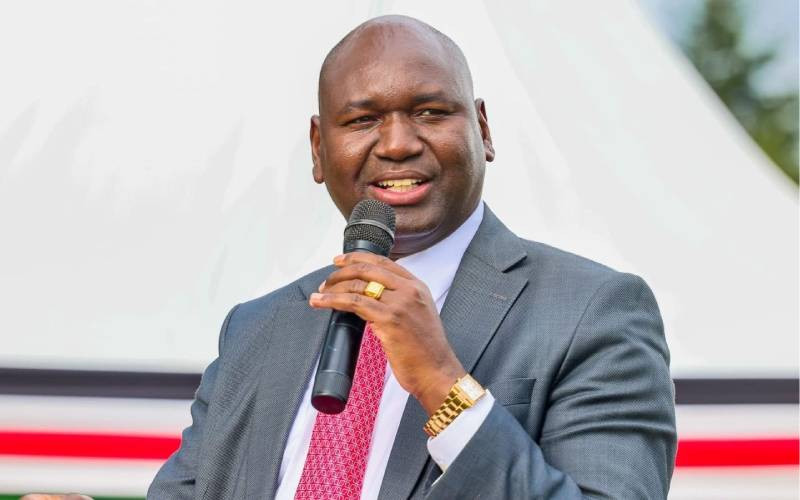
Basic Education Principal Secretary Julius Bitok has sought to allay these fears, insisting that government policy on free primary and free day secondary education remains intact.
This comes as questions around grading, preparedness of schools, infrastructure gaps and equity have dominated public debate, with fears that the new system could disadvantage thousands of learners.
Addresses Senior School placement jitters on TV47’s Events 2025, the PS said that the transition to senior school will be guided by fairness, equity and learner strengths.
“There is no contradiction or disadvantage in the new grading system. The problem is that many of us are trying to interpret Kenya Junior Secondary Education Assessment [KJSEA] using the old KCPE lens, yet this is a totally new curriculum with a totally new method of assessment,” Bitok said.
As Kenya prepares for the first major transition under the Competency-Based Education (CBE) system, anxiety has gripped parents, learners and teachers over the placement of students into senior schools.
Under the CBE system, learners are assessed both qualitatively and quantitatively, using descriptors such as Exceeding Expectation, Meeting Expectation and Approaching Expectation, rather than traditional A–E grades.
According to Bitok, the approach is meant to identify a learner’s competencies, talents and best capabilities, which will then guide placement into appropriate senior school pathways.
“The focus is not exams for ranking. The focus is on competencies whether a learner is strong in STEM, arts and sports, or social sciences. Placement into senior schools will reflect these strengths,” he explained.
However, Bitok acknowledged that the shift has come with challenges, particularly public misunderstanding, pressure on popular schools and uneven infrastructure across the country.
He noted that some parents continue to insist on a few traditionally prestigious schools, creating unnecessary competition and anxiety.
“That obsession with a few ‘big schools’ is what we are trying to eliminate. We want learners to choose pathways, not chase names,” he said.
To ease pressure, the ministry plans to allow learners and parents to revise school choices after initial placement.
Learners will also be given multiple comparable options rather than a single school, giving them flexibility while ensuring balanced enrolment across institutions.
Infrastructure remains another hurdle. With senior schools expected to offer specialized pathways, some institutions lack laboratories, workshops and trained teachers. Bitok said the government is addressing this through massive investment.
“We are building 23,000 classrooms and 1,600 laboratories across the country. This is about making schools more equal, even if it takes time,” he said.
Stay informed. Subscribe to our newsletter
Equity in placement, he added, will be guided by the County Revenue Allocation (CRA) formula, which factors in regional population, poverty index, geography and performance to ensure learners from marginalized areas are not disadvantaged.
Despite the challenges, Bitok expressed confidence in the reforms, describing CBE as transformative.
“Competency-based education is the best system this country could ever have. It is not easy, it requires huge investment and vision, but we are ready to walk the talk,” he said.