Please enable JavaScript to view advertisements.
×
App Icon
The Standard e-Paper
Join Thousands Daily
★★★★ - on Play Store
Download App

Chinese language Mandarin gains popularity among Kenyans as 'golden key' to trade, opportunities

Vocalize Pre-Player Loader

Audio By Vocalize


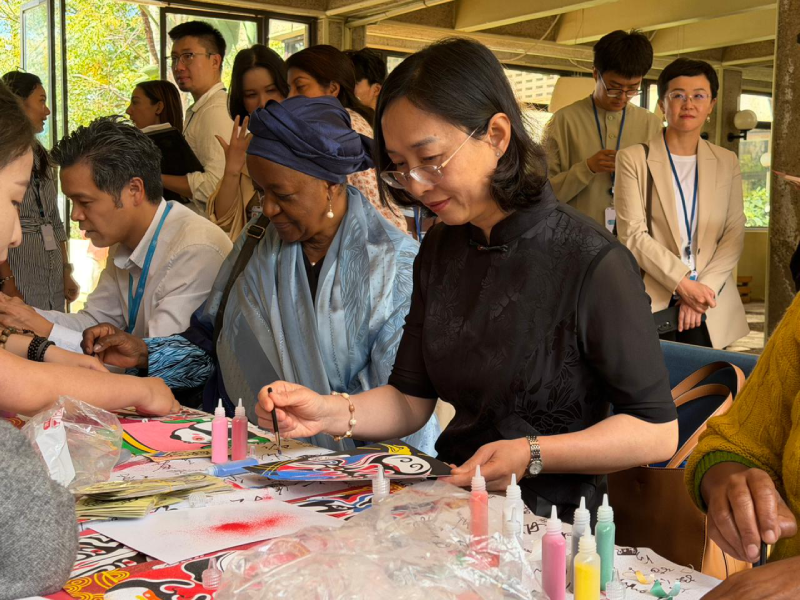
Zainab Hawa Bangura (left), Director-General of the United Nations Office at Nairobi (UNON), and Chinese Ambassador to Kenya Guo Haiyan (right) try their hand at Chinese calligraphy alongside Kenyatta University students during the United Nations Chinese Language Day celebration at UNON in Nairobi, Kenya, April 13, 2026.  [Courtesy]

The United Nations and China celebrated Chinese Language Day in Nairobi on Monday, hailing Mandarin as a "golden key" for Kenyan youth seeking to unlock economic opportunities in the world’s second-largest economy.

 The annual observance at the UN Office at Nairobi (UNON) comes as China’s $18 trillion economy plays an increasingly pivotal role in shaping global trade, climate action, and multilateral governance.

 “I am pleased to see that Chinese is becoming a ‘golden key,’ unlocking opportunities in Africa and in Kenya,” Chinese Ambassador Guo Haiyan told a gallery of diplomats and students.

 Ambassador Guo noted that the language acts as a primary connector to China’s "supersized" market of 1.4 billion people. "The potential of this market will be further unleashed with the expansion of the middle-income population. This will create more opportunities for African countries to move into international trade and global industrial chains," she said.

 Across Kenya, the demand for Mandarin has surged alongside deepening infrastructure ties with Beijing. The number of Kenyan institutions offering Chinese language programs has tripled from roughly 10 in 2023 to over 30 today.

Young Kenyans increasingly view the language  as a strategic tool for securing scholarships and high-value jobs. The Kenyan government has already identified 20 pilot schools to host Chinese language teachers, while the Ministry of Education has signed a memorandum of understanding with China to roll out Mandarin instruction nationwide.

 At the University of Nairobi’s Confucius Institute, enrollment in dual-degree programs has reached 230 students, reflecting a growing appetite for cross-cultural academic exchange.

 Zainab Hawa Bangura, Director-General of UNON, described multilingualism as a vital bridge for global peace.

 “Here in Nairobi, the only UN headquarters in the Global South, we witness daily the value of multilingualism in advancing dialogue,” Bangura said. “Language enables us to engage across cultures as we collectively address global challenges, including climate change, peace, and equity.”

 Chinese was established as a UN official language in 1946. The UN created Chinese Language Day in 2010, choosing April 20 to honor Cangjie, the legendary inventor of Chinese characters.

 Speaking under the theme “Characters Span Millennia, Cultures Shine Together,” Ambassador Guo used the art of calligraphy to illustrate how diversity can coexist without conflict.

 Citing the character hé (harmony), she noted that its strokes balance yielding and firmness, a philosophical lesson for diplomacy.

 “China adheres to the principle of mutual benefit and win-win cooperation to achieve mutual elevation and shared success with other countries rather than monopolize resources,” she added.

 With 2026 designated as the "China-Africa Year of People-to-People Exchanges," Beijing is positioning language as the ultimate connector for the next generation of African leaders, framing the "golden key" of Mandarin as a pillar of high-standard international opening.

Support Independent Journalism

Stand With Bold Journalism.
Stand With The Standard.

Journalism can't be free because the truth demands investment. At The Standard, we invest time, courage and skills to bring you accurate, factual and impactful stories. Subscribe today and stand with us in the pursuit of credible journalism.

Pay via
M - PESA
VISA
Airtel Money
Secure Payment Kenya's most trusted newsroom since 1902