×

The Standard e-Paper
Smart Minds Choose Us
 The Standard Group Plc is a
multi-media organization with investments in media platforms spanning newspaper
print operations, television, radio broadcasting, digital and online services. The
Standard Group is recognized as a leading multi-media house in Kenya with a key
influence in matters of national and international interest.
The Standard Group Plc is a
multi-media organization with investments in media platforms spanning newspaper
print operations, television, radio broadcasting, digital and online services. The
Standard Group is recognized as a leading multi-media house in Kenya with a key
influence in matters of national and international interest.

Audio By Vocalize
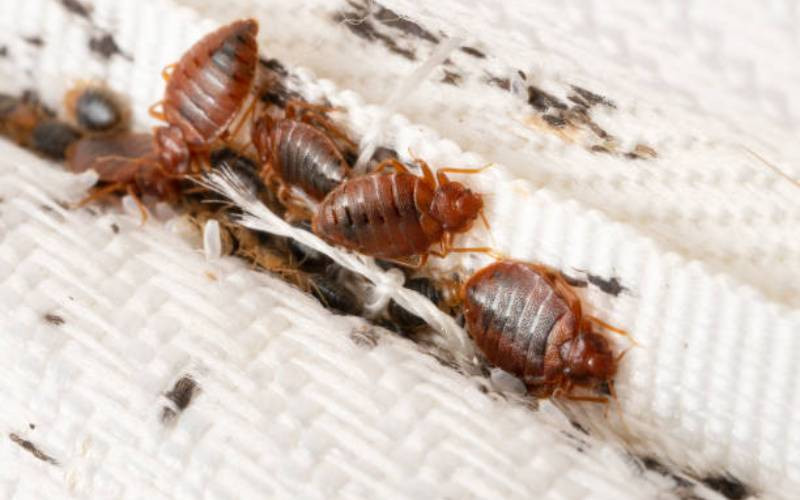
Bedbugs crawling on an infested surface. [iStockphoto]
What was meant to be a night trip for over 50 passengers aboard a Tameed bus from Mombasa to Nairobi turned into chaos and was cut short after bedbugs descended on the passengers.
The bus was forced to find an alternative after the passengers demanded they be returned to Mombasa.
In a viral video clip, numerous bedbugs are seen crawling from the blue deep sponge-upholstered seats as the passengers complain and demand that the bus stop.
Bedbugs have been a menace in Kenyan society, breaking protocol to attack even the affluent in society, raising the question of the hygiene standards of Kenyans.
From public transport to homes, offices, hotels and schools, the pests have caused havoc that most people feel ashamed to speak about or call for public help.
Neighbourhoods across Nairobi and Mombasa and towns, including upstate markets and even five-star hotels, have not been spared either.
The attack on passengers aboard Tahmeed on the night of August 17, 2026, is not an isolated case; several Mombasa-bound buses have been cited for not only carrying passengers but also bedbugs and roaches.
In the Tahmeed incident, the driver was forced to stop the said bus at its warehouse along the Mombasa-Nairobi Highway after the passengers demanded to be returned to Mombasa, forcing the management to secure another bus for the passengers.
James Kioko, one of the passengers, said that he had adjusted his seat to sleep when he had something bite him in the neck and, a minute later, another bite that made him alert.
“Upon flashing my phone light, I was devastated at the number of bedbugs I saw crawling from the cushions. My heart sank and screamed at the same time,” said Kioko.
He said that before he could react, a lady from the back screamed and shouted that the bus was bedbug-infested.
Her shouts alerted the whole bus, and everyone went into panic mode, and torches started flashing everywhere, with each skit confirming they had the company of the bloodsucking pests.
Natalia Wangeci said she could not pay Sh1,500 to be bitten by bugs all the way to Nairobi.
Stay informed. Subscribe to our newsletter
Wangeci said it was a horror on her seat when she looked at what was biting her.
“I cannot recover; those bedbugs were too many. No amount of fumigation can clear them. There was no way we were going to stay in that bus for another minute. I just wanted out,” said Wangeci.
James Athoko is one of the frequent commuters along the Mombasa-Nairobi highway, and he has experienced bugs in most of the buses he has ever used.
Athoko remembers his first encounter with bugs aboard a night trip on a bus from Nairobi, belonging to another prominent bus company plying the route.
He said the bus had bugs and cockroaches.
Athoko said that it was one of the most uncomfortable journeys ever travelled, as he spent the whole night alert, sitting at the edge of the seat.
“Despite complaints from the passengers, the bus crew kept quiet, and the journey continued like it was nothing. Other passengers were unbothered and continued sleeping,” said Athoko.
For Milkah Mwangi, she quit travelling using long-distance buses after she experienced the bedbug scare.
Mwangi resorted to using Standard Gauge Railways (SGR), pointing to them as clean and safe.
However, SGR was not spared either, as a bedbug infestation was reported in the economy class in 2019 and 2024, a fact that the Kenya Railways Corporation responded to and assured its customers that fumigation was regularly done to prevent any pests aboard.
In 2018, Mombasa County health minister Hazel Katana ordered professional fumigation at least three times a month in all matatus after a public outcry over bedbugs being transferred from residential households into commuter vehicles, turning the transport network into a breeding and dispersal web.
In Nairobi, despite the boosting of flashy pimped vehicles, some of the old vehicles plying Jogoo Road, Outer Ring Road, Thika Road, Mombasa Road, and Juja Road have faced the highest number of complaints from passengers over bedbug infestation.
Equally, Kawangware, Kangemi, Eastleigh, Kayole, Ngong, and Rongai have been repeatedly cited as routes with matatus that have high pest prevalence.
And with over half of commuters in cities and towns relying on matatus, passengers unknowingly pick up the insects on their clothes and carry them home or to workplaces, triggering fresh residential infestations.
As a measure to curb infestation, the Nairobi County Assembly Health Committee Chair Maurice Ochieng pushed for a policy where matatu drivers must produce fumigation certificates before entering the Central Business District (CBD).
Commuters in Nairobi and Mombasa have now resorted to boycotting older, poorly maintained matatus and have settled for newer vehicles known for strict hygiene standards, plastic or leather seating, and functional corporate management.
The bug infestation is a menace when it comes to estates across all towns and offices and hotels.
Francisca Muoki, a resident of Ngara Estate, knows well the struggle she underwent at the hands of bedbugs that infested the whole estate where she stayed with her young daughter.
Muoki said that in Nairobi, the moment you allow a person into your seat, be sure to comb for bugs after they leave because chances are that they might have left one or two for you.
“I do not allow guests in my house, including neighbours, after I suffered for months with my daughter being bitten by the bugs. She has marks that remind me of the bugs, and I cringe thinking about having them in the house again,” said Muoki.
Danstan Karanja, a local fumigator, said that being infested with bedbugs has a social stigma, and people are mostly afraid to publicly seek help as they fear being mocked, and some cannot afford thorough fumigation.
“Not many people are willing to pay between Sh2,500 and Sh4,000 to fumigate their bedsitters. It costs between Sh200 per bed or Sh25 per square metre," said Karanja.
Omar Abdalla, a resident of Kisauni, Mombasa County, said the Swahili houses are mostly affected by the bugs, as the people share a common clothesline that easily spreads the bugs.
Abdalla ensures his clothes are soaked in hot water and regularly does thorough cleaning weekly using hot water on his bed and wooden chairs and airing and inspecting the mattresses.
“For me, I have avoided cushioned items like couches since it is hard to deal with the bugs once they enter the seats. I plan to buy a plastic mattress cover to stop any possibility of a bug finding its way into the mattress,” said Abdalla.
For David Okumu, a resident of Kawangware, he lost his girlfriend from the suburbs of Lavington when a bedbug embarrassingly walked on the collar of his white shirt while on a date with the said lady.
“I still believe that bedbug was sent to embarrass me by my nemesis who did not want me to have a relationship with that beautiful lady. I must have picked it up in the matatu on my way to town. I wondered why her eyes became bigger in horror, only to realise she had seen a bedbug crawling on my collar and the white shirt couldn't hide it. That was the last I heard from her, and since then, I cannot stand the sight of a bedbug,” said Okumu.
Subscribe to our newsletter and stay updated on the latest developments and special offers!

 Prefer the Standard on Google








 join
join