×

The Standard e-Paper
Join Thousands Daily
 The Standard Group Plc is a
multi-media organization with investments in media platforms spanning newspaper
print operations, television, radio broadcasting, digital and online services. The
Standard Group is recognized as a leading multi-media house in Kenya with a key
influence in matters of national and international interest.
The Standard Group Plc is a
multi-media organization with investments in media platforms spanning newspaper
print operations, television, radio broadcasting, digital and online services. The
Standard Group is recognized as a leading multi-media house in Kenya with a key
influence in matters of national and international interest.

Audio By Vocalize
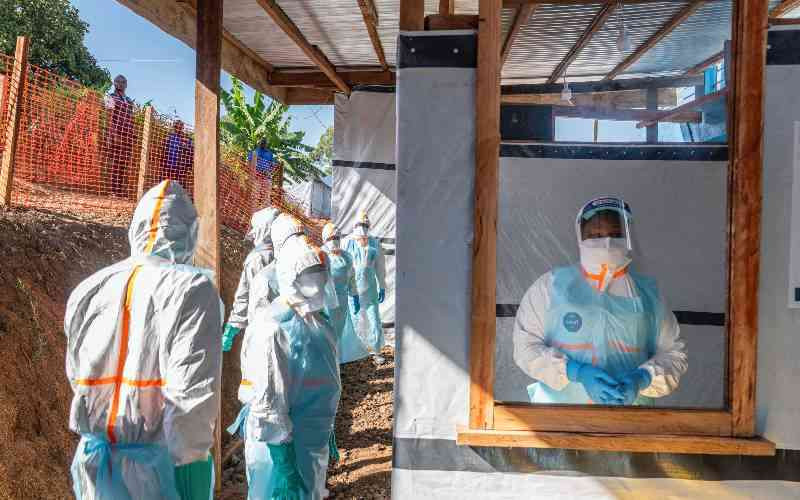
Kenyans were shocked and alarmed to learn that the United States Government had secretly built an Ebola isolation and treatment centre at Nanyuki Air Base, a Kenyan military facility.
They accessed the information through US media reports. The Government of Kenya withheld this information from Kenyans and did not seek their views on the project. Kenyans are therefore justified not only in asking questions but also in questioning the answers provided by their Government on the matter.
The Nanyuki Ebola facility is for the exclusive use of Americans under the management of the US military. It will not be open to non-Americans. Thus, if an American infects a Kenyan with Ebola while in Kenya, the American would be treated while the Kenyan is turned away at the gate.
Neither will any other party be involved in its management, as this would contravene the US military command structure. The facility, like a diplomatic mission, enjoys extraterritorial status. This is an unprecedented development in diplomacy, where such a facility with extraterritorial status exists within a host nation’s military installation.
It is important for the public to understand the motivation behind this unusual arrangement. In cases of global health epidemics, responses and treatment facilities are typically organised on a multilateral basis at or near the epicentre of an outbreak, rather than on a bilateral basis away from ground zero. In the present case, the arrangement is bilateral, between the US and Kenya, with the facility ring-fenced for the treatment of American nationals only.
The motivation appears to lie in the scramble for Congo’s mineral wealth. The US, under President Donald Trump, has led an intense resource offensive in the Democratic Republic of Congo, driven by military contractors, technology companies, and mining and investment firms. The aim is to reduce Chinese control over strategic minerals such as lithium, cobalt and copper, which are critical inputs in the development of defence technologies, weapons systems, electric vehicle batteries, microchips and communication devices.
It is for this group of Americans engaged in mining activities that the Ebola facility in Nanyuki has been established, should they contract the virus.
This unusual arrangement raises several medico-legal questions. Ebola infection does not extinguish citizenship or remove the right to return to one’s country for treatment. US government officials are on record stating that Ebola-infected Americans will not be admitted into the US. Instead, through overt or subtle coercion, they will be encouraged to travel to and be admitted at the Nanyuki facility. This amounts to “medical rendition”, with elements resembling “human trafficking”. Infected Americans would be denied the right to return home and receive care among their families, a practice that could be considered degrading and inhumane.
The US–Kenya Health Framework Agreements of 2015 and 2025 do not require the establishment of any facility such as the one in Nanyuki. The two agreements provide a framework for surveillance and outbreak response, including the collection and transport of pathogens, diagnostics, the establishment and management of laboratory and data systems, and training.
We challenge the Government to state which clauses in these agreements allow or oblige Kenya to agree to the establishment of the Ebola facility in Nanyuki. We also challenge President Ruto to state under what lawful authority, as Commander-in-Chief, he authorised the importation of Ebola into Kenya and into a Kenyan military facility at a time when Kenya is Ebola-free.
The said agreements require both the US and Kenya to respect Kenyan domestic law. Consequently, there ought to have been public participation on the matter. The injunction issued by Kenyan courts halting the construction of the facility is binding on the US Government.
Finally, we challenge the Government to release any public impact assessment conducted regarding the location of the facility in Kenya, particularly in relation to the potential spread of Ebola from the facility and its effects on Kenya, especially the tourism and aviation sectors.
If infected Americans are considered a health risk to the United States, why are they not considered a risk to Kenya, given our limited medical infrastructure? It is not only appropriate for Kenya to close this facility, but for the US to withdraw from it as well. The US and Kenya should instead work within a multilateral system to establish common-user Ebola isolation and treatment facilities.
-Omondi is MP, Suba South
Stay informed. Subscribe to our newsletter






Subscribe to our newsletter and stay updated on the latest developments and special offers!







 join
join