×

The Standard e-Paper
Stay Informed, Even Offline
 The Standard Group Plc is a
multi-media organization with investments in media platforms spanning newspaper
print operations, television, radio broadcasting, digital and online services. The
Standard Group is recognized as a leading multi-media house in Kenya with a key
influence in matters of national and international interest.

Audio By Vocalize
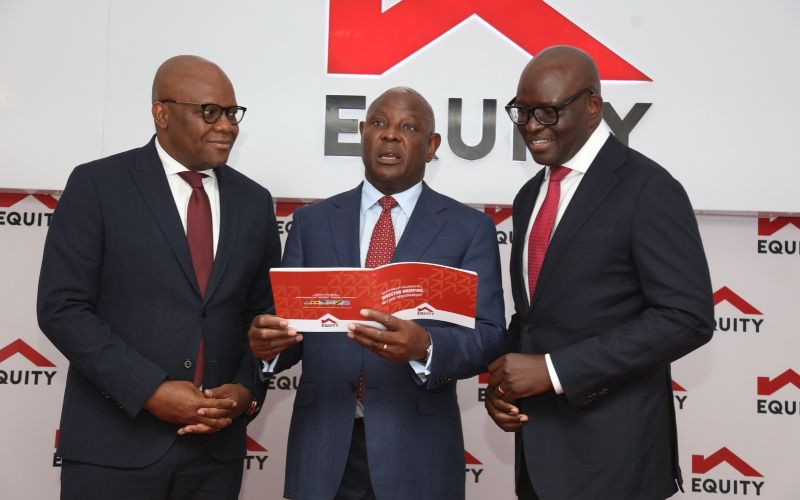
Equity Group Holdings, Kenya's largest lender by customer numbers, posted a 31.95 per cent jump in nine-month net profit to September 30, powered by faster-growing regional subsidiaries and a sharp fall in bad loans.
Net profit for the period climbed to Sh68.7 billion from Sh52.1 billion a year earlier, according to the lender's financial statements released on Tuesday.
Total income grew 23 per cent to Sh192.0 billion from Sh156.2 billion, driven by a 15 per cent rise in net interest income to Sh107.7 billion from Sh93.5 billion and a 34 per cent jump in non-interest income to Sh84.3 billion from Sh62.7 billion.
Net interest income, the core earnings from lending, accounted for 56 per cent of total income, while non-funded income, spanning fees, foreign exchange trading, dividends and other commissions, contributed 44 per cent, up from 40.1 per cent a year earlier.
The shift underscores Equity's success in diversifying its revenue base beyond traditional lending, with growth in digital transactions, trade finance and regional operations lifting fee-based earnings and cushioning the group against interest rate volatility.
The earnings reflect a broader transformation at the Group, which has steadily expanded its footprint beyond Kenya into some of Africa's fastest-growing economies.
"We are building a more balanced and resilient earnings base across geographies, products and business lines," Group Managing Director and CEO James Mwangi said in a statement. "Our regional subsidiaries are increasingly contributing to group profitability."
Equity Bank's operations in the Democratic Republic of Congo, Tanzania, Rwanda and Uganda accounted for 42 per cent of group banking profitability, 50 per cent of banking revenue, 54 per cent of deposits and 55 per cent of loans.
Equity BCDC in the DRC increased profit after tax by 34 per cent to Sh18.5 billion, while Equity Tanzania delivered 60 per cent growth to Sh2.4 billion. Equity Rwanda grew 10 per cent to Sh4.4 billion.
"The regional businesses are no longer just an extension of Kenya; they are becoming a core earnings engine," Mwangi said. "This diversification gives us resilience against country-specific shocks."
Total assets rose 18 per cent to Sh2.15 trillion from Sh1.82 trillion, driven by a 19 per cent increase in customer deposits to Sh1.58 trillion and 17 per cent growth in net loans to Sh1.01 trillion.
The Group's cost-to-income ratio improved to 47.9 per cent from 50.6 per cent while the NPL ratio fell to 9.3 per cent from 12.1 per cent, moving below the double-digit threshold for the first time in several years.
"We have made deliberate progress on asset quality through disciplined underwriting and stronger analytics," Mwangi said. "This is a key pillar of our long-term resilience."
Equity said 98.3 per cent of transactions are now conducted outside branches, with 89.5 per cent processed through digital channels.
Stay informed. Subscribe to our newsletter
The group serves more than 24 million customers through its mobile app, *247#, Equitel and agency network.
The lender has also invested heavily in staff training, with 97 per cent of employees completing generative Artificial Intelligence (AI) courses.
"As we invest in AI-enabled capabilities, we are strengthening our ability to serve customers at scale," Mwangi said. "Technology is at the heart of our 2030 strategy."
Equity Insurance Group reported a 52 per cent increase in gross written premiums to Sh10 billion and a 34 per cent rise in profit before tax to Sh1.96 billion. Life insurance policies issued reached 23.7 million, with 80 per cent distributed digitally.
Non-banking businesses accounted for 4.5 per cent of group revenue, up from 3 per cent, and 3.2 per cent of profit after tax.
With Equity's results out, attention now turns to other tier-one lenders, KCB Group, Absa Kenya, Standard Chartered Kenya and NCBA Group, which are yet to publish their nine-month financial results.
Analysts expect the sector to show resilience, though at varying degrees. Banks have emerged as a bright spot in an otherwise gloomy Kenyan economy, where corporates across manufacturing, retail and services are battling weak consumer demand, high borrowing costs and regulatory headwinds.
"The banking sector is benefiting from higher interest margins and improved asset quality, even as the broader corporate sector struggles," said a Nairobi-based banking analyst who declined to be named. "Equity's results set a high bar for its peers."
KCB, the largest lender by assets, is expected to report later this month. Absa Bank and NCBA have also scheduled announcements before the end of November.
Co-operative Bank of Kenya (Co-op Bank) said earlier it will pay out Sh8.8 billion in interim dividend to its shareholders after net earnings for the nine months to September 2026 rose by 27.2 per cent to hit Sh27.4 billion.
Mwangi remained cautious on the outlook, citing global geopolitical uncertainty and inflationary pressures in some markets. But he expressed confidence in the regional economies where Equity operates.
"Kenya is expected to grow by 4.5 per cent to 5 per cent, and our regional subsidiaries are in some of the world's fastest-growing economies," he said. "We remain well positioned to capture opportunities across multiple growth corridors."
Subscribe to our newsletter and stay updated on the latest developments and special offers!


 Prefer the Standard on Google