×

The Standard e-Paper
Kenya’s Boldest Voice
 The Standard Group Plc is a
multi-media organization with investments in media platforms spanning newspaper
print operations, television, radio broadcasting, digital and online services. The
Standard Group is recognized as a leading multi-media house in Kenya with a key
influence in matters of national and international interest.
The Standard Group Plc is a
multi-media organization with investments in media platforms spanning newspaper
print operations, television, radio broadcasting, digital and online services. The
Standard Group is recognized as a leading multi-media house in Kenya with a key
influence in matters of national and international interest.

Audio By Vocalize
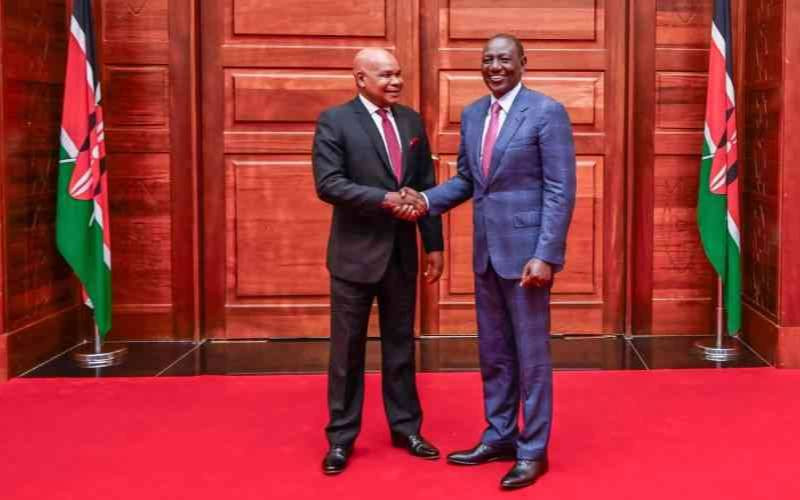
Reactions to President William Ruto's recent broadside against The Standard and Kanu Chairman Gideon Moi betrayed a man tottering on the precipice.
The responses were instructive and expressed the national mood, as close to a referendum on Ruto's leadership as could be. Overall, the responses were not reassuring to the president and those close to the seat of power, among them, Professor Makau Mutua.
Flustered, Mutua vented his spleen on The Standard, calling it 'a parasitic enterprise bereft of journalistic ethics'.
The chutzpah is impressive. What gives Mutua the right to such moral indignation in defense of Ruto? On July 18, 2020, Mutua wrote in one of the dailies that he would never work with Ruto. He did not say this in the privacy of his home. Rather, he committed it to print, for all and sundry to read, with the force of a man who regarded his own moral clarity as beyond negotiation. The answer, he declared with borrowed Russian gravitas, was ‘Nyet. Never. Ever. Case closed’.
Except that it was not closed. By April 2025, Mutua was at State House, smiling beside the man he once described as obnoxious, accepting the appointment as a Senior Adviser on Constitutional Affairs.
He is now Ruto's most vocal public defender; a man who appears on television to sanitise policies that, had another government implemented, he would have eviscerated with the full vocabulary of international human rights law.
When pressed to explain himself, he offered a line that deserves a place in the museum of intellectual dishonesty. His earlier condemnation, he said, was "related to a season". Elections, it would then seem, create seasons in which principles become costumes. When the season ends, one takes the costume off and puts on a government lanyard.
Mutua is not alone in this ignominy. History is replete with academicians, poets and public intellectuals who traded their integrity for proximity to power. Martin Heidegger, arguably the most influential philosopher of the 20th century, joined the Nazi Party in 1933 and delivered speeches celebrating the National Socialist project. Carl Schmitt, the brilliant constitutional theorist, became the Third Reich's legal apologist, providing the jurisprudential scaffolding for Hitler's excesses.
Ezra Pound, the modernist poet who shaped a generation of writers, broadcast fascist propaganda for Mussolini's Italy. Jean-Paul Sartre, the philosopher of radical human freedom, spent years defending Stalinist mass murder. These cases reveal a pattern. First, there is principled public opposition. Then comes the private approach by power. Thereafter, rationalisation delivered in the language of pragmatism or national interest. Then enthusiastic service. Finally, revisionism about the earlier opposition, now explained away as contextual, seasonal or situational.
This pattern betrays the absence of a core. A man with genuine convictions can update his views when presented with new evidence or changed circumstances. What he cannot honestly do is pretend that his previous convictions were never really convictions at all, merely electoral weather. The cost of this is greater than personal embarrassment.
When scholars of Prof Mutua's standing abandon their positions for government salaries, they corrode something essential in the public sphere. The intellectual's value to society rests on his or her independence. He is credible because he stands apart, because he cannot be compromised, because the analysis he provides is not shaped by the salary he receives.
The moment that independence is compromised, the credibility goes with it. Mutua may continue to produce legal opinions and public commentary, but he will never again be able to offer any of it as disinterested scholarship.
Anyone in such a position loses the moral authority to criticise others. On what basis does a man who wrote ‘never, ever’ and then accepted the job lecture others about integrity? What standing does a scholar who called a president obnoxious, then took his appointment, have to comment on anyone else's compromises?
Professor Wole Soyinka was imprisoned rather than accommodated. That is the standard. Anything less is self-interest presenting as conscience. Mutua and the long line of scholars who preceded him in this surrender deserve their place in history. Not a flattering one though.
Stay informed. Subscribe to our newsletter
Subscribe to our newsletter and stay updated on the latest developments and special offers!

 Prefer the Standard on Google






 join
join