×
App Icon
The Standard e-Paper
Home To Bold Columnists
★★★★ - on Play Store
Download App

Two children killed in Sudan drone strike, WFP warehouse targeted

Vocalize Pre-Player Loader

Audio By Vocalize

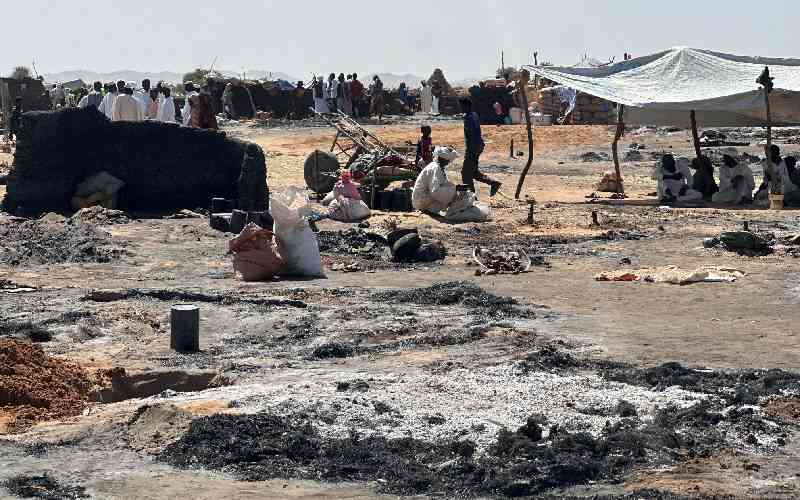
Displaced Sudanese people who left El-Fasher after its fall, sit in the shade in Tawila amid the remains of a fire that broke out in the camp on February 11, 2026. [AFP]

Drone strikes on Sudan's southern Kordofan region on Wednesday killed two children, wounded 12 others and severely damaged a United Nations warehouse full of famine aid, sources told AFP.

The Kordofan region, where deadly drone strikes have intensified, is currently the fiercest battlefield in the  war raging since April 2023 between Sudan's regular army and the paramilitary Rapid Support Forces (RSF).

A drone strike blamed on the RSF, on a school in North Kordofan's El-Rahad, killed two children and injured 12 others, a medical source told AFP.

"I saw a dozen students injured," Ahmed Moussa, an eyewitness to the attack, told AFP, adding that the drone had struck a traditional Koranic school.

A second drone strike hit a World Food Programme warehouse in the famine-hit South Kordofan state capital of Kadugli, causing "damage to the building and losses to the food supplies stored inside", a UN source told AFP.

Speaking on condition of anonymity, they said they could not specify which of the warring sides committed the attack.

In a statement, the RSF's political wing Tasis blamed the strike on the army, which holds the city and last week broke a paramilitary siege surrounding it.

On Friday, a drone strike blamed on the RSF hit a WFP convoy carrying aid to the North Kordofan state capital of El-Obeid, killing one and wounding several others.

Since it began in April 2023, the conflict between the army and the RSF has killed tens of thousands and left around 11 million people displaced, creating the world's largest hunger and displacement crises.

It has also effectively split the country in two, with the army holding the north, centre and east while the RSF and its allies control the west and parts of the south.

Tide turning

The army -- on the back foot since the RSF consolidated its hold on the western region of Darfur in October -- has appeared to tilt the balance in recent weeks, breaking paramilitary sieges on Kadugli and the nearby town Dilling.

The cities had come to exemplify the violence in Kordofan, where hundreds of thousands face starvation under daily drone strikes. Since October, over 115,000 people have been forced to flee their homes in the southern region.

A UN-backed report in November confirmed famine in Kadugli since September. According to the UN, Dilling had suffered similar starvation conditions.

For much of the war, supply routes to Dilling have been cut, both south to Kadugli and north to El-Obeid.

Since pushing the army out of Darfur, the RSF has pushed along the country's key east-west axis, which runs through El-Obeid to the White Nile river, in an attempt to capture Sudan's central corridor back to the capital Khartoum.

Battling for control of the oil- and gold-rich Kordofan region, the RSF and the army have traded drone strikes across vast areas, killing dozens at a time.

In a period of just over two weeks, some 90 civilians were killed and 142 injured in drone strikes, UN rights chief Volker Turk said this week.

He said strikes by both warring parties hit targets including markets, health facilities and residential areas across North and South Kordofan.

In the first week of February alone, three health facilities were attacked in South Kordofan, killing 30 people including at least five children and four health workers, according to the World Health Organization.