×
App Icon
The Standard e-Paper
Kenya's Bold Newspaper
★★★★ - on Play Store
Download Now

ICC sentences Sudan militia chief to 20 years

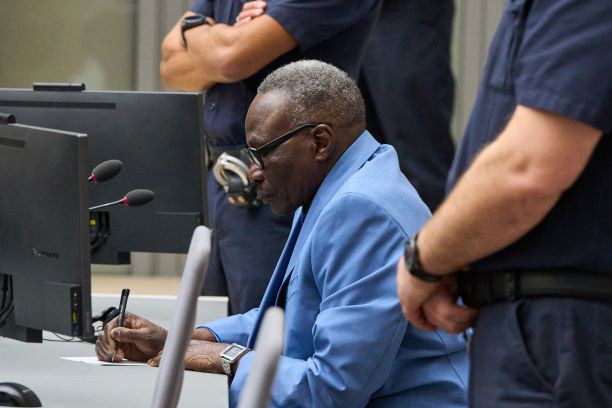
Ali Muhammad Ali Abd al-Rahman, a Sudanese national, waits to hear the verdict of the International Criminal Court (ICC), in The Hague, on December 9, 2025. [PETER DEJONG / ANP / AFP]

The International Criminal Court Tuesday handed down a sentence of 20 years to a Sudanese militia leader for war crimes and crimes against humanity committed during the country's civil war two decades ago.

The court had already convicted Ali Muhammad Ali Abd-Al-Rahman, also known as Ali Kushayb, of 27 counts of crimes against humanity and war crimes, including rape, murder and torture, in the western Darfur region between 2003 and 2004.

The 76-year-old, wearing a blue suit and tie, stood impassively as presiding judge Joanna Korner passed the sentence.

Abd-Al-Rahman was a leading member of Sudan's infamous Janjaweed militia who participated "actively" in multiple war crimes during the civil war, the court found.


Korner said Abd-Al-Rahman "personally perpetrated" beatings, including with an axe, and gave orders for executions.

She cited victims who said he had carried out a "campaign of extermination, humiliation and displacement".

Korner read out in court harrowing testimony from victims of the suffering they had endured under the Janjaweed.

"Days of torture began at sunrise... blood ran freely in the streets... there was no medical help, no treatment, no mercy," said Korner.

She said that Abd-Al-Rahman had personally walked on the heads of injured men, women and children.

Prosecutor Julian Nicholls had called for a life sentence, telling the court: "You literally have an axe murderer before you. This is the stuff of nightmares."

Abd-Al-Rahman had denied being a high-ranking official in the Janjaweed militia, a largely Arab paramilitary force armed by the Sudanese government to kill mainly black African tribes in Darfur two decades ago.

He fled to the Central African Republic in February 2020 when a new Sudanese government announced its intention to cooperate with the ICC's investigation.

He said he then handed himself in because he was "desperate" and feared authorities would kill him -- a claim the court rejected.

Korner said this voluntary surrender was one of several factors that mitigated the sentence, along with his age and good behaviour in detention.

"The chamber would have pronounced a higher sentence had it not been for the mitigating circumstances discussed above," said Korner.

The time he had already spent in detention since June 2020 would be deducted from the sentence.

'Symbolic' conviction

Fighting broke out in Sudan's Darfur region in the 2000s when non-Arab tribes, complaining of systematic discrimination, took up arms against the Arab-dominated government.

Khartoum responded by unleashing the Janjaweed, a force drawn from among the region's nomadic tribes.

The United Nations says 300,000 people were killed and 2.5 million more displaced in the conflict.

ICC prosecutors are hoping to issue fresh arrest warrants related to the current crisis in Sudan.

Tens of thousands have been killed and millions displaced in a war between Sudan's army and the paramilitary Rapid Support Forces (RSF), which traces its origins back to the Janjaweed.

The conflict, marked by claims of atrocities on all sides, has left the northeast African country on the brink of famine, according to aid agencies.

In passing sentence, Korner said the ICC wanted to ensure both "retribution and deterrence".

She added that "deterrence is particularly apposite in this case given the current situation in Sudan".

Victims' representatives had wanted the sentence to be sufficiently long that he would never return to Sudan.

The ICC, which tries individuals for the world's worst crimes, has the possibility to impose a life sentence, but has never done so.

Abd-Al-Rahman's conviction "is also symbolic", ICC deputy prosecutor Mame Mandiaye Niang told AFP in an interview on Friday.

"It is a signal to the victims in Sudan, but also to those committing crimes, that justice may be slow but it will get you in the end," Niang said.