×

The Standard e-Paper
Kenya’s Boldest Voice
 The Standard Group Plc is a
multi-media organization with investments in media platforms spanning newspaper
print operations, television, radio broadcasting, digital and online services. The
Standard Group is recognized as a leading multi-media house in Kenya with a key
influence in matters of national and international interest.
The Standard Group Plc is a
multi-media organization with investments in media platforms spanning newspaper
print operations, television, radio broadcasting, digital and online services. The
Standard Group is recognized as a leading multi-media house in Kenya with a key
influence in matters of national and international interest.

Audio By Vocalize
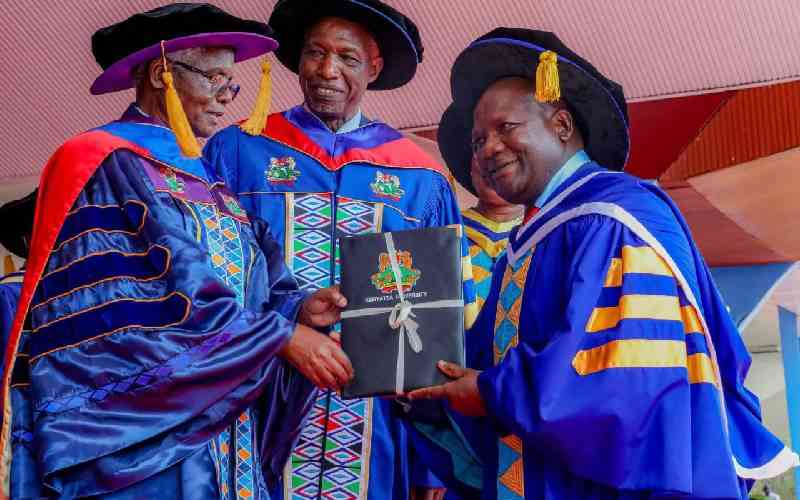
Kakamega Governor Fernandes Barasa has joined the small list of senior political leaders holding a Doctor of Philosophy (PhD), pledging to leverage his academic credentials to serve his people with renewed vigour.
Dr Barasa has become the first sitting governor to pursue and attain a PhD while in office, having enrolled for the programme in 2020 when he was the Chief Executive Officer (CEO) of the Kenya Electricity Transmission Company (KETRACO).
On Friday, the first-term governor was conferred with a doctorate in Public Policy and Management at Kenyatta University during its 58th graduation ceremony.
Speaking to The Standard, Dr Barasa emphasised the importance of education in Kenya’s governance system, noting that it equips leaders with skills to provide solutions and serve citizens more effectively.
“I am a proud alumnus of Kenyatta University, and I am going to serve my people with renewed vigour,” said Barasa.
He described his academic journey as a delicate balancing act between public service and scholarship.
“I am a true reflection of resilience, determination and commitment, and this has been my strength when pursuing my PhD. It demands a lot of sacrifice to ensure you serve your people satisfactorily while also focusing on your studies,” he said.
Dr Barasa, who is Chairperson of the Committee on Finance and Economic Planning at the Council of Governors (CoG), Kakamega ODM Chairperson and Chairperson of the ODM regional chairpersons’ executive committee, described the milestone as a testament to the transformative power of education and continuous learning.
“The PhD I have earned underscores the critical role of sound public policy and effective management in driving sustainable development and improving service delivery to our citizens,” he said.
He added: “I dedicate my PhD to my late parents, my wife, my family and the people of Kakamega, because they have been my pillar and part of my success journey.”
The governor lauded outgoing Kenyatta University Vice-Chancellor Professor Paul Wainaina, describing him as a resilient and visionary leader who has transformed the academic status of the institution.
“You give credit where it is due. Professor Wainaina has transformed and steered this university to greater heights. He has established a strong foundation that will continue to benefit future generations of scholars while strengthening the institution’s role in national and regional development,” said Barasa.
Dr Barasa first attained a Bachelor of Commerce (Accounting option) degree and later a Master’s degree in Business Administration, specialising in Finance, both from Kenyatta University in 2005.
He quit his executive role at KETRACO in 2021 to join politics and contested the Kakamega governorship on an ODM ticket.
Barasa defeated UDA’s Cleophas Malala to become the county’s second governor, succeeding Wycliffe Oparanya.
Stay informed. Subscribe to our newsletter
Over the years, many politicians have faced sharp criticism and legal scrutiny over fake academic papers, with several appearing in court over alleged forgery.
In May, the Ethics and Anti-Corruption Commission (EACC) raised the alarm over forged academic credentials in both the public and private sectors.
The concern was highlighted during the 2025 Ethics and Integrity Conference held at the Sarova Stanley Hotel in Nairobi, where top government and anti-corruption officials warned of far-reaching consequences if the vice is not urgently addressed.
Chief of Staff and Head of Public Service Felix Koskei warned that certificate forgery undermines the core values of integrity, competence and meritocracy in public institutions.
“This vice strikes at the heart of competence and integrity in our institutions,” Koskei said. “We must confront it decisively to safeguard our national objectives.”
According to data from the EACC, since 2022 the commission has investigated 549 cases of forged academic and professional credentials. Of these, 85 files have been forwarded for prosecution, resulting in 13 convictions and seven acquittals.
The EACC is also pursuing recovery of salaries and benefits fraudulently obtained by individuals who secured jobs using fake documents.
A verification exercise across 91 public institutions uncovered 1,208 forged certificates from a sample of 53,000 cases submitted to the Kenya National Resources Region Council.
Koskei further revealed that 787 officers in tertiary institutions were found to have used fake documents to secure appointments, promotions or resignations.
The forgery spans all levels of education, from secondary schools and TVETs to local and international universities.
The 2023–2024 National Values Report painted an equally grim picture: among 358 institutions that conducted certification audits for 168,000 officers, 859 individuals were confirmed to hold fake academic certificates, while 160 had fraudulent professional credentials. Alarmingly, 24,000 officers had not been certified at all.
The scandal has far-reaching implications for governance and institutional credibility, and comes at a time when Kenya’s youth face an estimated 67 per cent unemployment rate.
Subscribe to our newsletter and stay updated on the latest developments and special offers!







 join
join