×

The Standard e-Paper
Informed Minds Prefer The Standard
 The Standard Group Plc is a multi-media organization with investments in media
platforms spanning newspaper print operations, television, radio broadcasting,
digital and online services. The Standard Group is recognized as a leading
multi-media house in Kenya with a key influence in matters of national and
international interest.
The Standard Group Plc is a multi-media organization with investments in media
platforms spanning newspaper print operations, television, radio broadcasting,
digital and online services. The Standard Group is recognized as a leading
multi-media house in Kenya with a key influence in matters of national and
international interest.

Audio By Vocalize
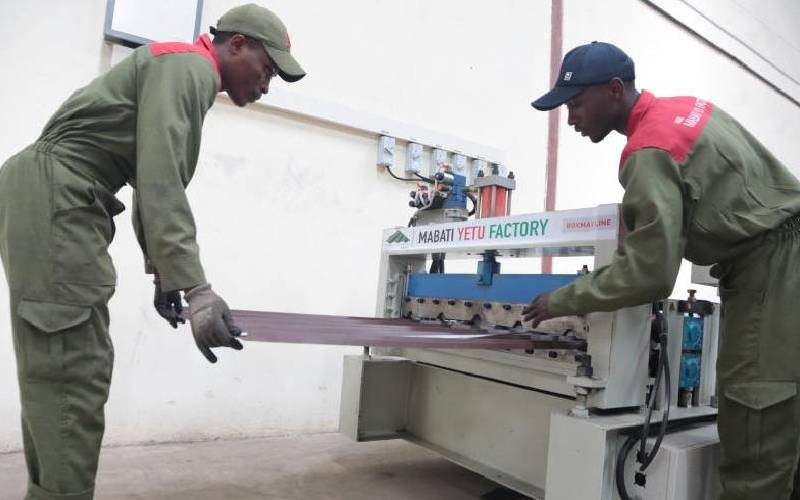
Bian Obagiwa and Edward Gitonga roll-forming iron sheets at Mabati Yetu Factory. [File, Standard]
“The best way to predict the future is to create it.”
That principle speaks directly to Kenya’s development challenge. The infrastructure, industries and jobs we want tomorrow will depend on the engineering knowledge, productive capacity and technical skills we deliberately build today.
Importantly, this is not merely an economic aspiration; it is reflected in Kenya’s legal and policy framework. Article 227(2)(a) of the Constitution expressly permits policies providing for preference in the allocation of public contracts.
The Public Procurement and Asset Disposal Act, 2015 goes further. Section 155(2) and 155(3) provides preferential treatment for goods manufactured, produced or assembled in Kenya and for qualifying Kenyan-owned firms.
More significantly for industrial capacity, Section 155(5) requires that where goods cannot be sourced locally, successful bidders may be required to facilitate technology transfer and employment creation.
The supporting Public Procurement and Asset Disposal Regulations, 2020, Regulation 144, make this practical by requiring technology, skills and knowledge transfer through the training, mentoring and participation of Kenyan citizens, alongside specified employment opportunities for Kenyans.
The same philosophy appears in the National Construction Authority Act. Section 5(2)(a) mandates the promotion and expansion of the construction industry; section 5(2)(c) provides for construction-sector research; section 5(2)(h) promotes improved construction techniques and materials; and section 5(2)(j) provides for coordinated training programmes for skilled construction workers and site supervisors.
Taken together, these provisions point to a broader development principle: every major investment should leave Kenya with more than a completed physical asset.
It should also leave behind stronger local suppliers, more capable engineers and technicians, transferred knowledge, improved production capacity and Kenyan enterprises better prepared to design, manufacture, maintain and eventually export increasingly sophisticated products and services.
Before a country develops factories, transport systems, energy networks or modern farms, it must cultivate the people who can design, operate, maintain and improve them. Machines can be purchased and plants installed, but their long-term value is strengthened when local engineers, technologists and technicians have the skills to operate, maintain and continuously improve these systems. Investing in human capacity is therefore an essential part of creating a productive, resilient and prosperous future.
Kenya’s industrial future therefore begins with engineering capacity. It starts in classrooms and laboratories, but must continue in factories, construction sites, power stations, water-treatment plants and workshops. A degree provides the scientific foundation. Professional capability grows when that knowledge is tested against real materials, budgets, safety requirements and human needs.
The scale of the task is clear. The Commission for University Education recorded 123,928 university graduates in 2024. Only 7,023 (5.7%) came from the combined field of engineering, manufacturing and production. These young people represent important national potential, but graduation should be treated as the beginning of professional formation, not its completion.
A graduate engineer needs structured exposure. They need mentors who explain not only how a calculation is performed, but why one design is safer, more economical or easier to maintain. They need equipment, laboratories, site experience and experienced professionals willing to transfer judgement that cannot be learnt from a textbook.
The Institution of Engineers of Kenya supports this transition by providing graduate members with mentorship opportunities, technical guidance, capacity-building programmes, seminars, conferences, site visits and access to professional engineers.
Stay informed. Subscribe to our newsletter
Through various targeted initiatives, IEK has also participated in mentorship activities involving secondary-school learners, university students and young professionals, helping them understand engineering careers and strengthen practical and leadership skills. IEK’s role is to help build the bridge between academic training, professional registration and meaningful service to society.
That bridge matters because engineering is not a sector apart from the economy. It is the system that enables other sectors to function.
Agriculture requires irrigation, mechanisation, cold storage and food processing. Healthcare depends on medical equipment, reliable electricity, clean water, ventilation and digital systems.
Transport needs roads, bridges, vehicles, railways and maintenance facilities. Financial services rely on data centers, telecommunications and secure power. Manufacturing needs production lines, instrumentation, quality control, automation, maintenance and safety systems.
When engineering capability grows, all these sectors gain room to grow.
Kenya’s manufacturing value added stood at about seven per cent of GDP in 2025. The figure matters because manufacturing reaches far beyond the factory gate. UNIDO reports that each manufacturing job generates more than two additional jobs in other sectors. It also reports that manufacturing accounts for approximately 60 per cent of green patents worldwide, illustrating the sector’s wider contribution to technology and innovation.
A manufacturer producing one item creates demand for packaging. Packaging creates demand for printing. Printing creates demand for paper, ink and machinery. Production also creates work in maintenance, transport, warehousing, accounting, insurance, ICT, testing, design and marketing.
This is how an industrial ecosystem develops. One factory supports suppliers. Suppliers create specialized skills. Those skills attract further investment. As firms learn to repair machines, fabricate parts and improve production processes, knowledge spreads through the economy.
Most importantly, it means recognising that engineering is at the heart of industrialisation.
The objective should therefore not simply be to “buy Kenyan”, it should be to build Kenyan capability.
That distinction is important. A local purchase may support one transaction. Capability building asks what remains after the transaction is complete. Has the project strengthened local suppliers? Has it created new manufacturing capacity? Have Kenyan engineers and technicians acquired new skills? Has meaningful technology transfer taken place? Have local companies gained the ability to participate in future projects? Has the investment created products or expertise that Kenya can eventually export?
These questions should help us evaluate major infrastructure, energy, housing, water, transport and digital projects. Price and completion time remain important, but they should sit alongside local engineering participation, training, supplier development, maintenance capacity, research collaboration and lifecycle value.
Every major project should leave behind more than an asset. It should leave behind people who know more, firms that can do more and institutions that are better prepared for the next assignment.
This does not mean lowering standards in the name of local participation. Kenyan manufacturers and engineering firms must compete on quality, safety, reliability and value. Local capability becomes sustainable when customers choose its products and services because they work well.
Universities, employers, professional institutions and industry each have a role. Universities must strengthen laboratory and project-based learning. Employers should treat internships and industrial attachments as workforce investment rather than an administrative burden.
Industry should open more pathways for graduate engineers to gain practical experience. Professional institutions should expand mentorship and continuous learning. Financing institutions should recognize the long-term value of investing in productive capacity.
Kenya’s greatest industrial asset is not a mineral, factory building or machine. It is the ability of its people to solve problems and improve what already exists.
The deeper measure of progress is whether each investment expands local knowledge, strengthens enterprise and prepares Kenyan professionals to take greater responsibility in future.
Kenya has young people with talent, firms with ambition and growing demand for infrastructure and manufactured goods. The task is to connect these strengths through engineering education, mentorship, practical training and purposeful industrial development.
If we cultivate that knowledge well, the harvest will be more than factories. It will be stronger businesses, better jobs, resilient infrastructure and a generation confident in its ability to build Kenya’s future.
- The writer is the policy, research and partnerships manager at Institution of Engineers of Kenya


Subscribe to our newsletter and stay updated on the latest developments and special offers!











 join
join