×

The Standard e-Paper
Home To Bold Columnists
 The Standard Group Plc is a
multi-media organization with investments in media platforms spanning newspaper
print operations, television, radio broadcasting, digital and online services. The
Standard Group is recognized as a leading multi-media house in Kenya with a key
influence in matters of national and international interest.

Audio By Vocalize
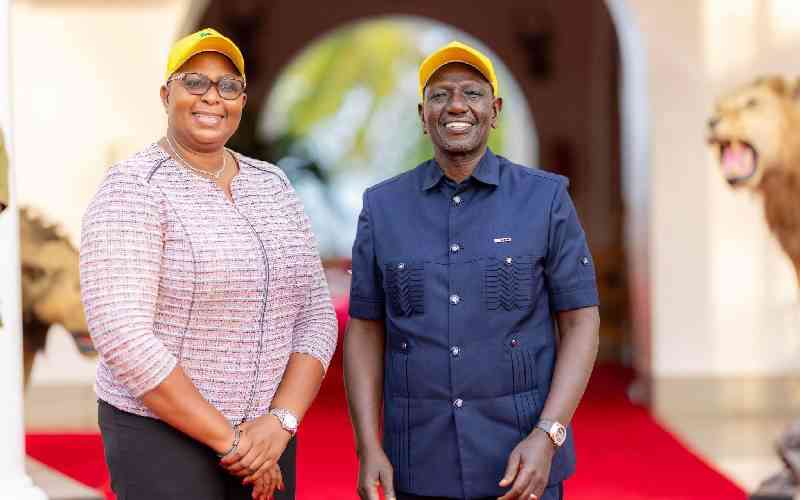
President William Ruto welcomes former Cabinet Secretary Aisha Jumwa back into the United Democratic Alliance at State House, Mombasa. [PSC]
In our current understanding of democracy, every few years, citizens are summoned to participate in an elaborate exercise of choosing who will govern them as part of a constitutional mandate. When it happens, the process is examined for fairness and freeness, which will prove the maturity of the democracy. Once the votes are counted and a government is installed, citizens return to the business of surviving, often under precisely the same conditions that made them desperate for political change in the first place.
We are then told to wait for another election, when we will have another opportunity to make a better choice. By contrast, when the process is postponed perennially by government, this becomes a measure of a total lack of democracy, and a dictatorship is announced. This phenomenon can be witnessed all across the continent. But perhaps it is time to question whether the problem is that we keep making the wrong choices, or whether the democratic system itself as sold to us is fundamentally inadequate.
The understanding of democracy that has been institutionalised across much of Africa is deeply rooted in the colonial political order. Colonial administrations were not established to facilitate the political participation of African populations. They were established to govern, extract resources, maintain authority and protect imperial interests. The colonial state was organised around a small governing class, with political decisions made by administrators who were accountable to imperial authorities rather than the people whose lives they controlled. Where limited representative institutions existed, they were designed to accommodate particular interests and preserve the structures of colonial power, not to facilitate popular sovereignty.
When independence arrived, many African countries inherited the administrative, legal and political machinery of colonial governments. The introduction of multiparty elections and constitutional institutions did not necessarily dismantle the underlying relationship between the governing class and the governed. Instead, political independence frequently involved the replacement of European administrators with African political elites who inherited the authority, institutions and economic arrangements of the colonial state. The population was now permitted to choose its rulers, but the fundamental question of who controlled resources, determined economic priorities and exercised power over ordinary people was not necessarily resolved.
This is not to suggest that elections have no value, or that the right to vote is insignificant. The ability to remove an unpopular government, participate in political competition and exercise political agency is important. However, we have elevated elections into the primary measure of democracy, sometimes treating the mere existence of a voting process as evidence that a country is democratic. This allows governments to claim legitimacy through electoral participation even when the conditions necessary for meaningful political choice are severely compromised.
Modern day Uganda and Rwanda offer particularly interesting examples of this phenomenon. In Uganda, President Yoweri Museveni has governed since 1986, presiding over an electoral system in which opposition politicians have repeatedly complained of intimidation, restrictions on political activity, arrests and the misuse of state institutions. In Rwanda, too, President Paul Kagame has maintained an extraordinary degree of political dominance since the aftermath of the 1994 genocide. Just as is the case in Uganda, his successive electoral victories have taken place within a political environment in which opposition parties and independent political actors face significant restrictions. The fact that elections take place does not necessarily mean that citizens have an equal opportunity to determine who governs them.
Kenya, meanwhile, presents a different kind of democratic predicament. We have established robust electoral mechanisms through the Constitution, the courts, and the passing of laws, yet the political class remains remarkably familiar, with the same individuals moving from party to party and forming and reforming coalitions during every election cycle. The names change occasionally, but the political arrangements remain largely intact. Every election is presented as an opportunity to transform the country, but the political choices offered are often limited to competing factions of the same political establishment. Somehow, in the process, we have come to understand political failure as a consequence of electing the wrong person, rather than questioning why the political system consistently reproduces the same interests.
If we are to allow ourselves to think outside this box of democracy and democratic processes, we might begin to arrive at a situation that is more favourable for the people than for the elite. Cuba offers one such alternative arrangement. Following the 1959 revolution, the country moved away from multiparty electoral competition towards a system organised around popular participation and the institutions of people's power. Its political system includes neighbourhood-level nomination processes, elected municipal assemblies, mechanisms for recalling representatives and extensive structures of community organisation. Elections are not organised around competing parties seeking to take control of government in the conventional liberal democratic sense. Instead, the stated emphasis is on participation in determining the priorities of the state and society, with great success amidst international repression.
Perhaps what Africa needs is a more expansive understanding of democracy; one that does not discard elections, while at the same time demanding more of the process. This would require, at the very least, the prioritisation of grassroots decision-making structures, which formed the basis of our nations before colonisation. This means shifting where political power resides, rather than being forced to participate in the spectacle of electing an elite class who ultimately will prioritise their own interests as they govern us.
Subscribe to our newsletter and stay updated on the latest developments and special offers!


 Prefer the Standard on Google