×

The Standard e-Paper
Smart Minds Choose Us
 The Standard Group Plc is a
multi-media organization with investments in media platforms spanning newspaper
print operations, television, radio broadcasting, digital and online services. The
Standard Group is recognized as a leading multi-media house in Kenya with a key
influence in matters of national and international interest.
The Standard Group Plc is a
multi-media organization with investments in media platforms spanning newspaper
print operations, television, radio broadcasting, digital and online services. The
Standard Group is recognized as a leading multi-media house in Kenya with a key
influence in matters of national and international interest.

Audio By Vocalize
In 1989, political scientist Francis Fukuyama famously argued in ‘The End of History?’, that liberal democracy had emerged as the dominant model of political organisation following the Cold War. Yet history had other plans for the Horn of Africa. Just two years later, Somalia's central government collapsed, sending shockwaves across the region. Kenya would go on to host hundreds of thousands of Somali refugees, while millions of Somalis rebuilt their lives at home and abroad. For families like mine, the promise of a peaceful ‘New World Order’ felt distant. The question is no longer whether the world is changing. It is whether East Africa is prepared for the opportunities and risks that accompany this transformation.
For much of the post-Cold War period, the United States occupied a position of extraordinary global influence. Its military power was unmatched, but American influence rested on something deeper: Alliances, universities, technology, markets, culture and the attraction of the American model itself. Political scientist Joseph Nye called this "soft power": The ability to influence others through attraction rather than coercion. That reservoir of influence matters because durable power is not only about what a country can compel others to do, but also about whether others see value in following its lead. That order is now under strain. The Trump administration has placed greater emphasis on sovereignty, tariffs, burden-sharing, transactional relationships and hard power, while showing less attachment to parts of the liberal international architecture Washington helped build. The significance is not that America has suddenly become weak. It remains a formidable military, technological and economic power. The more important point is that American primacy is no longer the only fact around which other countries must organise their foreign relations.
China has become a major economic and technological power. India is increasingly consequential. Turkey has expanded its diplomatic, commercial and security reach across Africa. The Gulf states, especially the United Arab Emirates, Saudi Arabia and Qatar, are deploying capital and diplomacy far beyond their immediate neighbourhood. Japan and the European Union remain important development and trade partners. None of these actors needs to replace the United States for Africa to gain strategic room. The opportunity arises precisely because there are now more centres of power with which African states can negotiate.
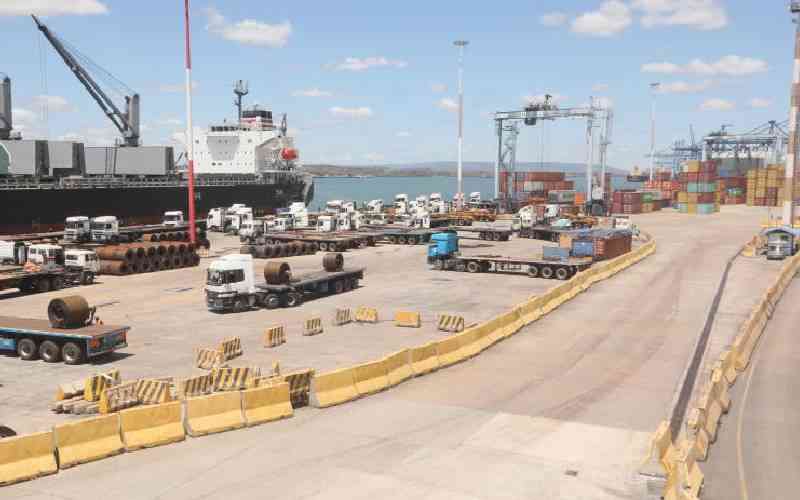
This changing order gives East Africa unusual leverage because the region sits at the intersection of some of the world's most consequential economic and geopolitical corridors. The Red Sea, the Gulf of Aden, the western Indian Ocean and the routes linking the Gulf to the Suez Canal are not distant abstractions. Disruption in one part of this system can affect shipping, insurance, fuel prices, import costs and the competitiveness of ports across the region. What happens in the Gulf can eventually be felt in Nairobi, Mombasa, Lamu and far beyond Kenya's borders.
The 2026 conflict involving Iran, the United States and Israel has offered a vivid demonstration of how quickly maritime geography can become geopolitical power. The conflict has severely disrupted commercial passage through the Strait of Hormuz, with vessel traffic falling dramatically below pre-war levels as attacks, security warnings and uncertainty over safe transit have deterred shipping. The disruption has rattled energy markets, increased shipping and insurance costs and forced Gulf producers and shipping companies to reconsider how reliably oil and other goods can reach global markets. Hormuz is not simply a narrow waterway on a map. In a crisis, the ability to restrict, secure or redirect access to it becomes strategic leverage.
East Africa should pay close attention. The Strait of Hormuz is not the same chokepoint as Bab el-Mandeb, but the lesson travels. The Gulf of Aden, Bab el-Mandeb, the Red Sea and the western Indian Ocean form part of the maritime system on which East African trade depends. Recent disruptions around both Hormuz and the Red Sea show how quickly conflict far from Nairobi can alter freight rates, fuel costs, insurance premiums and supply chains. Indeed, Kenya has already seen vessels and cargo diverted towards Mombasa and Lamu as disruption affected established Gulf shipping hubs.
This is why the region's ports and corridors should be treated as strategic assets, not simply construction projects. Ports such as Mombasa and Lamu should be understood not merely as transport infrastructure, but as instruments of national and regional strategy. The same logic applies to the Northern Corridor, LAPSSET, regional energy networks, airports, fibre-optic cables and cross-border rail and road systems. Their value cannot be measured only by immediate commercial returns. They create strategic options: alternative routes, alternative markets and greater resilience when established global networks come under stress.
Kenya should ask what capabilities are needed for Mombasa and Lamu to become indispensable nodes in global supply chains; how regional infrastructure can connect Ethiopia, Uganda, South Sudan, Tanzania, Somalia and Rwanda more effectively to those gateways; and how transit trade can be converted into manufacturing, logistics, technology, employment and tax revenue. The same principle applies to people. East Africa's young population can become a demographic dividend or a source of frustration depending on whether economies create productive work. Nairobi already occupies an unusual position as a diplomatic centre, financial hub, technology ecosystem and base for international organisations and multinational companies. Kenya's influence should therefore not be measured simply by the size of its economy, but by its ability to connect markets, ideas, institutions and countries.
That strategic value is becoming more important as external powers deepen their engagement with East Africa. China remains deeply involved in the region's port and infrastructure landscape, while Gulf states, Turkey, India and the United States are also expanding their economic, diplomatic, security or maritime partnerships across the region. Kenya itself has continued to deepen maritime-security cooperation with international partners while strengthening its own maritime capabilities. The objective for East Africa should not be to choose one external power over another, but to build the capacity to engage all of them on terms that advance African interests.
The greatest danger, therefore, is not China, America, Turkey or the Gulf. It is entering a period of intensified competition without a coherent East African strategy. If the region negotiates country by country, project by project and election cycle by election cycle, global powers will naturally pursue their own interests. East Africa will have failed not because outsiders were too powerful, but because the region never converted its own assets into collective leverage. For too long, African foreign policy has often been framed as a choice between competing patrons. That is the wrong question. East African states do not need to choose permanently between Washington, Beijing, Ankara, Delhi, Brussels, Tokyo or the Gulf. They need the institutional capacity to engage all of them according to clearly defined regional and national interests. Strategic autonomy should not mean isolation. It should mean the capacity to choose.
Geography has placed East Africa at the crossroads of global commerce for centuries. History has once again placed the region at the centre of a changing international order. Whether this moment becomes another missed opportunity or the beginning of a new era will depend less on the ambitions of Washington, Beijing, Ankara or Abu Dhabi than on the choices made in Nairobi, Mogadishu, Addis Ababa, Dar es Salaam, Kampala and across the region. The last time the world order shifted, my family, and millions of others across the Horn of Africa, lived through its consequences rather than helped shape its outcome. As another geopolitical transition unfolds, my hope is that this time East Africa will meet history with strategy rather than surprise. As the world changes, East Africa must do more than adapt; it must lead. The last major transformation of the international order happened to East Africa. The next one should be shaped by East Africa.
Subscribe to our newsletter and stay updated on the latest developments and special offers!


 Prefer the Standard on Google






 join
join