×

The Standard e-Paper
Smart Minds Choose Us
 The Standard Group Plc is a
multi-media organization with investments in media platforms spanning newspaper
print operations, television, radio broadcasting, digital and online services. The
Standard Group is recognized as a leading multi-media house in Kenya with a key
influence in matters of national and international interest.
The Standard Group Plc is a
multi-media organization with investments in media platforms spanning newspaper
print operations, television, radio broadcasting, digital and online services. The
Standard Group is recognized as a leading multi-media house in Kenya with a key
influence in matters of national and international interest.

Audio By Vocalize
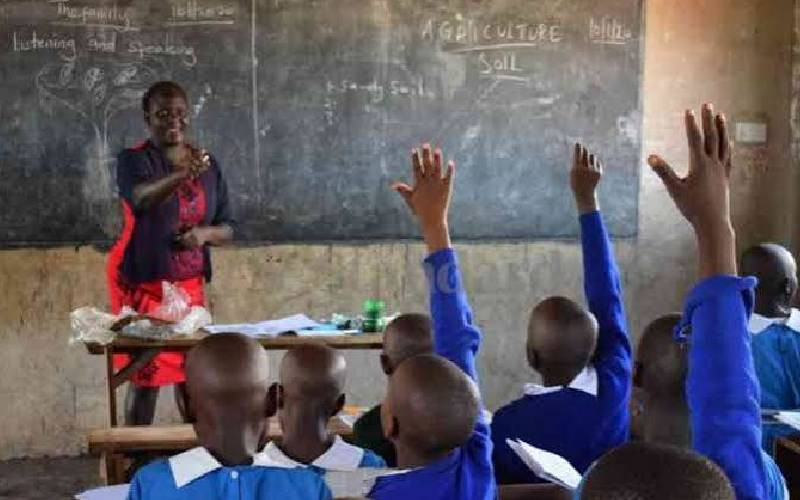
By the time two children walk into a pre-primary school classroom for the first time, life may already have set them on very different paths. One may arrive healthy, well-nourished, confident and curious. They may have spent their first three years being spoken to, played with, comforted and encouraged to explore. They may have grown up in a safe home, received essential healthcare and had a caregiver with the time and support to respond to their needs.
Another child may arrive carrying a very different story. Perhaps they have experienced poor nutrition, repeated illness, inadequate stimulation or an unsafe home environment. Perhaps their caregiver has been struggling to put food on the table, leaving little time or capacity for the nurturing interactions that young children need.
These two children may be the same age. They may sit in the same classroom. They may wear the same uniform and experience the same teacher, but they do not begin from the same starting line. Therein lies one of the most important development challenges facing County Governments today: What they do in the first three years of a child's life to ensure that where a child is born does not determine how far that child can go.
For too long, Early Childhood Development (ECD) has been treated as synonymous with pre-primary education. The first years of life are when the foundations for health, learning, relationships and future productivity are established. ECD is therefore not simply an education priority, but a development priority that has major implications on human capital development.
A child born into poverty cannot choose their circumstances. A child with a disability cannot choose whether services are accessible. A child in a marginalised community cannot determine whether quality healthcare, nutrition, childcare or early learning are available. County governments have a responsibility to ensure these children are not left behind.
Every child needs good health, adequate nutrition, responsive caregiving, opportunities for early learning, safety and security. These five domains of the Nurturing Care Framework are interconnected, and together they provide the conditions children need to survive, grow and reach their full potential. These factors are moderated by different duty bearers at policy level.
Recognising the need to accelerate investment in ECD, the Council of Governors has developed a Model County Early Childhood Development Policy. This policy marks a significant milestone in Kenya's devolved system of governance and represents a shift in perspective; one that views a child as far much more than simply a learner and embraces a holistic approach to children’s development.
The model policy provides counties with a common framework for moving away from fragmented interventions towards a more coordinated approach to ECD. It creates a basis for different sectors to see their contribution to the same outcome: ensuring that every child gets the best possible start in life. Additionally, it gives counties an opportunity to make a deliberate commitment: to plan for ECD, budget for it, coordinate it and, critically, measure whether children are deriving benefits.
Kenya's much-discussed demographic dividend will not materialise simply because we have a young population. Young people become an economic asset when they are healthy, educated, skilled and able to participate meaningfully in society. The demographic dividend is not created when a young person enters the workforce. Its foundations are laid when that young person is still a child.
The child who receives adequate nutrition today is more likely to be ready to learn tomorrow. The child who grows up safe and supported has stronger foundations for healthy development. The child who receives quality early learning is better prepared for the years of education ahead. This is why ECD should not be seen as an insignificant programme competing with roads, markets, water or hospitals for attention. It is an investment that makes all our other investments more valuable. A road connects a child to opportunity. A health facility keeps that child healthy. A water project creates a healthier environment. A school provides learning opportunities. But ECD helps ensure that the child is healthy enough, nourished enough, secure enough and supported enough to benefit from all of them.
That is the promise of the Model County ECD Policy. It is not about how many pre-primary schools have been built but rather, how well our youngest citizens are developing. It gives Counties a framework to put the child, not the institution, programme or sector, at the centre of development. Most importantly, it reminds us that development is not only about what we leave behind in concrete and steel. It is about the people we help build. The greatest legacy of devolution may not be the infrastructure we construct, but the generations we give a fairer chance to thrive.
- Mary Mwiti, EBS - Chief Executive Officer, Council of Governors
Stay informed. Subscribe to our newsletter
Subscribe to our newsletter and stay updated on the latest developments and special offers!


 Prefer the Standard on Google