×

The Standard e-Paper
Home To Bold Columnists
 The Standard Group Plc is a
multi-media organization with investments in media platforms spanning newspaper
print operations, television, radio broadcasting, digital and online services. The
Standard Group is recognized as a leading multi-media house in Kenya with a key
influence in matters of national and international interest.
The Standard Group Plc is a
multi-media organization with investments in media platforms spanning newspaper
print operations, television, radio broadcasting, digital and online services. The
Standard Group is recognized as a leading multi-media house in Kenya with a key
influence in matters of national and international interest.

Audio By Vocalize
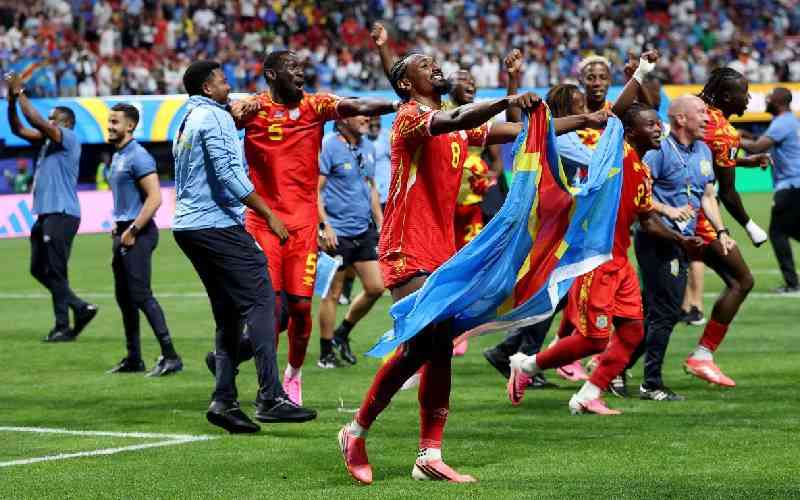
DR Congo celebrates after the 3-1 win against Uzbekistan during the World Cup 2026 Group K match at Atlanta Stadium in Atlanta, Georgia, on June 27, 2026. [AFP]
With a record ten African nations competing in North America, the 2026 World Cup has become the continent's most eloquent argument yet that the gap is closing. For Kenya, co-host of Afcon 2027, the messages from these pitches are urgent and unavoidable.
The roar that rose from BMO Field on Friday evening, as Iliman Ndiaye ran 20 yards and thumped the ball into the Iraq net to complete a stunning 5-0 demolition, carried far beyond the stadium walls.
It echoed across a continent that has waited decades for a moment like this. And if the people running Kenyan football were watching, it should have made them uncomfortable.
Senegal's performance against Iraq was not a routine result. It was the biggest winning margin ever recorded by an African nation at a Fifa World Cup, five goals against ten men in Toronto. But the scoreline was almost secondary. What mattered was what the performance said about where this team, and this continent, have arrived.
For the first time in the history of the sport's grandest stage, ten African teams have competed at a single World Cup. Algeria, Cape Verde, Cote d'Ivoire, DR Congo, Egypt, Ghana, Morocco, Senegal, South Africa and Tunisia arrived in North America not as grateful participants filling up a 48-team bracket. They came as footballing nations with something to prove and, in several cases, the quality to back it up.
Seven African teams are already through to the Round of 32: Morocco, South Africa, Senegal, Ivory Coast, Egypt, Ghana and Cape Verde.
Cape Verde, a nation of half a million people in its first-ever World Cup, drew with Spain and Uruguay, then advanced to face Argentina. Let that sentence sit for a moment.
To understand what Senegal has become, you had to watch the Norway match on June 22 at MetLife Stadium in New Jersey. It was pulsating, physical and deeply instructive.
Sadio Mane, a man who has no obligation to be still playing at this level, was everywhere. He created danger in the opening minutes with a delivery that the Norwegian defence barely cleared, he drew fouls, and he kept defenders honest. And then he set up Ismaila Sarr for an equaliser that stopped the crowd cold.
Sarr curled it into the top corner. Mane raised both arms and turned to face his teammates. At 34, he still moves with the certainty of someone who has not yet finished his business in the game.
Norway eventually won 3-2, with Erling Haaland scoring twice and the Vikings booking their place in the knockouts. Senegal lost. But they had matched one of Europe's most compelling teams for long stretches and shown a collective organisation that their group stage record does not fully capture.
Iliman Ndiaye is 24 and plays like someone who has been waiting his whole life for a stage this large. Against Iraq, he came on as a substitute and, within minutes, scored the fifth with a shot of such controlled ferocity that it left the goalkeeper motionless. Pape Gueye, another substitute, had already scored two of his own, one clocked at 132 kilometres per hour.
These are not players improvising. They are players executing a plan within a system that gives them the freedom to be themselves. That distinction matters enormously.
Morocco entered this tournament ranked eighth in the world. That number used to feel like an anomaly. At this World Cup, it feels accurate. The Atlas Lions are not underdogs. They are contenders, and the group stage has been a steady reminder of why. They lead the African scoring charts, their defensive structure is cohesive, and their attacking transitions are ruthless, as Scotland, Haiti and Brazil discovered at considerable cost.
Stay informed. Subscribe to our newsletter
None of this happened by accident. More than 15 years ago, Morocco made a national decision about football. They built training centres. They developed academies. They pursued diaspora talent with the seriousness of a recruitment operation, persuading gifted young players with French, Spanish and Dutch passports to commit to the Moroccan shirt.
When Ayyoub Bouaddi, one of the most celebrated teenage talents in French football, turned down France to play for Morocco, it was not a surprise. It was the system working.
The results of patient, properly funded, intelligently directed football development look like this: a team that reached the semi-finals in Qatar and has arrived in North America not to repeat the trick but to go further.
No story at this World Cup will be told to grandchildren with more warmth than Cape Verde's. The Blue Sharks are a nation of 500,000 people. This is their first World Cup. And they are through to the knockout round to face Argentina.
There are no reasonable words for what that means in the archipelago right now, where supporters who could not obtain American visas gathered in halls and bars to watch their team take on Spain and Uruguay and refuse to flinch.
Their goalkeeper, Vozinha, has been a revelation in the tournament. Their outfield players press with the urgency of people who understand that this moment may not come again for a generation. And the structure behind the performances is no accident either.
Cape Verde built their squad by intelligently mapping the Lusophone diaspora, identifying players eligible through heritage and converting their potential into a coherent footballing identity. The squad is tight, the system is clear, and the belief is visibly real.
Bafana Bafana are back at the World Cup after 16 years, and they have made the return count. Their victory over South Korea was described by those present as one of the most unexpected results of the opening round.
More significantly, they have now advanced beyond the group stage for the first time in their history. That is not a small milestone. That is a country discovering what its football is capable of when the conditions are right.
Egypt's story is different but equally important. The Pharaohs have five points in Group G and carry themselves with the assurance of a team built for the long haul, not simply assembled around Mohamed Salah and told to hope for the best.
For years, Egypt's international fortunes tracked almost perfectly against the Liverpool forward's form on any given day. Something structural appears to have changed.
The collective is functioning even when Salah is not at his peak, suggesting genuine coaching progress rather than continued reliance on individual genius.
Kenya will co-host Afcon 2027 alongside Tanzania and Uganda. It is the most consequential footballing moment this country has faced since the World Cup came to Nairobi's television screens in 1982 and a generation of young Kenyans fell in love with the sport.
The question is not whether the tournament will happen. It will. The question is whether the Harambee Stars will be ready to do it justice on the pitch.
Morocco's example speaks to the value of investment and patience. World-class football infrastructure produces world-class footballers, and neither arrives quickly.
The FKF and government must commit to academies, proper coaching pipelines and competitive environments not for next year but for the decade ahead. You cannot sprint towards what Morocco built by walking.
Senegal's journey carries a sharper, more immediate message. Individual quality only becomes something when it is organised within a system. Mane, Ndiaye, Sarr and Nicolas Jackson are exceptional footballers. But they are not left to freelance.
The Lions of Teranga are tactically disciplined, collectively coherent, and capable of adapting when circumstances change mid-match.
The Harambee Stars have too often looked like players sharing a pitch rather than a team sharing a purpose. That has to change before the continent arrives at our door.
Cape Verde's example is perhaps the most unsettling for the football federation, because it removes the excuse of resources.
Kenya has a diaspora across Europe and North America. There are footballers with Kenyan heritage and British, German, or Scandinavian passports who have never been seriously pursued.
A properly resourced and genuinely motivated federation could begin changing that within two years. The players exist. The question is whether the people responsible for finding them are equal to the task.
Co-hosting Afcon 2027 is a privilege. The stadiums will be built, the flags will be raised, and the opening ceremony will be spectacular. All of that is already in motion.
But the real measure of what this hosting means for Kenyan football will come when the Harambee Stars walk onto the pitch in front of their own people.
In that moment, everything that has been said about building the sport in this country will either hold up or fall apart.
Iliman Ndiaye ran 20 yards and hit the net. Pape Gueye's shot was clocked at 132 kilometres per hour. Sadio Mane, at 34, was still moving like he had unfinished business. Africa watched and roared. Kenya, if it is paying the right kind of attention, should already be at work.
Subscribe to our newsletter and stay updated on the latest developments and special offers!


 Prefer the Standard on Google






 join
join