×
App Icon
The Standard e-Paper
Smart Minds Choose Us
★★★★ - on Play Store
Download App

Of Isaac Ruto, Judicial Service Commission and party colours

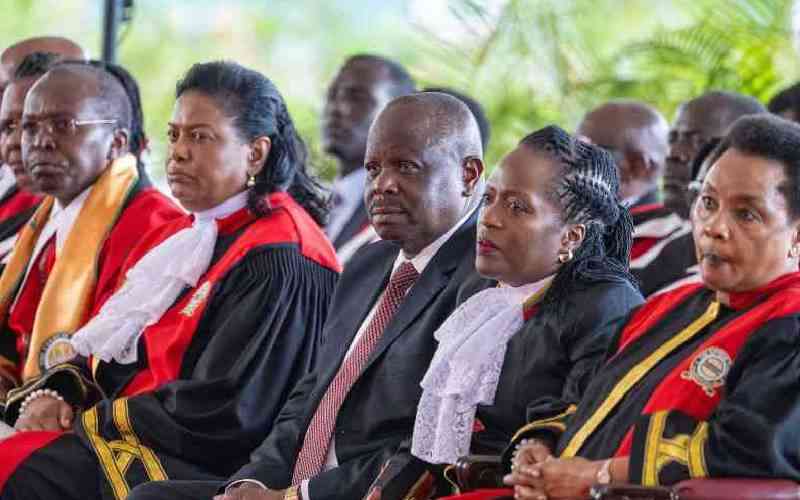
President William Ruto presided over the swearing-in of the 15 newly-appointed judges of the Court of Appeal at State House Nairobi. [PCS]

The Constitution was designed with a deep awareness of history. It emerged from a past in which political power routinely reached into institutions meant to restrain it. For that reason, the Constitution paid particular attention to independent commissions, and especially to the Judicial Service Commission.

Article 249 was crafted to ensure that such bodies would not just be independent in form, but independent in substance and perception. It is against this constitutional architecture that the conduct of Isaac Ruto, Vice Chairperson of the Judicial Service Commission, must be judged.

When the Vice Chair of the JSC attends a ruling party meeting at State House, dressed in party colours, the Constitution bleeds. Any public office holder has a duty to uphold constitutional fidelity. Article 249(1) makes it clear that constitutional commissions exist to protect the sovereignty of the people and never advance partisan interests.

Article 249(2) requires them to be independent and subject only to the Constitution and the law, while Article 249(3) expressly insulates them from direction or control by any person or authority. These provisions collectively impose a duty of visible distance from partisan political power, particularly for those who lead institutions central to the administration of justice.


Much of the defence offered for the Vice Chair’s conduct rests on the argument that he was appointed by the President and therefore retains political loyalty to the appointing authority. That argument is inconsistent with the text and logic of the Constitution itself.

Article 171(2)(h) does not describe these presidential appointees as representatives of the President. It describes them as representatives of the public. This distinction is central in this piece.

As constitutional scholar Yash Pal Ghai has observed times without number, independent commissions were deliberately structured to redirect loyalty away from political actors and toward constitutional principle and public interest. Once appointed, the commissioner’s mandate is reconstituted by the Constitution and shifted from being understood as though sustained by political gratitude.

The requirement that such appointments receive the approval of the National Assembly further reinforces this point. Parliamentary approval is a substantive constitutional safeguard. It presupposes scrutiny, contestation, and ultimately public validation through elected representatives.

Migai Akech has argued before that this approval mechanism converts presidential nomination into a shared constitutional act, thereby weakening any claim of personal or political allegiance after appointment. The President proposes, on the one hand, and the Constitution disposes with an ultimate firm hand. Loyalty after approval is owed to the people directly as opposed to the nominator.

In this case, the constitutional burden was even heavier. Isaac Ruto is not an ordinary member of the JSC in the eyes of the public; he was elected Vice Chairperson by fellow commissioners.

That position carries symbolic and institutional weight. He is a public face of the Commission, a custodian of its moral authority, and a visible guarantor of its impartiality. Comparative constitutional scholarship is almost unanimous that where institutions depend on public trust rather than coercive power, perception becomes as important as legal correctness.

BM Keke has noted that the legitimacy of the JSC is inseparable from public confidence in its political neutrality because its core function is to insulate the judiciary from external influence.

The invocation of the right to freedom of association does not alter the constitutional arrangement I have laid here. Political rights, while fundamental, are not absolute. Article 24 of the Constitution expressly allows for limitation of rights where such limitation is reasonable and justifiable in an open and democratic society.

Few contexts justify restraint more clearly than leadership within an institution that appoints, disciplines, and safeguards judges. Charles Geyh argues that impartiality is not always a subjective state of mind. Oftentimes, it is an objective standard assessed through the eyes of a reasonable observer. It is both a question of fact and of law in a sense.

Justice, as Lord Hewart famously observed, must not only be done but must be seen to be done. This principle extends beyond courtrooms to the institutions that sustain them. When the Vice Chair of the JSC appears in overt partisan settings, at the seat of executive power, the signal transmitted overwhelms any subsequent explanation.

Symbols matter in constitutional governance. They shape perception, and perception shapes legitimacy. Once the public begins to doubt the impartiality of judicial governance structures, the authority of the entire justice system is weakened.

The whole issue turns on constitutional role and institutional responsibility. Article 10 binds all state officers to the values of integrity, accountability, and good governance. Integrity in this context requires restraint, distance, and an acute awareness of how conduct resonates beyond the individual.

The Constitution does not demand political amnesia from members of independent commissions, but it does demand constitutional discipline.

By attending a partisan political meeting at the State House while adorned in party colours, the Vice Chair of the Judicial Service Commission blurred a line that the Constitution deliberately drew. In doing so, he violated the spirit and the letter of Article 249, undermined the mandate conferred by Article 171(2)(h), and compromised the public confidence upon which judicial independence ultimately rests.

Constitutional offices, apart from restraining power, must also, of necessity, restrain proximity to power, especially when in public service. As scholars of constitutionalism remind us, legitimacy dissolves quietly, through symbols ignored and lines crossed, long before courts fall or laws are broken. Vigilance and never convenience sustain justice.