×
App Icon
The Standard e-Paper
Read Offline Anywhere
★★★★ - on Play Store
Download Now

Realpolitik of recognition and and dream of Greater Somalia

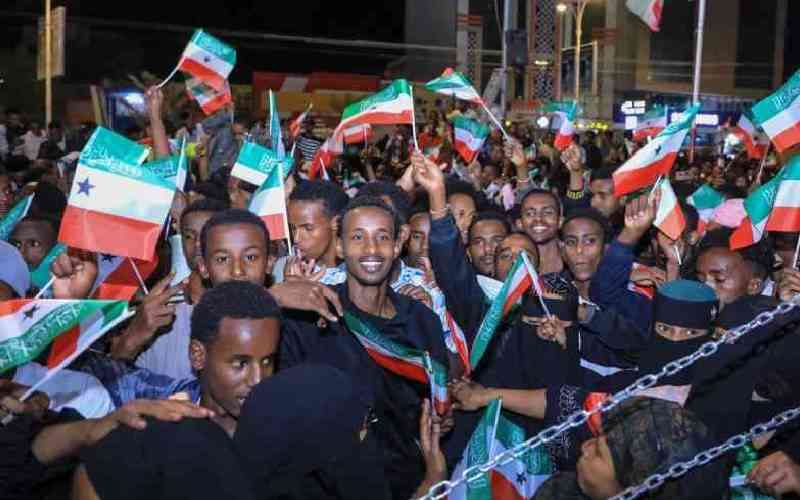
Residents wave Somaliland flags as they gather to celebrate Israel’s announcement recognising Somaliland’s statehood in downtown Hargeisa, on December 26, 2025. [AFP]

Having worked extensively in Somalia and Somaliland, the contrasts between these two regions are strikingly clear. Walking the streets of Hargeisa, capital of Somaliland, gives an impression of stability and order.

People move freely, markets bustle with commerce and public institutions function in a way rarely seen in the Horn of Africa. Since declaring independence from Somalia in 1991, Somaliland has built functioning democratic institutions, maintained security, and fostered economic activity despite being unrecognised internationally.

Yet nearly three decades later, it remains in diplomatic limbo. This is not a failure of governance, but a reflection of the realpolitik shaping the Horn of Africa—shaped by history, colonial legacies, clan dynamics, gender politics, strategic geography, and regional nationalist ambitions.


Somaliland’s history is distinct. The territory was a British protectorate until 1960. On June 26, 1960, British Somaliland gained independence from the United Kingdom as a sovereign state. Five days later, it voluntarily joined the former Italian Somaliland to form the Somali Republic. The historical reason for this union was a shared vision of Somali nationalism.

Leaders in both territories sought to unite all Somali-speaking territories into a single state, hoping to overcome the artificial divisions imposed by colonial powers and realise the dream of a Greater Somalia. It was this nationalist objective that also sparked regional conflicts: in north-eastern Kenya, it fuelled the Shifta War (1963–1967); in Ethiopia, it drove the Ogaden War (1977–78); and in Djibouti, pan-Somali agitation sought union before independence. Thus, Mogadishu interprets Israel’s formal recognition of Somaliland, and fears that the US, a strong ally of Israel, might do the same, as a defiance of the Greater Somali nation dream.

In Somalia, governance has been decisively shaped by clan politics. Somalia’s instability is often traced to competition among its five major clans—Darod, Hawiye, Dir, Isaaq, and Rahanweyn—which were worsened by colonial boundaries, favouritism under Siad Barre, and the collapse of central authority. At the Somalia Peace Conference at Arta, Djibouti in 2000 and at Mbagathi, Nairobi in 2002, the writer observed at both events that discussions were held to formally recognise women as the Sixth Clan of Somalia. This reflected the recognition that men wielded disproportionate political muscle, taking all available seats at the expense of gender representation.

But breathing the air of Hargeisa and then Mogadishu presents an aura in which the differences in stability and governance are starkly evident. Hargeisa demonstrates that effective governance, internal cohesion, and security can create de facto legitimacy even without international recognition. Its relative peace, minimal insurgency, functioning institutions, and respect for constitutionalism and the rule of law allow for predictable trade, investment, and regional partnerships. Mogadishu, by contrast, embodies volatility: persistent insurgencies, fragile governance, and political infighting.

Many observers question the hullabaloo surrounding Israel’s declared recognition of Somaliland when comparisons are drawn with South Sudan. Yet such comparisons underscore how historical, legal, geopolitical, and diplomatic contexts shape pathways to recognition. South Sudan attained independence in 2011 through a negotiated and legally binding process, followed by immediate international recognition and admission to the United Nations.

Somaliland, by contrast, declared independence unilaterally in 1991, grounded in its prior sovereign status and the collapse of governance in Somalia, but without any binding international endorsement. Its quest for recognition therefore remains contingent on strategic interests, regional stability, and cautious diplomacy. Notably, should Somaliland’s independence eventually receive international recognition, it would stand out as a rare case of peaceful secession achieved without the shedding of blood, a distinction uncommon in global experience.

The African Union (AU) remains wary of Somaliland’s independence, even though Somaliland would continue as a bona fide member of the AU and a prospective member of IGAD, the EAC, and COMESA. Recognition would not remove it from continental or regional frameworks; rather, it could enhance regional stability and integration. Even so, the AU finds itself in a catch-22 dilemma. Its charter emphasises both unity and the doctrines of territorial integrity and non-interference (Constitutive Act, Articles 3(h) and 4(o)), making it difficult to support self-determination movements.

Somaliland’s quest for independence is best appreciated against the backdrop of Africa’s protracted conflicts—such as those in Western Sahara, eastern Democratic Republic of Congo, Sudan, South Sudan, the Anglophone regions of Cameroon, and parts of Ethiopia—which persist largely because dissenting groups feel they were compelled to remain in political unions that constrain their agency as a people group.

At the same time, Somaliland’s strategic location makes it critical to global powers. Its access to the Red Sea and the Gulf of Aden positions it as strategically significant, much like Djibouti. Ethiopia has invested in Berbera, viewing Somaliland as a stabilising partner, and by extension, the wider Horn of Africa and Eastern Africa region stands to benefit from one of its more stable and economically promising regions. International actors engage pragmatically: the United States prioritises counter-terrorism cooperation, the European Union focuses on trade and migration management, and China concentrates on port access, all while stopping short of formal recognition.

Recognition is therefore a matter of realpolitik. Somaliland has prioritised internal legitimacy, security cooperation, democratic elections, and economic initiatives such as the development of Berbera port, carving out de facto recognition through performance rather than formal endorsement. Despite obstacles, Somaliland continues to reshape perceptions of governance in the Horn of Africa. It demonstrates that political stability, economic initiative, and security provision can emerge even outside internationally recognised statehood, provided governance is institution-based and accountable, rather than reliant on personality-driven politics—the very model that has hindered progress in many African countries.