×
App Icon
The Standard e-Paper
Home To Bold Columnists

★★★★ - on Play Store
Download Now

US's onslaught on Venezuela targets its large oil resources

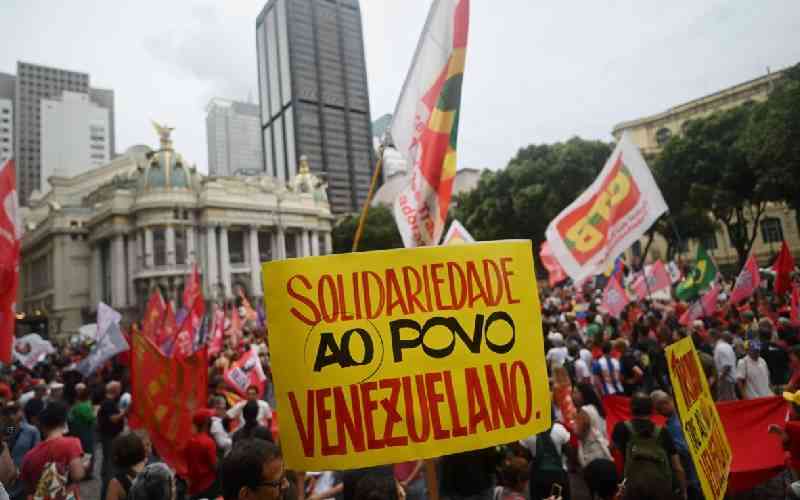
Protesters demonstrate in support of Venezuela's President Nicolas Maduro at the Cinelandia square in Rio de Janeiro, Brazil, on January 5, 2026. [AFP]

Geopolitical news from the past few months, and especially the beginning of this year, point to the fact that the United States has ramped up its efforts to rid the world of any socialist or communist influence in countries it considers an asset to its capitalist agenda.

This ridding of socio/communist ideology can also be read as an attempt to curb the influence of China and Russia, moving beyond propaganda and proxy wars, and carrying out outright attacks and political offensive. As the year closed, the US, through its proxy State Israel, challenged Somalian unification by recognising Somaliland. And President Trump has gone further, invading Venezuela, kidnapping President Maduro and his wife, and transporting them to New York to face trial for narcotics trafficking.

The narcotics narrative has been built by the Trump administration for some time now. The US has in the last year planted its warships in international waters, and has been intercepting Venezuelan ships in a bid to board and seize them, with the approval of such neighbours of Venezuela as Trinidad and Tobago. According to the US, this was being carried out to reduce the movement of drugs in Latin American and Caribbean waters, but in reality, ships transporting oil were the ones being intercepted.


This is because Maduro, like his predecessor Chavez, sought to nationalise Venezuelan oil, in the process reducing America’s access and the possibility of private companies to reap massive profits. Instead, Chavez and Maduro have been painted as ruthless dictators for redirecting profits from national oil to healthcare and education, and America has piled so many sanctions on the nation that people have died of starvation and hundreds of thousands fled their home.

This latest onslaught has therefore been the latest in many attempts by America to regain access to and control of Venezuela’s oil reserves. In the process, dozens of Caribbean citizens have lost their lives, and no drugs have been seized. That drugs travel on the high seas of South America is irrelevant. What we must pay attention to here is the concept of manufacturing consent for invasion. The US utilises this playbook fairly regularly, and particularly in Latin America. It floods the media with propaganda that claims a crisis is ongoing in an area, and then swoops in to save the day.

Kenyans are not spared from this phenomenon, as can be seen with our involvement in Haiti. Prior to invading Haiti, America spread news of wild gangs that were wreaking havoc, going even so far as to paint some gang leaders as cannibals. The world fell for these exaggerated accounts hook, line and sinker, ensuring that Haiti remains in the shackles of imperialism, as Jamaica and Kenya do the dirty work of policing for America’s interests.

Venezuela’s current crisis must therefore be read within this context. Prior to the election of Maduro in 2024, America had taken a more subtle, yet equally egregious approach, by installing its own puppet President by the name of Juan Guaido between 2019 and 2023. While the people in Venezuela, and the socialist peoples of the world, recognised the Presidency of Maduro, America and her allies insisted that Guaido was the legitimate president.

Eventually, this posturing bore no fruit, and it appears that America has chosen the narcotics narrative to take out a legitimate president and install one that will not jeopardise its oil interests in Venezuela.

Where does international law stand in all of this lawless movement by the US? Since 1998, the international community of jurists has been working to define the jurisprudential and criminal parameters of what is known as the crime of aggression, codifying it into the Rome Statute in 2010. The UN Charter, since 1945, has recognised under article 39 that “the Security Council shall determine the existence of any threat to the peace, breach of the peace, or act of aggression and shall make recommendations, or decide what measures shall be taken”.

That it is left to the Security Council, of which the US is a member, to determine whether a situation constitutes a crime of aggression is the first hurdle in itself. So often, the United Nations is held back from action because the Security Council members are quick to veto any proposed steps to sanction the core members or their allies.

Ms Njahira is an international lawyer