×
App Icon
The Standard e-Paper
Read Offline Anywhere
★★★★ - on Play Store
Download Now

Peace and gender equality begin when stories change

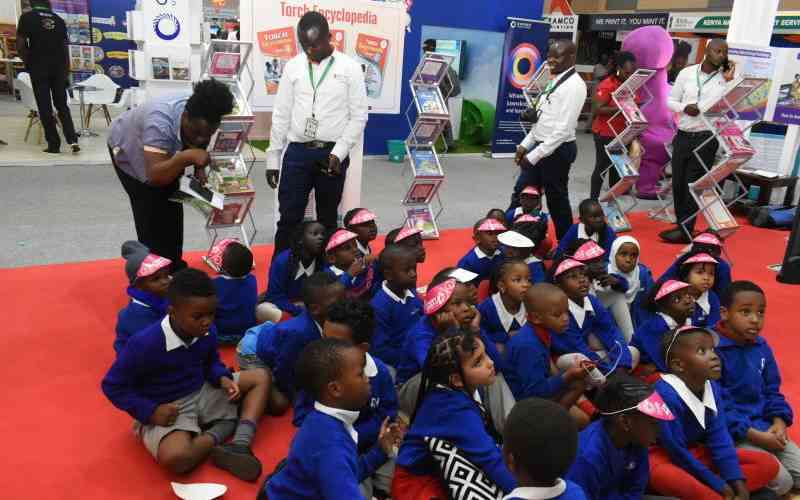
Makini Junior School learning in a cartoon class at Sarit Centre  Nairobi during the 24th Nairobi International Book fair on Thursday, September, 28, 2023. The event was graced by Education and Defense CS Aden Duale among others.[FILE,Standard]

I have been facilitating a workshop on Women, Peace and Security (WPS) and male engagement in the Igad region, in Machakos County. It has been a fulfilling and intellectually engaging experience. The workshop brought together actors from across Igad member states with a shared purpose: developing an action plan for meaningful and sustained male engagement in Gender Equality and Women’s Empowerment (Gewe).

Workshops of this nature often plunge immediately into activism. Participants expect frameworks, commitments and timelines. I chose to begin differently. I invited participants to confront the more uncomfortable task of understanding the roots of Western thought on women, and to begin the difficult process of unlearning inherited gender scripts.

I guided participants through classical Greek philosophy, often celebrated as the birthplace of reason and democracy. Unfortunately, it is also the birthplace of systematic gender hierarchy. Aristotle, whose authority shaped Western thought for nearly two millennia, argued that nature itself was hierarchical. Men represented reason, form and completeness; women represented emotion, matter and deficiency. He described women as “mutilated males”, biologically and intellectually incomplete.

Plato, who is often cited as more progressive, allowed women to become guardians of the state, provided they received the same education as men. Yet even here, women were described as weaker versions of men. In other writings, Plato suggested that women were reincarnated men who had lived inferior or cowardly lives.


Let us be honest: ideas do not remain in books. They organise societies. As Greek thought influenced Roman civilisation, women’s inferiority was translated into law and public policy. Roman thinkers such as Cicero viewed women as emotionally unstable and intellectually unreliable, and therefore unfit for public responsibility.

Philosophy rationalised inequality, and religion sanctified it. Interpretive traditions within the Hebrew Bible placed blame for humanity’s fall on Eve, casting women as morally weak and dangerously persuasive. The claim that woman was created from a man’s rib has long been interpreted as symbolic of derivation and dependence. This reading is philosophically troubling, even as I speak as a Christian. Modern science complicates this symbolism. A rib is among the least consequential bones in the human body: one can live fully without it, and it has no generative function.

St Thomas Aquinas, who drew heavily from Aristotle, gave patriarchy theological coherence. He described woman as “defective and misbegotten”. Gender hierarchy was no longer merely natural; it was divinely ordered. Confucian traditions similarly framed submission not as oppression, but as virtue.

Even modern democratic thinkers were not exempt. Jean-Jacques Rousseau insisted that women existed to please men and should be educated only for domestic service. Immanuel Kant viewed women as governed by emotion rather than reason.

When philosophy and religion began to lose authority, science stepped in. Sigmund Freud’s psychoanalytic theories framed female identity as “lack”. Freud biologised inequality and pathologised female ambition.

What emerges from this long intellectual history is not a series of isolated prejudices, but a coherent system. Philosophy, religion, culture, and science worked together to construct a worldview in which male dominance appeared natural, moral, rational, and inevitable.

This is why male inclusion in Gewe work is not optional. Men did not simply inherit power. No. They inherited ideas that told them that power was natural.

This is precisely where literature, community theatre, and film become indispensable to the WPS agenda. Althusser reminds us that ideology works best when it is invisible. Literature and the arts make it visible. They expose how proverbs, jokes, school texts, sermons, and popular narratives reproduce unequal gender relations. Where policy regulates behaviour, art reshapes belief.

I argued that institutions alone are not enough. Laws can restrain conduct, and policies can redesign systems, but culture shapes attitudes. Literature reveals what power hides. Theatre stages what society prefers to whisper. Film allows communities to see themselves, their violence, their silences, and their possibilities, reflected back to them.

Without storytellers, peace cannot endure, because peace is first a story people must believe. Novels, poetry, community theatre, film, and especially children’s literature are crucial for early transformation.

We need stories that redefine positive masculinity and community-based films that speak in familiar idioms. Development agendas must therefore promote good literature and the arts as seriously as they promote policy reform. Peace does not begin with agreements. It begins with imagination. And imagination is shaped by story. Period.