×

The Standard e-Paper
Fearless, Trusted News
 The Standard Group Plc is a
multi-media organization with investments in media platforms spanning newspaper
print operations, television, radio broadcasting, digital and online services. The
Standard Group is recognized as a leading multi-media house in Kenya with a key
influence in matters of national and international interest.

Audio By Vocalize
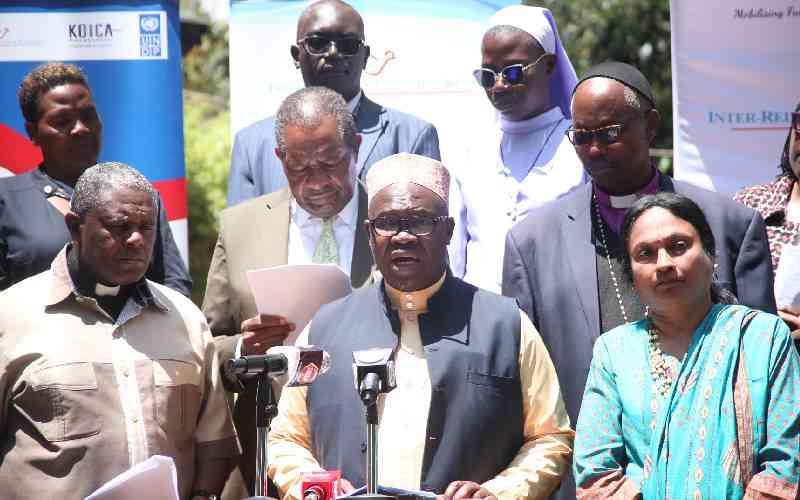
IRCK Board member Sheikh Yusuf Abu Hamza, Rev Fr Charles Kilonzo and Treasurer Sujatha Kotamraju condemn political intolerance ahead of elections, at Ufungamano House in Nairobi on November 5, 2026. [Kanyiri Wahito, Standard]
Nine months to the next General Election, religious leaders under the umbrella of the Inter-Religious Council of Kenya (IRCK) are pledging to prescribe to Kenyans the type of values to look out for when choosing their leaders.
This comes against the backdrop of the last election cycle when the religious leaders, particularly the church, faced a lot of backlash after the 2022 General Election, where they appeared to have blurred the line between church and politics and were interpreted to have sided with President William Ruto.
To avoid falling into this predicament once again, the leaders have stated that they will come up with a guide to help inform their followers of the choices they should make.
"We will develop and popularise a guide for electing leaders with values." said Rev Kepha Nyandega, General Secretary of the Evangelical Alliance of Kenya (EAK), who is also an executive member of IRCK, reading the IRCK statement.
The move goes beyond the value system with the leaders also targeting to counter false narratives being sold, especially on social media during this campaign season.
Just last month, an investigation by US-based AI firm Anthropic revealed that an unidentified Kenyan actor misused Anthropic's Claude AI model to mass-produce online content praising Energy Cabinet Secretary Opiyo Wandayi and targeting political opposition figures.
"We will work with all like-minded partners and stakeholders to create and propagate positive narratives and share fact-checked messages that counter misinformation." added Nyandega.
Further, the church is also proposing to play a much bigger role in resolving the disputes that arise from the party nominations that are always clouded with violence to the election itself.
"As part of our preparedness, IRCK will mobilize and equip the national peace and mediation team, a team of respected religious and non-religious team of mediators trusted across faith, political and ethnic divides to diffuse tensions before they escalate and help resolve disputes arising from party nominations, campaigns results, to serve as party mediators throughout the electoral cycle." Nyandega stated.
To facilitate this, they have pledged to work in close conjunction with state actors to also contain hate mongering and ethnic incitement that is cropping up in the political space.
"The team will remain on standby at National and county levels and will work closely with NCIC, the National steering committee on peace building and conflict management. We will run grass root inter-faith dialogue forums to support local peace committees so that political disputes stay off the streets." said Nyandega.
With the church also being accused of sometimes being a bystander when some matters of national concern are brought to the fore, IRCK, have said that they will use their platforms to also conduct civic education.
"As the Inter-Religious Council of Kenya, we commit to using our platforms, that is, the churches, temples, mosques and other spaces convened and controlled by the religious leaders across the country to preach peace and tolerance and to conduct civic education," Nyandega added.
Stay informed. Subscribe to our newsletter
Just like in his 2022 campaigns, President William Ruto and his allies have been making appearances in churches almost every Sunday, making huge donations for church projects.
A number of church delegations have also visited State House, including the Friends Church Quakers, the Methodist Church, the Akorino Israel Church, Sheiks and Imams.
Opposition leaders have also been making their own donations.
On this, IRCK has warned against politicization of donations from the political class.
"We discourage politicized donations and deny partisan actors from using religious platforms," Nyandega said.
Religious leaders now have the task of remaining impartial even in their quest to prescribe values.
Just this past Sunday, while attending service at the PCEA Kamangu Parish in Kikuyu Constituency, Democracy for the Citizens party leader Gachagua alleged that the presbytery had been used by area MP and National Assembly Majority Leader Kimani Ichung'wa to intimidate the Reverend and pressure church leaders against hosting him.
"We do not want the President to intimidate the church. I want to ask William Ruto, you chased me from Government, now you want to even chase me away from church?" he said.
The church-state relationship under the leadership of the current Government has also been sour, with the Kenya Conference of Catholic Bishops (KCCB) leading from the front in critiquing the Government over poor leadership, goonism in the country, cost of living and some of the Government's policies.
It is also under the leadership of this Government that the teargasing of congregants inside churches has happened more than thrice, happening when former Deputy President Rigathi Gachagua is in attendance.
With religious leaders now appearing to take a stand, the outcome is now a wait-and-see.
Subscribe to our newsletter and stay updated on the latest developments and special offers!


 Prefer the Standard on Google