×

The Standard e-Paper
Smart Minds Choose Us
 The Standard Group Plc is a
multi-media organization with investments in media platforms spanning newspaper
print operations, television, radio broadcasting, digital and online services. The
Standard Group is recognized as a leading multi-media house in Kenya with a key
influence in matters of national and international interest.
The Standard Group Plc is a
multi-media organization with investments in media platforms spanning newspaper
print operations, television, radio broadcasting, digital and online services. The
Standard Group is recognized as a leading multi-media house in Kenya with a key
influence in matters of national and international interest.
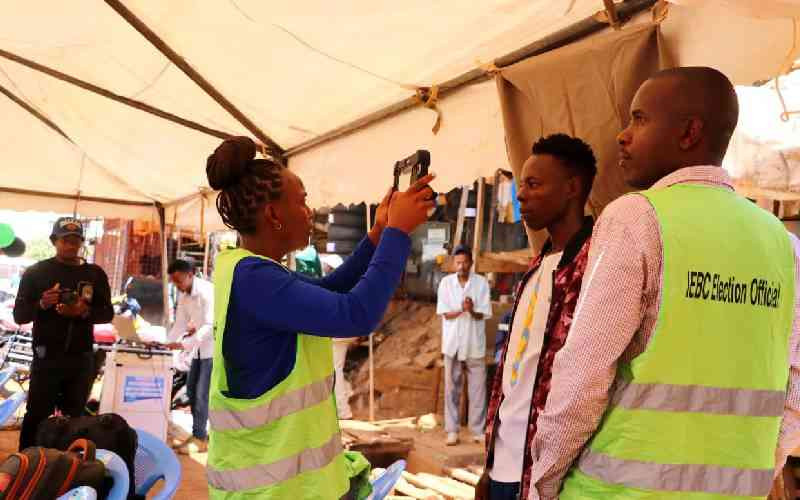
If the elections were to be held next week on Tuesday, as per High Court Mugure Thande’s verdict, then the country would go to the polls with nagging questions on the validity of the Bomas tally, the use of Artificial Intelligence and diaspora voters’ registration.
With the country hurtling towards the next general election, eyes are on the courts as litigants’ troop to seek clarity on how the next election will be conducted.
As activist Khelef Khalifa and lawyers Dr. Owiso Owiso and Ashioya Biko won their battle that the election should be held on the second Tuesday of August 2026, Lewis Itenya was filing yet another case against the Independent Electoral and Boundaries Commission (IEBC), challenging the appointment of county election managers and senior election officers internally.
Itenya argued that the process was not competitive and had locked out qualified Kenyans from serving Kenyans.
“The said positions are permanent and the Senior Election Officer position, in particular, doubles as the Returning Officer during elections and Voter Registration Officer during voter registration, positions of immense public trust and constitutional significance,” he argued.
The man is not alone in the corridors of justice, with cases likely to affect the election.
Kenyans living abroad separately moved to the High Court seeking to have elections moved from consulates and embassies.
In their case,the group led by Dr. Martin Koyabe Danson Mukile and Dr. Kenneth Karanja claimed that those living abroad have always been excluded from the elections owing to logistical issues and restrictions around embassies and consulates.
According to them, those living in the United States of America (USA), Canada, the Kingdom of Saudi Arabia, Australia, the United Kingdom, China, Sweden, Finland, Norway, Denmark, Belgium, and South Africa have to dig deep into their pocket to travel in a bid to register as voters.
“ This signifies that millions of Kenyans living in over 100 countries have been effectively disenfranchised, not by constitutional mandate but lack of legislation, an administrative regulation and the absence of diplomatic infrastructure,” their lawyer Ambrose Mulandi argued.
According to him, it is practically impossible for a Kenyan living in the USA, Canada, or the UK to travel or even access a polling station at an embassy or consulate.
“ The unreasonable limitation imposed by regulation 34(2) is discriminatory, arbitrary, and creates unjustifiable hardship by conditioning a constitutional right on the mere existence of a diplomatic office. This creates inequality of access to the franchise and violates Articles 38(3), 27, 81, and 83,” said Mulandi.
In the case, the petitioners sued the Independent Electoral and Boundaries Commission (IEBC), the Attorney General, the Senate, and the National Assembly. They also cited Katiba Institute, the Law Society of Kenya, the Commission of Administrative Justice (ombudsman), the Center for Multiparty Democracy, Kenya, and the Election Observation Group (ELOG) as interested parties.
According to Mulandi, calls for reforms and past attempts to engage IEBC and other relevant agencies on the need to expand diaspora registration beyond diplomatic missions have hit deaf ears.
Mukile filed a supporting affidavit in support of the case.
He told the court that he lives in Dallas, Texas, USA.
According to him, Kenyans living abroad have an equal stake as those in the country to determine who will lead and democratic governance. He said those outside Kenya, for example, last year sent Sh 637.3 billion in remittances, hence supporting the country economically and socially.
Mukile said that, for example, in 2019, census data showed that there were at least 136,239 Kenyans in the USA. However, he stated that Kenya has only three polling stations: the embassy in Washington, D.C., and the consulates in New York and Los Angeles.
According to him, a person living outside these locations will pay between Sh 144, 480 and Sh 168, 216 each time he or she goes for voter registration, verification and voting.
“ This means that a Kenyan living in Dallas like myself has to either travel to the consulate and the current polling or registration center in new York which is approximately 2495 kilometres away for voter registration verification and voting,” he said.
In the meantime, the court heard that there are 44, 635, and 22,063 Kenyans in Canada and Australia, respectively, but there are two voting stations in Ottawa and Vancouver and one in Canberra.
He asserted that a Kenyan living in Australia is expected to part with Sh 322,500 to exercise voting rights.
At the same time, those in the United Kingdom, around 6484, have only one polling station in London.
He said that other countries such as Rwanda, Moldova and the Philippines have multiple voting stations near their citizens.
In the meantime, Busia Senator Okiya Omatah, United Opposition Coalition leaders Kalonzo Musyoka, Rigathi Gachagua, Fred Matiang’i, Mithika Linturi and Justin Muturi urged the High Court to abolish the recount and verification of the presidential election at the National Tallying Centre, saying that there is no law to establish such a mechanism.
In their final submissions before High Court Judge Gregory Mutai, they said that the IEBC created an illegal office of a county returning officer and verification staff, despite the law and court judgment clarifying that the results are final.
Okiya submitted first. He asserted that only an election court has the power to reopen or scrutinise the results declared by the returning officer at the constituency level. He insisted that the avenue used for rigging is the creation of a separate level for reopening the results and re-tallying at the Bomas.
The Senator insisted that the exercise at the National Tallying Centre is illegal as it amounts to the commissioners and the IEBC chair usurping the powers of the constituencies’ returning officers. He said that
According to him, the work of the national tallying centre should be a simple collation of results from each constituency without modification, verification or alteration.
The Senator further argued that Section 39 of the Elections Act, Article 86 and Article 138 of the Constitution, adding that the sections indicate that the results from the constituency level are final and binding.
“The petitioner asserts that the introduction of this redundant verification step creates a contradiction: if the results at the constituency level are final (as per the Constitution), then what exactly is the IEBC verifying at the national tallying centre? This duplicative verification process has actually served no purpose other than to open the door for potential manipulation, errors, or inconsistencies that could undermine the integrity of the electoral process in the 2013, 2017 and 2022 general elections,” argued Omtatah.
He added that the role of the IEBC chair is almost a ceremonial one, as he is only required to announce the total results from the constituencies.
According to him, centralisation of tallying and verification of results violates the finality of results as required by the Constitution.
“The National Tallying Centre improperly reintroduces a level of discretion and delay into the process of declaring presidential results, contrary to the simple arithmetic requirement of Article 138(4),” he said.
Okiya’s case is the second contest filed against the commission in a bid to ring-fence the presidential contest to the constituencies.
In the meantime, the United Opposition Coalition leaders argued that once the results are collated at the polling stations and announced at the constituencies, the national tallying centre ought to adopt the same numbers without alteration or re-tallying.
According to them, re-tallying and re-verifying the results at the national tallying centre creates an opportunity for potential manipulation.
Their lawyer, Margaret Ngesa, stated that with the election being one year and eight months away, his clients are pushing for the commission to deliver an accurate and verifiable election.
Ngesa further stated that the practice adopted by the Ethekon Edung-led commission creates confusion on which of the results announced at the constituencies and those at the national tallying centre is final.
“This practice has resulted in immense confusion, created opportunities for manipulation and has been a primary source of litigation in every presidential election cycle. The current legal framework, particularly Section 39 of the Elections Act, is interpreted and applied by the Respondents to permit this parallel verification process. However, this process is not anchored in the specific provisions of the Constitution, which prescribe a clear and linear pathway for the tallying and declaration of results,” argued Ngesa.
She said that the commission has allegedly consistently failed to have the results verified at the constituencies before they are transmitted electronically.
She argued that the results of the election of the Members of the National Assembly and the County Women Representatives are final upon declaration by the constituency returning officer; then the presidential votes count should not undergo further verification or alteration at the national level.
“There exists no rational or justifiable constitutional basis for treating the results of the presidential election differently. The constitutional architecture for elections, as outlined in Article 86, is uniform. The creation of a separate, superior process exclusively for presidential results is an arbitrary and discriminatory practice that lacks a legitimate constitutional objective,” argued Ngesa.
She urged the court to force the commission to gazette all polling stations and make them public.
On the other hand, IEBC lawyers urged the court to dismiss the twin cases. Lawyers Wambua Kilonzo, Hassan Nura, and Moses Kipkogei separately argued that the issues raised involved an election and had been resolved by other courts.
Kilonzo, on his end, argued that all countries which were once ruled by Britain have a similar process.
“ All Commonwealth countries have a centralized place where several processes are undertaken before a declaration of the winner,” argued Wambua.
At the same time, lawyer Kipkogei argued that the Supreme Court had in 2017 annulled the Presidential election after IEBC failed to verify the results.
He claimed that it is now clear that the power to verify and tally the results lies with the commission, which involves the staff. He said this happens at the National Tallying Centre.
“ The issue has been resolved,” he replied, adding that it is clear that the returning officer is allowed to publish the results once they have been collated.
It is not the first time that the exercise at Bomas has been in court.
Former IEBC chair Wafula Chebukati in 2017 told the Supreme Court that he wanted the powers to correct Forms 34B in the event they do not tally with Forms 34A.
When his lawyer Paul Nyamodi was asked by Supreme Court judge Isaac Lenaola what exactly he wanted the court to order, he said he needs the powers taken away by the Court of Appeal.
According to the lawyer, Chair is a helpless man who can only do nothing but announce figures if they have errors, then wait for the consequences.
“What do you want us to do? You have the baby in your hands; what do you want?” Justice Lenaola asked.
Lawyer Nyamodi replied: “The Court of Appeal, with tremendous respect, took away the powers of the second respondent to correct the forms if they do not add up.”
Also submitting to the court on behalf of the IEBC, senior lawyer Kamau Kaori told the court that there is a likelihood of the country plunging into chaos, just like in 2007, if a winner is not announced.
Lawyer Kamau told a five-judge bench composed of Chief Justice David Maraga (now retired), his deputy Philomena Mwilu and Justices Lenaola, Smokin Wanjala and Jackton Ojwang that if the chairman cannot announce a winner over errors in the forms, then chaos might erupt.
“Arising from the judgment of this honourable court, it is now unclear as to what; as the returning officer for the presidential election; the Chairperson ought to do, in view of the clear prohibition of the Court of Appeal in the Maina Kiai case barring the Chairperson from “varying, confirming, altering, modifying or adjusting the results” relayed from to the national tallying center,” said Kamau.
At the same time, the court heard, it will be very easy for IEBC to face cases over issues that could be rectified administratively.
The judges heard that they did not offer a solution on what should be done after verification in the event it identifies errors in what its officers submit.
“ We will be generating obvious petitions if we do not verify and correct the errors. We do not want a situation just like in 2007 where the then chairman said he did not know who the winner was,” lawyer Kamau argued.
Both the Jubilee Party and then Attorney General Githu Muigai were in support of the application filed in court.
In their separate arguments by lawyers Kiragu Kimani and Immanuel Mbita, they argued that there was a legitimate concern which the court needed to solve.
On the other hand, National Super Alliance, Ekuro Aukot and Law Society of Kenya asked the justices to dismiss the case as it was an appeal of the Court of Appeal orders.
The other case that has a likely direct implication on the election involves John Wangai, Peter Agoro and Antony Manyara. They argued that the country has no blueprint on Artificial Intelligence. Their concern was that AI is likely to be used for election disinformation and interfere with a free and fair election.
They argued that without safeguards in place, there is a likelihood of algorithm profiling and manipulation in order to sway the votes in favour of either side of the divide.
“ The 2027 elections are approaching, and Kenya has no legal framework to prevent or remedy AI-enabled electoral manipulation. This is not a hypothetical threat as deepfake technology and generative AI have already been used to manipulate elections in other jurisdictions, and such technologies are readily accessible in Kenya,” they argued.
Subscribe to our newsletter and stay updated on the latest developments and special offers!


 Prefer the Standard on Google




 join
join