×
App Icon
The Standard e-Paper
Read Offline Anywhere
★★★★ - on Play Store
Download Now

Cracks beneath another building raise safety fears

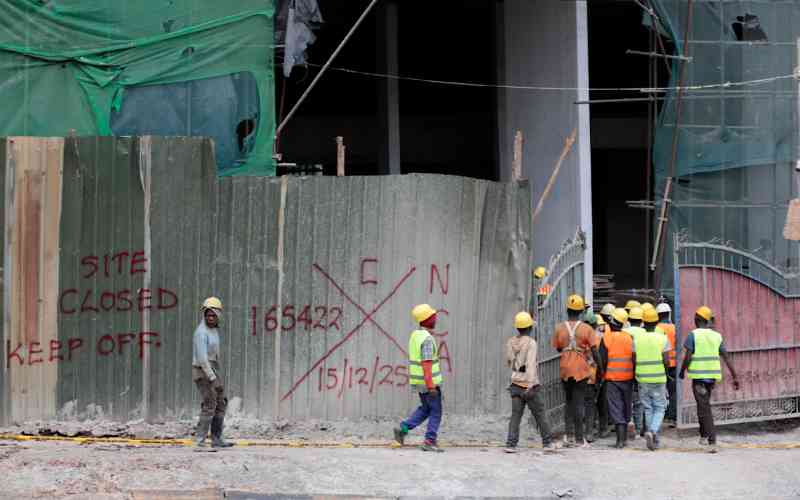
A building under construction that is allegedly on the verge of collapse along Peponi road in Westlands, Nairobi on December 16, 2025. [Boniface Okendo, Standard]

Residents along Donyo Sabuk Way off Peponi Road in Nairobi are living in fear, their routines disrupted by a multi-storey building whose structural integrity has been in question since cracks appeared last year.

The 13-storey structure, intended to rise to 17 floors, is draped in green netting and sealed off with a warning sign reading “SITE CLOSED – KEEP OFF”, bearing a suspension order from the National Construction Authority (NCA) dated December 15, 2025. Construction was halted four days later after one of the building’s main pillars developed visible cracks.

Neighbours say they have received little information since then, despite assurances from authorities that clear communication would follow. “We were told we would be informed on what to do next, but the new year came and nothing happened,” said one resident, who asked not to be named.


Those living closest to the site say they fear a possible collapse, pointing to visible damage inside the structure.
“The cracks inside tell a different story. One of the pillars is cracked and bent, yet we are told it is being repaired,” another neighbour said.

Photographs seen by The Standard show a slender column with extensive cracking and visible deformation, images that have heightened anxiety among residents.

Officials from the Office of the President, including the area police commissioner, are said to have visited the site and advised neighbours to consider evacuating.
“They told us evacuation was our choice. They said by 2pm they would tell us whether the building would be demolished or repaired,” a resident said. No definitive feedback followed.

Architect Paul Ochieng’, who is involved in oversight, said construction was immediately stopped once the damage was identified.
“The developer was required to carry out propping to prevent further damage. No further work has been approved until an independent integrity test is done by a qualified engineer,” he said.

Ochieng’ described the steel supports now visible on the building as a temporary stabilisation measure.
“Propping is like first aid. Without it, the building could have collapsed and damaged neighbouring properties,” he said, adding that the immediate danger had been contained.
“There is no work going on now, and the building is not collapsing in its current state.”

However, the next steps remain unclear. According to Ochieng’, the owner must commission a full integrity test to determine whether the structure can be repaired or must be demolished. “That test will inform whether the building is salvageable and the methods to be used, or whether controlled demolition is necessary,” he said.

Residents have been advised to continue with their daily lives but to remain alert. On the ground, however, confusion persists, fuelled by conflicting information. Some residents claimed the building owner, contractor and caretaker had been arrested, although this could not be independently confirmed. Calls to a senior police officer whose contact was shared by residents went unanswered by the time of publication, while attempts to reach the site engineer were unsuccessful.

Serious concerns

The Architectural Association of Kenya (AAK), following a preliminary inspection, confirmed serious structural concerns.
“One wall is cracked and the slab is affected. What we have seen so far suggests a ripple effect across the structure,” an AAK official said, describing the situation as a structural failure requiring a comprehensive review.

For long-term residents living behind the building, fear is mixed with uncertainty. One man who has lived in the area for four decades said he only recently learnt of the risk.
“We were told there is a cracked column and that we should not stay, but until something actually happens, people wait,” he said. Six families living near the river below the site remain unsure whether to leave or stay.

The NCA suspension order sheds light on deeper regulatory failures. Addressed to Donyo Hills Residence Limited, the developer, and Meraki Universal Builders Limited, the contractor, it cites non-compliance under Section 23(6) of the NCA Act. Inspectors found serious breaches, including structural failure concerns, a contractor operating without a valid practising licence, absence of NCA-accredited skilled workers and supervisors, lack of a proper site board displaying statutory approvals, and failure to provide basic personal protective equipment.

In a statement issued on December 17, 2025, the NCA confirmed receiving reports of structural failure at the Peponi Road site, designed to include three basement levels and 13 suspended floors. A multi-agency committee was formed to determine whether the structure could be salvaged or required controlled demolition.

Subsequent NCA updates indicating that emergency propping works were underway sparked public outrage, with many questioning why a suspended site was still being worked on. Online, some Kenyans argued the building should be demolished outright, while others pointed to broader failures in construction oversight.

The Peponi Road case reflects long-standing concerns in Kenya’s construction sector. A 2023 KIPPRA study on recurrent building collapses found that between 2009 and 2019, at least 86 buildings collapsed nationwide, killing an estimated 200 people. A 2018 audit cited in the report found that more than 72 per cent of sampled buildings were unsafe.

The study links collapses to poor workmanship, unethical conduct by contractors, substandard materials and weak enforcement, warning that without stronger oversight and updated laws, Kenya’s push for mass housing risks putting lives at danger.