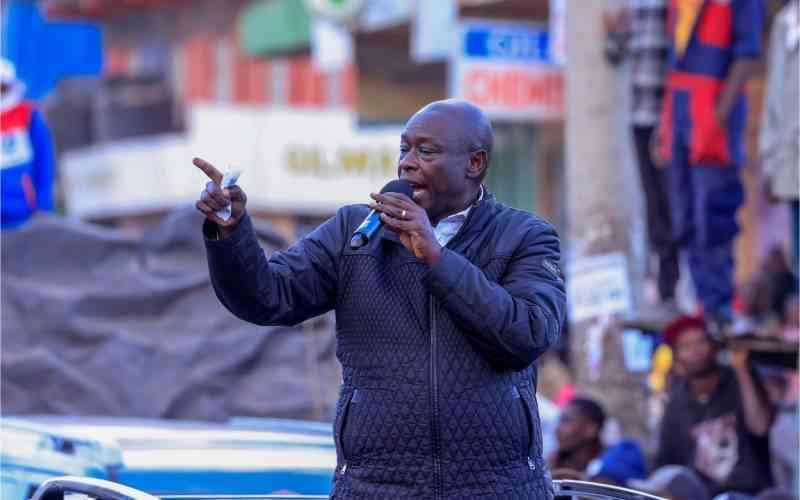
In his usual blunt style, former Deputy President Rigathi Gachagua this week raised an issue whispered in many circles, particularly in Central Kenya. In the view of the former DP, supported by a significant constituency, national schools located in the region were “our schools” and majority of students in those schools should be “our children”.
Supporters of this position contend that communities in Central had invested their resources, by inter alia donating community land, providing free labour and investing resources through harambee and prudent use of CDF and county monies, to develop and improve these schools only to be denied primary access. Instead, their children had been admitted to far off national schools in which little investment had been done by local leadership, or been relegated to local less endowed schools, causing untold prejudice to the children.
Unfortunately, since it was clothed in ethnically heavy garb, it generated usual base level conversations that fail to appreciate complexity of such issues. It is impossible in one column to comprehensively tackle the fundamental issues this debate raises but I will provide several teasers which I hope will enrich the discourse.
Firstly, the issue of access to quality education for deserving children from Central is legitimate. But so is access to quality education for deserving children from Tot in Turkana or Garsen in Tana River. And in a country in which cross pollination is ideal for nation building, children, particularly those that will play significant roles in leadership in public or private sectors, should be granted opportunities to interact with children from other localities.
This will hopefully imbue in them a broader appreciation of the Kenyan ethno and social mosaic. I attended high school when “A” levels were National. My classmates were Luo, Luhya, Kamatusa and from other Kenyan communities. At a time when my world view was forming, I was able to appreciate the value of other communities and reduce some of the instinctive prejudice that growing up and schooling exclusively amongst my community would naturally generate.
In an ideal world therefore, quality educational institutions should be equally available in all parts of Kenya so that deserving children can cross-pollinate in similar schools in whichever part of Kenya they are assigned. But we all know the investment in public schools has not been equitable, despite equity in CDF and County allocations.
While some leaders like my good friend Ndindi Nyoro have used their CDF allocation better, and community philanthropy has enabled enhanced investment in education in much of Central more than some parts of Kenya, this is very small part of the story.
Decades of inequitable allocation of expansive subsidies and other financial support by the central government have privileged many schools, particularly in Central Kenya, and enabled them outshine their counterparts facility-wise. Historical privileging has numerous multiplier effects that have led to better outcomes not just in education but also in health, wealth and opportunities.
The debate around devolution and equity provisions in the Constitution were intended to cure this historical malady. But structural inequities are not easy to unravel, they take decades of deliberate policy to reverse. While what is obvious now is the access to well-endowed public schools, the inequity that ails Kenya is overwhelming in many sectors.
In my consulting life I have spent time in the “other Kenya” and been humbled by just how privileged we are in my part of Kenya. Challenges like open defecation, preventable diseases, extensive teenage marriages, high child mortality, absolute lack of teachers, and similar challenges that were eradicated in other parts of Kenya in my childhood, are the norm in parts of this other Kenya.
These Kenyans are not children of a lesser god. They are not in this state because they are inherently inept and incapable. Their leaders are not intrinsically corrupt and incompetent. Many of their challenges are structural. While some are accentuated by poor leadership, most require structural policy driven solutions. This understanding is what should undergird debates that deal with equity not just in education but in other sectors, if we are to grow a Kenya in which everyone feels a legitimate part of.
-The writer is an advocate of the High Court of Kenya