×

The Standard e-Paper
Join Thousands Daily
 The Standard Group Plc is a
multi-media organization with investments in media platforms spanning newspaper
print operations, television, radio broadcasting, digital and online services. The
Standard Group is recognized as a leading multi-media house in Kenya with a key
influence in matters of national and international interest.
The Standard Group Plc is a
multi-media organization with investments in media platforms spanning newspaper
print operations, television, radio broadcasting, digital and online services. The
Standard Group is recognized as a leading multi-media house in Kenya with a key
influence in matters of national and international interest.

Audio By Vocalize
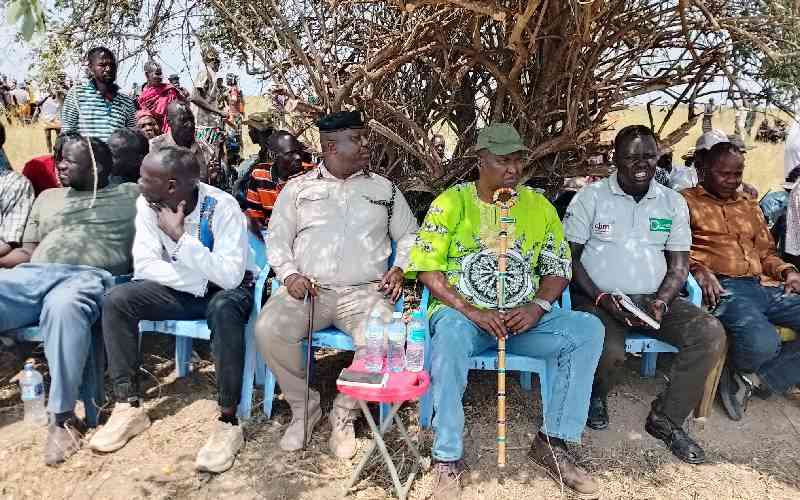
Leaders from Turkana, Nyangatom and Dasanech from Ethiopia South Omo zone during a cross-border meeting at Natiir along the Kenya-Ethiopia border. [Lucas Ngasike, Standard]
As the afternoon heat and erratic temperatures hit down on the dusty plains of Natiir along the Kenya-Ethiopia border, the only sounds are the gentle ringing of cattle bells and children laughing as they herd cows and goats towards a shrinking watering point.
It is a scene few people here ever imagined they would witness.
Only a few years ago, this same landscape echoed with gunfire as the Turkana of northern Kenya and the Dassanech of Ethiopia's South Omo Zone clashed over cattle, fishing grounds and grazing land. Crossing the border often meant risking death.
Today, cattle belonging to families from both communities graze side by side peacefully, while elders exchange greetings beneath a plain pasture land and young warriors who once carried rifles now discuss how to protect the little pasture that remains.
For pastoralists whose survival depends entirely on livestock, climate change has become a far greater enemy than each other.
The prolonged drought sweeping across northern Kenya has dried grazing fields and rivers in Soya and Kibish, forcing hundreds of Turkana families to move closer to the volatile border in search of water and pasture.
Across the frontier, the Dassanech faced a different disaster.
Floodwaters from Ethiopia's River Omo submerged villages and grazing lands in Lopeimukat, Salany and Lomomeri, displacing families and pushing their livestock southwards towards the same borderlands already occupied by Turkana herders.
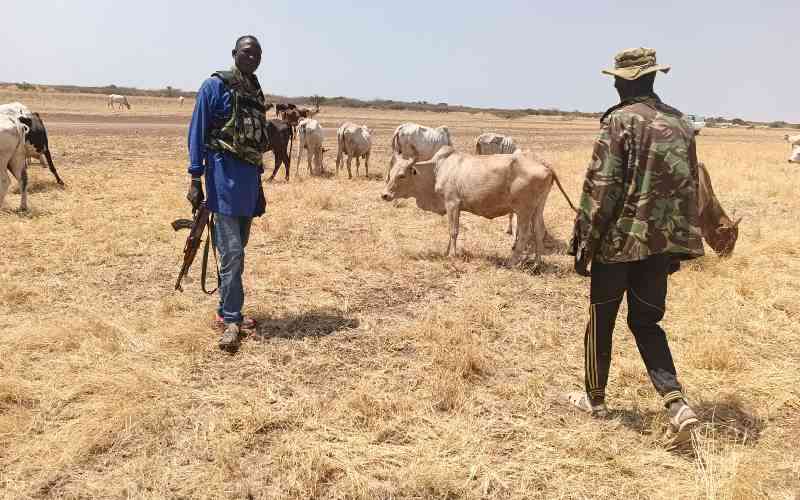
Reservists guard cows at Natiir pasture land near the Kenya-Ethiopia border. [Lucas Ngasike, Standard]
Communities that once fought over territory suddenly found themselves sharing the same struggle.
There was simply nowhere else to go.
"If we fight today, our cattle will die tomorrow," remarked a Dassanech peace actor Kuu te during a recent peace meeting, summing up the painful reality confronting pastoral families,
At Natiir, Nadome and Merukuka, survival has become stronger than hostility.
Stay informed. Subscribe to our newsletter
Thousands of cattle now share fragile grazing fields under the watch of herders who only recently feared encountering one another.
Women collect water from a lagoon known as (a pas) while children from the kraals play together, unaware of the violence that defined their parents' generation.
For many residents, climate change has delivered a powerful lesson: it recognizes no tribal boundaries.
The transformation is particularly remarkable given the painful history between the neighbouring communities.
Only a few years ago, the Todonyang massacre claimed the lives of more than 40 Turkana fishermen, becoming one of the darkest chapters in the history of the Kenya-Ethiopia border conflict.
Those memories remain painfully fresh, yet dialogue is slowly replacing revenge.
Turkana and Dassanech elders, youth and local leaders now meet regularly to discuss resource sharing and conflict prevention instead of preparing for retaliation.
The fragile peace has been strengthened through joint efforts by the governments of Kenya and Ethiopia, supported by development partners including Tupado, Catholic Caritas Ethiopia and the DanChurchAid (DCA) Spread Project.
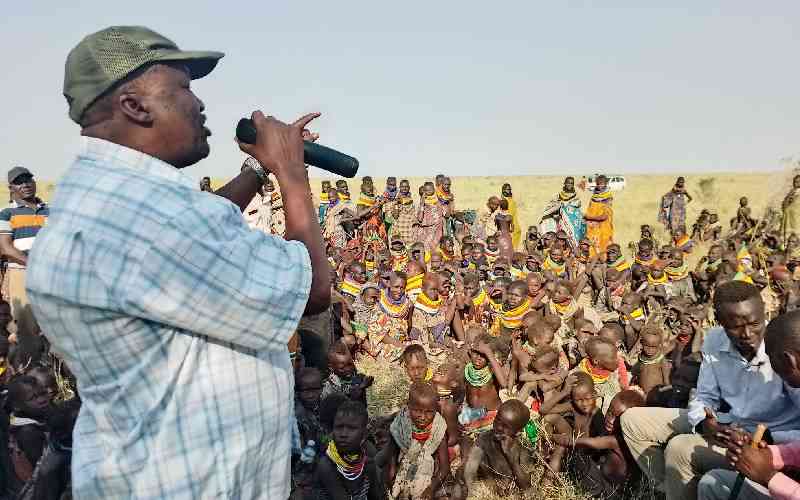
Teketel Endrias, Programme Manager at Catholic Caritas Soddo Ethiopia, says communities have undergone a remarkable transformation.
"People have realized that drought and floods are affecting everyone. Instead of fighting over the little that remains, they have started sharing grass and water. That is the biggest victory," he said.
For Kokuro location Chief Vivian Ekadeli, the peace agreement has brought hope, but also new challenges.
She says thousands of cattle have migrated to Natiir after drought devastated grazing lands across Turkana North, forcing even herders from Turkana West to seek pasture near the Ethiopian border.
While communities are now grazing together peacefully, she worries that overgrazing could quickly exhaust the remaining pasture.
"The communities have agreed to live peacefully and graze together, but we must also protect the little pasture that remains. If it is exhausted, another crisis could emerge," she warned.
Shrinking and contaminated water sources have forced desperate families to trek for days towards the Ethiopian border, where cleaner water is still available at Omo river lagoon in Lake Turkana.
Even as peace begins to take root, another threat has emerged.
Turkana Professional Association member Paul Lonoko has raised alarm over a suspected outbreak of livestock diseases affecting several villages near the Kenya-Ethiopia border, including Nayenae Epuul, Nayanae Edapal, Adome and Wolegesh.
According to Lonoko, mysterious illnesses are killing livestock the very animals that sustain pastoral families through milk, meat and income.
He appealed to the County Livestock and Veterinary departments to urgently investigate the outbreak, dispatch veterinary officers and provide medicines before more animals die.
"Livestock remains the primary source of food and livelihood for residents. Continued animal deaths could worsen food insecurity in the area," Lonoko warned.
Kibish Deputy County Commissioner Tom Otieno says both the Kenyan and Ethiopian governments remain committed to ensuring peace despite mounting pressure on natural resources.
He urged communities to share water and grazing land responsibly and avoid criminal activities that could undermine the fragile coexistence.
Kenya's Special Envoy for Peace in the Ateker Region, John Munyes, believes climate change has become one of the greatest security threats facing pastoral communities across the region.
He says prolonged drought has forced pastoralists into the borderlands of Ethiopia and Uganda, making peaceful resource sharing no longer an option but a necessity.
Munyes announced plans to establish a joint grazing committee to oversee organized grazing patterns and peaceful coexistence, noting that at least 15 nomadic kraals from Soya, Natapar, Koyasa, Lokamarinyang and Kibish have already moved closer to the Ethiopian border.
Addressing a joint peace meeting between Turkana and Dassanech leaders, he urged communities to embrace lasting peace while promising continued engagement with Ethiopian authorities to allow Turkana herders temporary access to grazing land inside Ethiopia during severe drought.
He also encouraged the revival of livestock markets and cross-border trade through Omorate, Merukuka and Kibish, saying shared economic opportunities would strengthen the new partnership.
According to Munyes, the restoration of peace has already enabled traders and pastoralists to resume travelling to Omorate after years of fear and insecurity.
He acknowledged reports of donkeys allegedly stolen by suspected Dassanech youth but welcomed assurances from Ethiopian authorities that efforts were underway to recover the animals peacefully, preventing retaliation that could derail the progress achieved.
Although the border remains vulnerable, many residents believe they have entered a new chapter.
Climate change has taken away rivers, pasture and certainty.
Yet in doing so, it has also dismantled barriers that decades of peace negotiations struggled to overcome.
Where gunshots once echoed across the plains of Todonyang and Kibish, the sounds heard today are cattle bells, children herding livestock together and traditional songs performed during evening cultural dances.
In one of East Africa's most volatile borderlands, climate change has become a harsh and unexpected teacher.
It has shown former enemies that survival is no longer about defending territory. It is about protecting life together.
Subscribe to our newsletter and stay updated on the latest developments and special offers!


 Prefer the Standard on Google








 join
join