×
App Icon
The Standard e-Paper
Smart Minds Choose Us

★★★★ - on Play Store
Read on the App

Oil producers stand in the way of a global treaty on plastics regulation

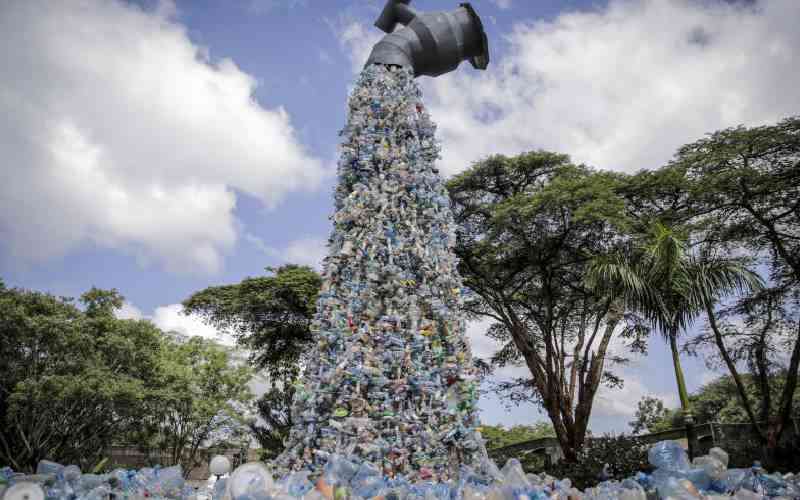
A giant art sculpture showing a tap outpouring plastic bottles, each of which was picked up in the neighborhood of Kibera, during the UNEA held at the U.N. UNEP headquarters in Nairobi, Kenya Wednesday, March 2, 2022.[Brian Inganga, Standard] .

In March 2022, during the fifth session of the UN Environment Assembly (UNEA-5) held in Nairobi, a historic resolution for the world to develop an international, legally binding instrument on plastic pollution was adopted.

The resolution called for the establishment of the Intergovernmental Negotiating Committee  (INC) to develop a treaty that would comprehensively address the full life cycle of plastic, including its production, design, and disposal, to curb plastic pollution even in the marine environment.

Late in November 2024, the INC, which is made up of negotiators from nearly all countries in the world, met (their fifth such meeting) in Busan, South Korea.


“The expectation was that this would be the last such meeting; that an agreement would be arrived at and that we would have a treaty,” says Griffins Ochieng, an environmentalist and Executive Director of Centre for Environmental Justice and Development (CEJAD).

INC-5 concluded on December 1 without a treaty. Simply put, delegates failed to agree.

Dr Ayub Macharia, the Director of Enforcement at the National Environment Management Authority (NEMA), is Kenya’s Focal Point in the INC Process.

He says: “An international plastic treaty will be very important because plastic is ubiquitous and it moves across borders; not to mention that the world’s oceans have no boundaries to block plastic litter from moving in any direction.”

An international treaty, he says, will unify the world in fighting plastic pollution.

“If (as an example) Kenya is fighting plastic pollution and Uganda or Tanzania are embracing plastics, it looks unfair because plastics from those other countries could easily cross into Kenya. If Tanzania has a lot of its plastics going into the Indian Ocean, nothing prevents the litter from travelling towards the Kenyan side. This is why we need a treaty for everyone to adhere to,” Macharia explains.

As INC-5 wound up, news media reported ‘deep divisions’ between countries (mostly non-oil producing countries) hankering for a comprehensive treaty and those that only want it to focus on plastic waste only (mostly oil producing nations and their close allies) and not production.

At the negotiations, the  Rwandan delegate, Juliet Kabera, told the media that a small number of countries were unsupportive of stipulations that would achieve real change.

Why would oil producers (and their allies) be stifling progress towards an effective treaty?

“Plastics are derived from crude oil, natural gas, or coal,” says Ochieng.

Oil-producing countries have the raw material for plastic production, a key revenue source.

Yet, environmentalists like Ochieng say that plastic pollution can never be addressed if production is not reduced.

Their point of view was validated by a study published in the journal Science.

Samuel Pottinger, of the University of California, Berkeley, was the lead author of the research.

In an interview published in December 2024 by British Publication The Guardian, Pottinger said: “The results of this new analysis and our interactive tool show very clearly that it will be nearly impossible to end plastic pollution without cuts to plastic production.”

Pottinger said that plastic waste is on the rise to weigh 121 million tonnes by 2050, from 20 million, if limits on production are not adopted.

In the same period, greenhouse gas emissions associated with the extraction and processing of oil and gas used to make plastic, plastic production, and plastic waste management will go up by 37 per cent, contributing significantly to climate change.

Today, over 460 million tonnes of plastic are produced every year. That’s roughly the weight of all humans on the planet.

Kenya, says Macharia, is a proponent of a treaty that will regulate plastic production.

“Remember, all synthetic plastics that have ever been produced are still in the environment today in one form or another; they don’t biodegrade. Even new plastics being produced today will be here longer than all humans that are alive today. Therefore, it is of great importance that production is addressed,” he says.