×
App Icon
The Standard e-Paper
Home To Bold Columnists
★★★★ - on Play Store
Download Now

Vihiga mothers turn to community therapy to ease postpartum stress

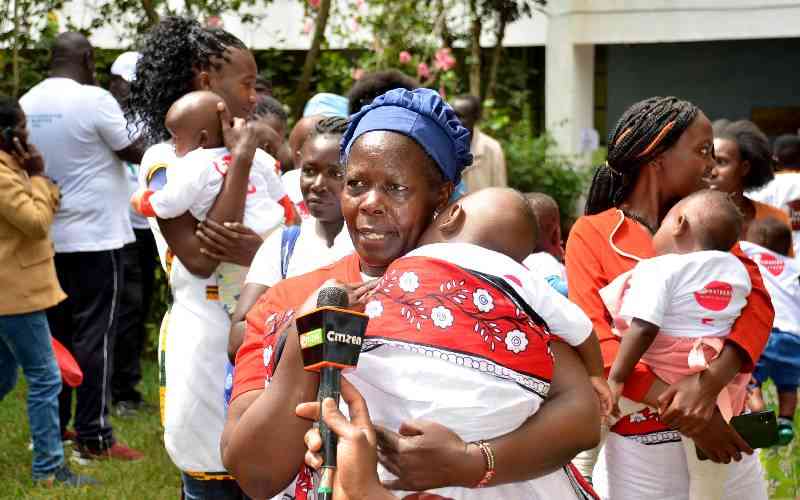
Mothers who underwent mental health screening and counselling at Shamakhokho, Vihiga County, on December 20, 2025. [Brian Kisanji, Standard]

When Eunice Minadia brought her eight-month-old baby girl to take part in a crawling race at Shamakhokho Secondary School in Vihiga County, her aim was not to win a medal.

Instead, she hoped the creative activity would help ease the everyday stress that many mothers like her silently endure.

Minadia, 30, a mother of one, said the past few months had been particularly difficult, with family disputes and financial strain pushing her to the brink. “This event helped me relax and connect with other mothers. It reminded me that my mental health matters too,” she said.


She explained that persistent financial uncertainty had been her biggest worry, as she struggled to provide for herself and her baby, Blessing. Over time, the pressure led to sleep loss, prolonged sadness, emotional withdrawal, fatigue, and changes in appetite.

Some of these challenges, she said, made it difficult to bond with her newborn, placing her at risk of postpartum depression.

Minadia is among more than 100 women in Vihiga County currently receiving therapy and engaging in small business activities to cope with existing or potential mental health challenges.

She emphasised that maternal mental wellness is central not only to family wellbeing, but also to national development. “We cannot talk about healthy children if we ignore the mental and emotional health of mothers,” she said. “Mental health must be treated with the same seriousness as physical health in policies and budgets.”

For many mothers who attended the Shamakhokho event, most of whom had experienced postpartum depression, the impact was deeply personal. “This is the first time anyone has asked me how I am feeling inside, not just about my baby. It makes a big difference to know someone cares,” Minadia added.

The initiative was organised by groups, such as Thalia Psychotherapy under its Maisha Mothers programme, which provides a platform for mothers to speak openly about their mental health.

During the event, mental wellness advocates adopted creative approaches, including the baby crawling race, to draw attention to maternal mental health—an issue often overlooked in public discourse.

Among the participants was nine-month-old baby accompanied by her mother, Shirley Liya from Hamisi Constituency. Liya, in her early twenties and a single parent, said the pressure of raising a child alone had left her mentally and emotionally drained. “Even small things, like not having enough nappies, can make life feel unbearable,” she said. “When evening comes and you realise your baby has nothing, your stress levels rise. You feel like you have failed your child.”

The strain pushed her to seek help through locally organised maternal mental wellness groups that offer screenings, counselling, and practical support. “I went through a mental health assessment, and it showed I was under high stress,” Liya said. “I started therapy and received some essential household items, which helped me cope.”

Her experience reflects that of many mothers across Kenya who suffer in silence after childbirth due to stigma, neglect, and limited access to structured mental health support.

Mental health champions in Vihiga County, led by counsellors, such as Aglay Alio, are addressing the issue by linking emotional care with practical assistance.

At the Shamakhokho event, mothers received mental health screenings alongside family planning services, referrals to specialised care, and access to affordable household essentials through a bulk-buying initiative. “Early results are promising,” Alio said. “Clinics are reporting better attendance and greater openness among mothers to discuss emotional challenges.”

Maternal mental health challenges, including anxiety, postpartum depression, and trauma following childbirth, are widespread but largely unaddressed in Kenya. Limited awareness, poor access to specialised care, social stigma, and weak support systems all contribute to the problem.

For many rural women, hope lies with community health promoters (CHPs). In Vihiga County, CHPs have become lifelines for mothers unable to access specialised care after childbirth.

Linet Ambio, a CHP based in Sabatia Sub-County, said young and first-time mothers are the most affected.“Mothers who lack support from their partners struggle the most. Many cannot meet basic needs, which deepens emotional distress,” she said.

CHPs are trained to build trust and encourage mothers to share their experiences. Those requiring further care are referred to counsellors or organisations, such as Maisha Mothers. “When a mother’s mind breaks, everything else breaks with it, the family, the child, and even the local economy,” said Ruth Amuko, Head of Special Projects at Thalia Psychotherapy.

According to the Ministry of Health, about one in five mothers experiences postpartum mental distress, yet many cases remain undiagnosed. The World Health Organisation estimates that global postpartum depression rates range from 100 to 150 per 1,000 births.

To address the gap, Maisha Mothers has integrated mental health screening into routine maternal healthcare. Mothers are assessed during clinic visits and provided with follow-up support, including counselling and referrals.

The programme also promotes economic empowerment through farming and small-scale businesses.

Margaret Suba, a mother from Luanda, is part of a group cultivating kitchen gardens while offering one another emotional support. “As we work, we talk about our problems and encourage each other,” she said. “It has been very healing.”

While the Maisha Mothers model has shown success in Vihiga County, advocates are calling for sustained funding and stronger policy support.

Nicholas Kitungulu, Vihiga County Executive Committee Member for Health, estimates that 20 per cent of the county’s population is at risk of mental health challenges, particularly mothers.

“There is still a gap in follow-up after delivery. Community health promoters are currently filling that space,” he said.