×

The Standard e-Paper
Smart Minds Choose Us
 The Standard Group Plc is a
multi-media organization with investments in media platforms spanning newspaper
print operations, television, radio broadcasting, digital and online services. The
Standard Group is recognized as a leading multi-media house in Kenya with a key
influence in matters of national and international interest.
The Standard Group Plc is a
multi-media organization with investments in media platforms spanning newspaper
print operations, television, radio broadcasting, digital and online services. The
Standard Group is recognized as a leading multi-media house in Kenya with a key
influence in matters of national and international interest.

Audio By Vocalize
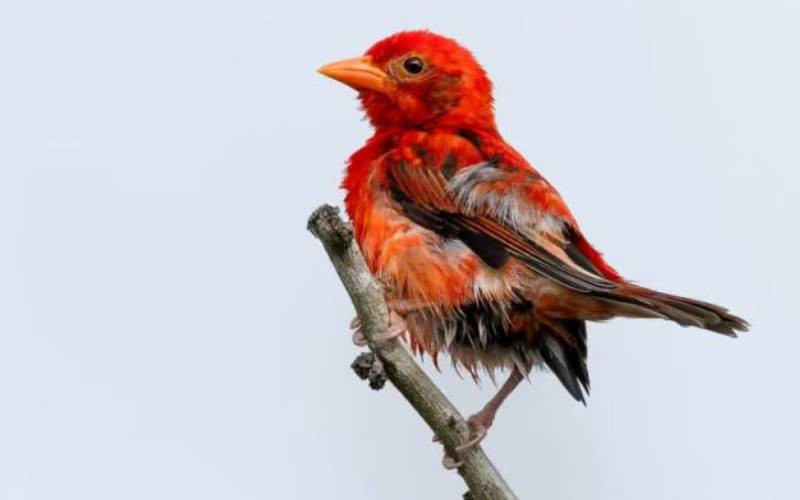
When James Apolloh Omenya and Simon Odhiambo walked alongside a team of local guides and armed Kenya Defence Forces (KDF) escorts into the dense Boni-Dodori Forest, it seemed, on the surface, like just another gruelling day in the field.
Yet deep down, they knew the Red Weaver, a bird last photographed 12 years ago, existed somewhere in the thickets. It was this belief that drove them to comb through remote, security-sensitive terrain purely to contribute to science.
The last time the bird had been documented on camera was in April 2014, when ornithologist John Musina took a photograph of a male in the Boni-Dodori Forest. As the years passed without another record, scientists grew increasingly worried. In March 2025, having gone over a decade without a confirmed sighting, the Red Weaver was officially added to the global Search for Lost Birds priority list.
Although the International Union for Conservation of Nature (IUCN) Red List had long classified the Red Weaver as "Least Concern," experts knew this was a dangerous illusion because its population size was entirely unknown due to an extreme lack of field records.
“Spotting the Red Weaver has been extraordinarily difficult because its primary home, the Boni-Dodori Forest near the Kenya-Somalia border, is a high-risk area where security concerns severely restrict field research,” said Musina, a researcher with the National Museums of Kenya.
Until the team's breakthrough on July 3, 2026, Kenya had two bird species listed on the global Search for Lost Birds registry. With the Red Weaver now found, only the Tana River Cisticola remains actively listed as “Lost.” It has not been officially documented for 59 years, since 1967, and is currently the target of joint field expeditions by Nature Kenya, the National Museums of Kenya, and A Rocha Kenya.
Part of the Red Weaver’s disappearance was also a matter of classification. For over a century, the bird was grouped as a subspecies of the common Red-headed Weaver. Because it was not recognised as a stand-alone species, birdwatchers and researchers rarely tracked it.
That changed in 2024, when major scientific bird databases officially recognised the Red Weaver as its own standalone species. The decision came after taxonomists noted clear physical differences. While the common Red-headed Weaver has a red head and a yellow-to-white belly, the male Red Weaver boasts a striking, almost entirely crimson body with dark markings around its eyes and wings.
“This means that the bird had not been recorded since its official recognition as a species in 2024,” Musina explained. “Although the indigenous Aweer community knew the bird was still around, they lacked the cameras needed to capture scientific proof, leaving the species hidden in plain sight simply because researchers could not safely access the forest.”
According to the Search for Lost Birds initiative, proving a missing species is still alive requires undeniable evidence. How much proof scientists need depends on the bird itself. If a species has unique colours and a distinct call that no other animal shares, a quick snapshot can be enough. But if it resembles a common neighbour, the bar is much higher to rule out lookalikes.
The pressure to get it right is huge because conservation laws and funding are at stake.
“How do we protect animals and plants if we don’t know where they live or what threats they face? Our knowledge about a species’ distribution, population, and natural history is the foundation for both scientific research and conservation planning,” Search for Lost Birds noted. “In extreme cases, a species may have been recorded so rarely that it’s unclear whether it still exists at all.”
The coastal forests of Eastern Africa, stretching from southern Somalia through Kenya and Tanzania to Mozambique, form a fragile biodiversity hotspot where rare species cling to survival in shrinking patches of green.
“These ancient forests have a specific type of vegetation, supporting some of the world's most vulnerable birds and mammals, as well as serving as a stopover for migratory birds,” Musina added. “This makes forest reserves like Boni-Dodori critical Important Bird Areas (IBAs).”
Despite their ecological value, these coastal forests face severe threats from agricultural expansion, logging, and infrastructure development.
Stay informed. Subscribe to our newsletter
“Such rediscoveries highlight the urgent need to train local communities in conservation initiatives and citizen science, while encouraging sustainable ventures that incentivise habitat protection in remote areas,” Musina noted.
Subscribe to our newsletter and stay updated on the latest developments and special offers!

 Prefer the Standard on Google