×

The Standard e-Paper
Smart Minds Choose Us
 The Standard Group Plc is a
multi-media organization with investments in media platforms spanning newspaper
print operations, television, radio broadcasting, digital and online services. The
Standard Group is recognized as a leading multi-media house in Kenya with a key
influence in matters of national and international interest.
The Standard Group Plc is a
multi-media organization with investments in media platforms spanning newspaper
print operations, television, radio broadcasting, digital and online services. The
Standard Group is recognized as a leading multi-media house in Kenya with a key
influence in matters of national and international interest.

Audio By Vocalize
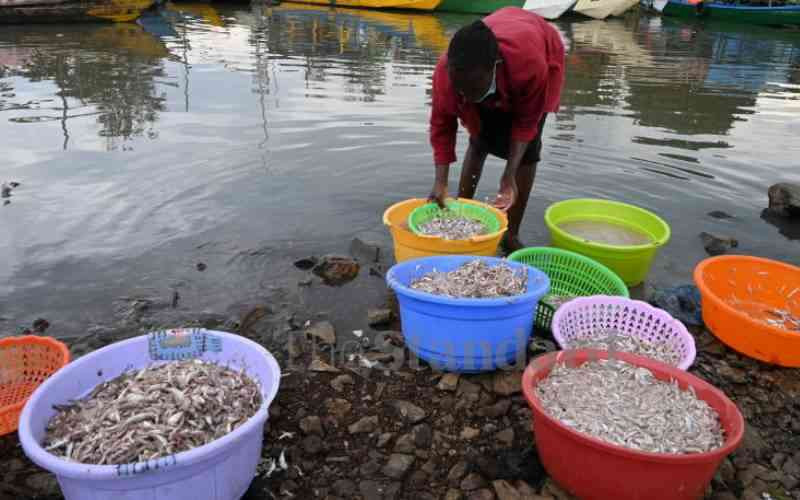
At Obunga in Kisumu, piles of discarded fish bones and scales that were once regarded as worthless waste are finding a new purpose in an unlikely place; jewellery and decorative art.
For years, fish remains generated from processing and smoking have been left on open ground or around fish-processing areas, where they rot, attract flies and other scavengers and, during rains, can be washed into Lake Victoria.
But 73-year-old Norah Agwata sees something different. To her, the bones of Nile perch are not rubbish. They are raw materials that can be cleaned, dried and transformed into earrings, necklaces, pendants and other ornaments, while fish scales can be turned into colourful flowers and decorative designs.
From her small enterprise, Norez Gift Flowers and Designs, located in Kona Lejo in Kisumu near Manyatta, Agwata is demonstrating how a waste problem can be turned into an environmental and economic opportunity.
Her journey into fish-waste recycling began in 2020 during the Covid-19 pandemic, when restrictions forced people to remain indoors and disrupted businesses and livelihoods.
Agwata had been selling tomatoes and other food items, but with markets affected, she needed something to occupy her time.
“I started this during Covid-19. Remember, at that time we were indoors, and you could not go to the market. I decided to make myself busy, and this is where it started,” she says.
She initially began making flowers from locally available materials. Later, she experimented with fish scales and discovered that they could be transformed into attractive flowers.
She eventually introduced fish bones into her designs, using them to make earrings and other jewellery. What started as an activity to pass time during the pandemic slowly evolved into a business.
When Covid-19 restrictions were lifted, Agwata did not return to her former trade and instead, she continued with her art, turning discarded fish remains into products that could generate an income.
“I never went back to the market to sell tomatoes and other foods. This is where I continued selling my art,” she says.
Her search for raw materials takes her to Obunga, one of the areas where fish is processed and smoked. Agwata says that when she started collecting the bones, fish processors and traders would throw them away indiscriminately.
She approached them and began collecting the discarded bones, partly as a way of helping to clean the environment and partly to obtain materials for her new enterprise.
Initially, the bones cost her nothing but as more people began recognising their value, she says the material acquired a price.
“At first, when I started, I could get these bones free of charge, but nowadays they sell them. One kilogramme is Sh40, which I can absolutely manage,” she says.
Stay informed. Subscribe to our newsletter
When she needs supplies, Agwata travels to Obunga and collects between 40 and 50 kilogrammes of bones before transporting them back to her workshop.
The bones cannot immediately become jewellery. At home, Agwata boils them in hot water mixed with detergents and other cleaning agents to remove remaining flesh and dirt. After the cleaning process, she dries them under the sun before selecting the pieces that can be shaped into different jewellery designs.
It is a process she has developed through experience, but she is not alone in the work. Agwata says she works with other people and has established a small training initiative where she teaches others the skills.
“I don't do this alone. I have around four people who work with me. There are also some whom I train in this small school of mine,” she says.
She now says six people are being trained through the initiative and for her, the environmental benefit is just as important as the income.
She believes that collecting fish bones removes some of the waste that would otherwise accumulate around fish-processing areas.
“We are in a place where fish is eaten, and throwing these bones away is just common. From my end, this has been helpful around Obunga and other areas of Kisumu along the lake where I get these bones because the areas are cleaner,” she says.
Her story, however, is taking place against a much larger waste problem facing Lake Victoria. The lake supports an extensive fishing and fish-processing economy, providing food, employment and income to communities in Kenya, Uganda and Tanzania. KMFRI says its Kisumu research centre conducts research on Lake Victoria fisheries, water quality, pollution and value addition, with the fishery supporting livelihoods across the three countries.
But processing fish, particularly Nile perch for fillets, produces large quantities of solid and liquid waste.
Research cited by the Kenya Marine and Fisheries Research Institute shows that in industrial processing of Nile perch, only about 30 to 50 per cent of the raw fish mass is recovered as edible fillet. The remaining 50 to 70 per cent consists of materials such as frame bones, scales, skins, heads, viscera and swim bladders.
Across the three riparian countries, Lake Victoria produces more than one million tonnes of fish annually, while industrial and artisanal processing generates an estimated 150,000 to 300,000 tonnes of fish-processing waste each year.
In Kenya's major processing centres, including Kisumu and Homa Bay, tonnes of fish frames, scales and offal are generated every day.
KMFRI assessments further indicate that between 60 and 80 per cent of secondary waste, including gut contents, scales and wastewater at some artisanal landing beaches is directly washed into shoreline waters or dumped on open land.
Hilda Mogaka, a research scientist at KMFRI Kisumu, says the scale of fish waste means the issue cannot be treated merely as a sanitation problem.
She explains that a large proportion of the fish processed for fillets does not end up as food, leaving significant quantities of organic material that require proper management. “Fish processing generates massive quantities of solid and liquid waste daily,” Mogaka says.
The environmental consequences become more serious when that waste is allowed to accumulate near the lake. Mogaka explains that fish waste contains organic carbon, lipids, and proteins. When it is dumped directly into nearshore waters, microorganisms break down the organic matter, a process that consumes oxygen.
The result can be declining dissolved oxygen levels in the water, creating conditions that are difficult for fish and other aquatic organisms to survive in.
“Unprocessed fish waste contains high concentrations of organic carbon, lipids and proteins. When dumped directly into nearshore waters, the decomposition process can severely deplete dissolved oxygen,” she says.
The concern is particularly important for a lake whose fisheries depend on healthy aquatic habitats. When oxygen levels fall significantly, fish can become stressed or die, while organisms living on the lake bottom can also be affected.
A 2025 study by KMFRI researchers on recurrent fish kills in Kisumu Bay found severe hypoxia, with dissolved oxygen levels below 2.5 milligrams per litre at sampled locations, compared with the 6–8 milligrams per litre threshold identified in the study as necessary for fish survival. The researchers also identified severe eutrophication, elevated nutrients and algal blooms among the environmental conditions associated with the fish kills.
Lake Victoria is already under pressure from several other sources of pollution, including untreated wastewater, agricultural runoff and industrial discharges.
In 2024, the Kisumu County Government and KMFRI investigated pollution concerns following reports of fish deaths in parts of the Winam Gulf. The investigation followed complaints from affected Beach Management Units, with untreated factory waste among the concerns raised.
The wider challenge makes the idea of converting fish waste into useful products increasingly important. Mogaka says fish bones and scales should not necessarily be viewed as materials that have reached the end of their usefulness.
Scientifically, she explains, the composition of fish bones and scales gives them characteristics that can make them suitable for a range of value-added products.
“Fish bones and scales possess biochemical and physical properties that make them suitable raw materials for crafts, jewellery and other high-value applications,” she says.
Fish bones contain calcium phosphate minerals, primarily hydroxyapatite, within a collagenous matrix. Once properly cleaned, degreased and dried, they can be carved, ground or shaped into beads, pendants and other jewellery components.
Fish scales also have a mineralised layer and a collagen-rich fibrillar layer, giving them flexibility, lightness and natural iridescence that can be enhanced through polishing or dyeing.
Mogaka says proper sanitation, degreasing and drying can make scales suitable for several creative applications. “Once properly treated, scales can be fashioned into artificial flowers, sequins, decorative lampshades and jewellery,” she says.
This is where Agwata's work provides a practical example of what researchers describe as value addition. Her flowers and earrings are small-scale products, but they demonstrate how a material that previously had no apparent market can be transformed into something people are willing to buy.
The potential, however, extends far beyond jewellery. Mogaka says fish scales can also be used as raw materials for extracting collagen and gelatin, which have applications in pharmaceuticals, cosmetics, food products and biomedical materials.
“Collagen and gelatin extracted from fish scales have potential applications in pharmaceutical capsules, biomedical wound dressings, cosmetics and food industries,” she says.
KMFRI, working with research partners, has already explored the extraction of gelatin from fish scales, with research aimed at understanding how such products can eventually be scaled up for commercial use.
Such developments could open new opportunities for women and young people along the fish value chain. Instead of waste representing an expense or an environmental burden, it can become a source of income.
Mogaka describes this approach as part of a circular bioeconomy, where waste is kept within the production system and converted into new economic value. KMFRI's research into fish leather dates back to 1986, when the first Food Processing Laboratory was established at the KMFRI Kisumu Research Centre under the Food and Agriculture Organisation.
“Fish leather research at KMFRI dates back to 1986, and testing demonstrated its potential as a quality material compared with conventional leather sources,” she says.
Mogaka says researchers, fishing communities, innovators, private companies and government agencies need to work together to establish safe and commercially viable ways of converting fish waste.
“KMFRI can provide technical validation, laboratory testing and safety protocols, while fishing communities can provide indigenous knowledge, waste-collection systems and labour,” she says.
One possible solution is the establishment of community-based processing hubs near fish-landing sites.
Such hubs could bring together researchers, chemical engineers, Beach Management Units and local communities to develop decentralised, low-cost systems for processing fish waste.
For Agwata, however, the transformation begins at a much smaller scale.
Her customers include tourists, residents and people walking around the area. Referrals have helped her expand her market, and she estimates that she earns between Sh15,000 and Sh20,000 in a month.
She has also travelled outside Kenya through exchange programmes involving innovative women from different parts of the world since starting her enterprise.
The exposure has strengthened her belief that women should not wait for formal employment before creating livelihoods.
“To those women who are saying there is no job, that is a constructed notion. Let them be innovative,” she says.
Her ambition now is to expand the business while continuing to address the environmental problem that gave birth to it.
“In the next five years, I want to expand this business of mine while at the same time cleaning the environment. I want to clean the environment and convert the waste in the environment into something innovative,” she says.
She hopes to secure grants to expand the enterprise, train more people and reach more communities. The 40 to 50 kilogrammes of bones she collects at a time may be insignificant compared with the thousands of tonnes of fish-processing waste generated across the Lake Victoria basin. But her work demonstrates what can happen when waste is treated as a resource rather than an unwanted end product.
The environmental challenge facing Lake Victoria cannot be solved through jewellery alone. The scale of fish waste requires coordinated waste-management systems, investment in treatment facilities, enforcement, research, markets for by-products and stronger partnerships between communities, scientists, government and businesses.
Subscribe to our newsletter and stay updated on the latest developments and special offers!

 Prefer the Standard on Google